


Amid escalating worries about bad loans and declining profits in the nation's banking sector, an analyst warned yesterday that investors should be wary of financial institutions with soaring reserves for writing off debts.
Investors may need to exert caution when making investment in banks whose annualized charge-off ratio for credit or cash-advance card loans exceeds 10 percent, and whose cumulative provision amounts to more than NT$1 billion (US$30 million), SinoPac Securities Corp (建華證券) finance analyst Chu Yu-chun (朱玉君) said in a research note released yesterday.
With card issuance cost at around 5 percent to 6 percent, an annualized charge-off ratio exceeding 10 percent will dent banks' profitability, while a cumulative charge-off amount of NT$1 billion is almost equivalent to a small bank's annual earnings, she explained.
Based on those criteria, the analyst named a group of card issuers that should prompt caution for investors, including Taishin International Bank (台新銀行), Chinatrust Commercial Bank (中國信託銀行) and Chinese Bank (中華銀行).
Taishin International, the nation's second largest credit card issuer with 5 million cards in circulation, saw a charge-off amount of NT$2.9 billion and charge-off ratio of about 11 percent as of September.
Taiwan's largest credit card issuer, Chinatrust Commercial, which has 7 million cards in circulation, had NT$3.9 billion and 7.7 percent over the same time, according to SinoPac's figures.
Chinese Bank, Taiwan's fifth biggest cash-advance card issuer with around 262,000 cards outstanding, has spent NT$2.5 billion on charging off the bad loans, or an annualized 10.7 percent of its total lending balance, the brokerage said.
Concern over mounting bad debts generated from credit cards and cash-advance cards emerged in the middle of the year.
The nation's non-performing loan (NPL) ratio spiked up after the adoption of a new default loan definition that shortened the overdue period from 180 days to 90 days, weakening cardholders' solvency.
"The overall bad debt issue is expected to be contained at the end of this year, while its impact on certain banks may linger throughout the first quarter of next year," Chu said.
The total balance of credit and cash-advance card lending, which accounts for around 5 percent of total lending, remained minimal, she said -- particularly in light of an average NPL ratio for local banks of 2.8 percent.
However, the bad loan problem will eat into the banking sector's profitability next year, after intensive write-offs in the fourth quarter of this year.
Local banks' combined profits next year will be trimmed to NT$130 billion after the provisions, down more than 10 percent from this year's NT$155.3 billion, according to SinoPac.
Next year's lending balance growth, meanwhile, could slow to 5 percent from this year's 9 percent, after banks adopted a tightened loan policy in a bid to minimize their bad debt risk, the company said.

Stephen Garrett, a 27-year-old graduate student, always thought he would study in China, but first the country’s restrictive COVID-19 policies made it nearly impossible and now he has other concerns. The cost is one deterrent, but Garrett is more worried about restrictions on academic freedom and the personal risk of being stranded in China. He is not alone. Only about 700 American students are studying at Chinese universities, down from a peak of nearly 25,000 a decade ago, while there are nearly 300,000 Chinese students at US schools. Some young Americans are discouraged from investing their time in China by what they see

Taiwan Transport and Storage Corp (TTS, 台灣通運倉儲) yesterday unveiled its first electric tractor unit — manufactured by Volvo Trucks — in a ceremony in Taipei, and said the unit would soon be used to transport cement produced by Taiwan Cement Corp (TCC, 台灣水泥). Both TTS and TCC belong to TCC International Holdings Ltd (台泥國際集團). With the electric tractor unit, the Taipei-based cement firm would become the first in Taiwan to use electric vehicles to transport construction materials. TTS chairman Koo Kung-yi (辜公怡), Volvo Trucks vice president of sales and marketing Johan Selven, TCC president Roman Cheng (程耀輝) and Taikoo Motors Group

MAJOR DROP: CEO Tim Cook, who is visiting Hanoi, pledged the firm was committed to Vietnam after its smartphone shipments declined 9.6% annually in the first quarter Apple Inc yesterday said it would increase spending on suppliers in Vietnam, a key production hub, as CEO Tim Cook arrived in the country for a two-day visit. The iPhone maker announced the news in a statement on its Web site, but gave no details of how much it would spend or where the money would go. Cook is expected to meet programmers, content creators and students during his visit, online newspaper VnExpress reported. The visit comes as US President Joe Biden’s administration seeks to ramp up Vietnam’s role in the global tech supply chain to reduce the US’ dependence on China. Images on
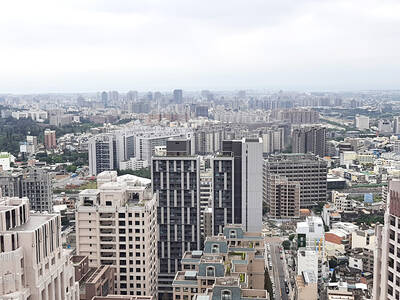
New apartments in Taiwan’s major cities are getting smaller, while old apartments are increasingly occupied by older people, many of whom live alone, government data showed. The phenomenon has to do with sharpening unaffordable property prices and an aging population, property brokers said. Apartments with one bedroom that are two years old or older have gained a noticeable presence in the nation’s six special municipalities as well as Hsinchu county and city in the past five years, Evertrust Rehouse Co (永慶房產集團) found, citing data from the government’s real-price transaction platform. In Taipei, apartments with one bedroom accounted for 19 percent of deals last


 RSS
RSS