


Wall Street turned on the afterburners over the past week as investors scrambled to get in on what some see as a building year-end rally. But some analysts remain cautious about how far the momentum will carry.
Posting a second week of solid gains, the Dow Jones Industrial Average gained 1.2 percent to close Friday at 10,530.76.
The Standard and Poor's 500 broad-market index advanced 1.8 percent to 1,220.14, giving the market a psychological lift by moving into positive territory for the year. The technology-heavy NASDAQ composite index had a banner week, surging 3.8 percent to 2,169.43.
"The positive momentum remains intact on Wall Street," said Al Goldman, chief market strategist at AG Edwards.
Goldman said stocks are "reasonably priced" based on forward earnings projections, opening the door to a positive close for the year.
"Now it is time for November to start the seasonal joy, and we believe it will," he said.
"The bull [market] is now three years old, and the economy is close to starting its fifth year of expansion. We don't expect either the stock market or the economy to act with youthful enthusiasm. However, we do expect investors to take advantage of all the goodies on the table," Goldman said.
In the last four years, the S&P 500 has risen sharply in the fourth quarter, and many investors are hoping this year will be no different and help salvage what has been a lackluster year for equities.
Paul Mendelsohn, chief investment strategist at Windham Financial Services, said the market was on a positive track because it has "very good money flows coming in" from investors sitting on the sidelines in recent months.
"People want to be long this market because of the seasonal history coming into the end of the year and that this seems to be overriding the data," he added.
Paul Nolte at Hinsdale Investments said he remains concerned about market volatility as the economic landscape shifts.
"As we are not willing to cross the tennis court during a heated match, we are not willing to place long-term investments at this time," Nolte said.
"If pressed, we believe the fourth quarter rally will take place, however it may begin later than many expect and may not be enough to pull the market much above the zero line for the year," he said.
Investors appeared to be reassured about the US economic outlook despite a weaker-than-expected 56,000 new job creations in October, which appeared to have been showing the effect of Hurricane Katrina.
Helping sentiment were strong surveys from the Institute of Supply Management on manufacturing and the service sectors of the economy, and a robust report on labor productivity.
"Setting aside the employment result, the US bore witness to a series of strong economic indicators," said Eric Lascelles, economist at TD Bank Financial Group.
Lascelles said further reassurance came from Fed Chairman Alan Greenspan, who told Congress that "economic fundamentals remain firm" and the economy possesses "important forward momentum."
One big worry for the stock market is interest rates, and the bond market appears to be showing tensions over how far the central bank will push up rates to keep inflation in check.
Joseph Abate at Lehman Brothers said feeding the fears is the change in leadership at the Fed in January, when Ben Bernanke, if confirmed by the Senate, will take over from Greenspan.
Abate said the bond market is worried about how well a new Fed chief will tackle inflation, and that feeds into market expectations.
"We worry that, when a new and untested Fed chairman is at the helm, even a temporary or minor loss of inflation-fighting credibility could propagate inflation fears, making the Fed's job much more difficult," he said.
"A number of papers focusing on central bank credibility have found that the more that [investors] believe the institution's commitment to rein in inflation, the less tightening is ultimately needed to alleviate price pressures," he said.
Bonds were hit hard over the past week. The yield on the 10-year US Treasury bond rose to 4.657 percent from 4.567 percent a week earlier while that on the 30-year bond increased to 4.852 percent from 4.773 percent. Bond yields and prices move in opposite directions.

Taiwan Transport and Storage Corp (TTS, 台灣通運倉儲) yesterday unveiled its first electric tractor unit — manufactured by Volvo Trucks — in a ceremony in Taipei, and said the unit would soon be used to transport cement produced by Taiwan Cement Corp (TCC, 台灣水泥). Both TTS and TCC belong to TCC International Holdings Ltd (台泥國際集團). With the electric tractor unit, the Taipei-based cement firm would become the first in Taiwan to use electric vehicles to transport construction materials. TTS chairman Koo Kung-yi (辜公怡), Volvo Trucks vice president of sales and marketing Johan Selven, TCC president Roman Cheng (程耀輝) and Taikoo Motors Group

Among the rows of vibrators, rubber torsos and leather harnesses at a Chinese sex toys exhibition in Shanghai this weekend, the beginnings of an artificial intelligence (AI)-driven shift in the industry quietly pulsed. China manufactures about 70 percent of the world’s sex toys, most of it the “hardware” on display at the fair — whether that be technicolor tentacled dildos or hyper-realistic personalized silicone dolls. Yet smart toys have been rising in popularity for some time. Many major European and US brands already offer tech-enhanced products that can enable long-distance love, monitor well-being and even bring people one step closer to

RECORD-BREAKING: TSMC’s net profit last quarter beat market expectations by expanding 8.9% and it was the best first-quarter profit in the chipmaker’s history Taiwan Semiconductor Manufacturing Co (TSMC, 台積電), which counts Nvidia Corp as a key customer, yesterday said that artificial intelligence (AI) server chip revenue is set to more than double this year from last year amid rising demand. The chipmaker expects the growth momentum to continue in the next five years with an annual compound growth rate of 50 percent, TSMC chief executive officer C.C. Wei (魏哲家) told investors yesterday. By 2028, AI chips’ contribution to revenue would climb to about 20 percent from a percentage in the low teens, Wei said. “Almost all the AI innovators are working with TSMC to address the
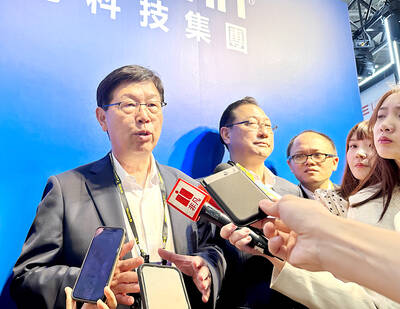
FUTURE PLANS: Although the electric vehicle market is getting more competitive, Hon Hai would stick to its goal of seizing a 5 percent share globally, Young Liu said Hon Hai Precision Industry Co (鴻海精密), a major iPhone assembler and supplier of artificial intelligence (AI) servers powered by Nvidia Corp’s chips, yesterday said it has introduced a rotating chief executive structure as part of the company’s efforts to cultivate future leaders and to enhance corporate governance. The 50-year-old contract electronics maker reported sizable revenue of NT$6.16 trillion (US$189.67 billion) last year. Hon Hai, also known as Foxconn Technology Group (富士康科技集團), has been under the control of one man almost since its inception. A rotating CEO system is a rarity among Taiwanese businesses. Hon Hai has given leaders of the company’s six


 RSS
RSS