


The nation's insurance companies are lukewarm about the government's plan to boost their investments in the stock market, due to the plan's lack of detail and the local bourse's poor returns.
On Thursday night, Premier Frank Hsieh (謝長廷) announced a package of incentives designed to lure insurers into the ailing local bourse. They include lifting the regulatory ceiling of overseas investment in insurers to 40 percent of working capital, from the current 35 percent, if the firms raise their holdings in local markets.
"The plan is still too obscure and lacks enough specifics for us to make an evaluation for the moment," Victor Hsu (許澎), spokesman of Shinkong Life Insurance Co (新光人壽), the nation's second-largest life insurer, told reporters yesterday.
Poor returns
It will be difficult to get insurers such as Shinkong to pour more money into the local stock market since the bourse offers less than ideal returns, and the level of government support for such investments is unclear, he said.
"We will probably maintain our local stock investment at the level of around 5 percent [of available funds]," Hsu said.
Shinkong Life, the flagship unit of Shinkong Financial Holdings Co (新光金控), sold over NT$2 billion (US$60 million) in shares on the local stock market last month, reducing the value of its domestic stock investment to NT$48.2 billion, or 5.34 percent of its total NT$902.3-billion investment, the company said yesterday. In the same month it boosted its more lucrative overseas investments to NT$319.9 billion, reaching the regulatory limit of 35 percent.
More incentives
The government also relaxed its rules on share buybacks by financial holding firms, cutting the required capital adequacy ratio to 120 percent from the 150 percent set last year, as part of its bid to revive the moribund local bourse.
This offered financial holding companies a chance to stabilize their share prices, Hsu said, but he added that Shinkong Financial, which has a capital adequacy ratio of over 140 percent, has no buyback plan yet.
For the first nine months of this year, Shinkong Financial yesterday posted unaudited earnings of NT$7 billion, or NT$2.07 per share. The company raised its earnings forecast to NT$7.41 billion, or NT$1.83 per share, from NT$6.08 billion, or NT$1.78 per share, after making smaller lender Macoto Bank (
The company plans to spend no more than NT$800 million on improving its operating conditions by the end of the year, Shinkong Financial's accounting manager Hsu Shun-yun (徐順鋆) said.
It aims to slash the non-performing loan ratio of its banking unit after the merger with Macoto to 2.5 percent, down from the current combined 2.73 percent, and raise the bad loan coverage ratio to 40 percent, up from 35 percent.
Bad loans
Despite the long-term potential of the merger, Macoto's consumer banking business is expected to see rising bad-loan pressure, which in the short term could be a downside for Shinkong Financial shares, Invesco Taiwan's fund manager Shirley Yang (楊慶祺) said.
The benefits of the merger may not become evident until the second half of next year, Yang said.
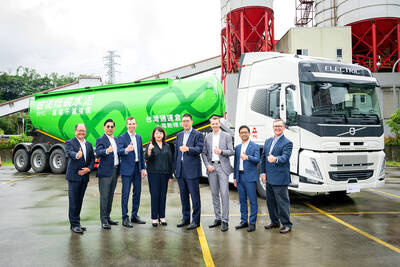
Taiwan Transport and Storage Corp (TTS, 台灣通運倉儲) yesterday unveiled its first electric tractor unit — manufactured by Volvo Trucks — in a ceremony in Taipei, and said the unit would soon be used to transport cement produced by Taiwan Cement Corp (TCC, 台灣水泥). Both TTS and TCC belong to TCC International Holdings Ltd (台泥國際集團). With the electric tractor unit, the Taipei-based cement firm would become the first in Taiwan to use electric vehicles to transport construction materials. TTS chairman Koo Kung-yi (辜公怡), Volvo Trucks vice president of sales and marketing Johan Selven, TCC president Roman Cheng (程耀輝) and Taikoo Motors Group

Among the rows of vibrators, rubber torsos and leather harnesses at a Chinese sex toys exhibition in Shanghai this weekend, the beginnings of an artificial intelligence (AI)-driven shift in the industry quietly pulsed. China manufactures about 70 percent of the world’s sex toys, most of it the “hardware” on display at the fair — whether that be technicolor tentacled dildos or hyper-realistic personalized silicone dolls. Yet smart toys have been rising in popularity for some time. Many major European and US brands already offer tech-enhanced products that can enable long-distance love, monitor well-being and even bring people one step closer to
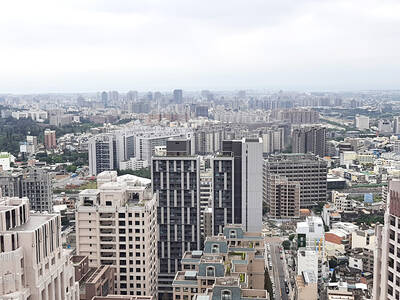
New apartments in Taiwan’s major cities are getting smaller, while old apartments are increasingly occupied by older people, many of whom live alone, government data showed. The phenomenon has to do with sharpening unaffordable property prices and an aging population, property brokers said. Apartments with one bedroom that are two years old or older have gained a noticeable presence in the nation’s six special municipalities as well as Hsinchu county and city in the past five years, Evertrust Rehouse Co (永慶房產集團) found, citing data from the government’s real-price transaction platform. In Taipei, apartments with one bedroom accounted for 19 percent of deals last
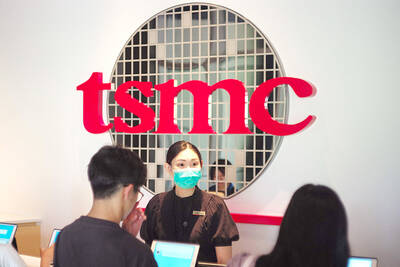
RECORD-BREAKING: TSMC’s net profit last quarter beat market expectations by expanding 8.9% and it was the best first-quarter profit in the chipmaker’s history Taiwan Semiconductor Manufacturing Co (TSMC, 台積電), which counts Nvidia Corp as a key customer, yesterday said that artificial intelligence (AI) server chip revenue is set to more than double this year from last year amid rising demand. The chipmaker expects the growth momentum to continue in the next five years with an annual compound growth rate of 50 percent, TSMC chief executive officer C.C. Wei (魏哲家) told investors yesterday. By 2028, AI chips’ contribution to revenue would climb to about 20 percent from a percentage in the low teens, Wei said. “Almost all the AI innovators are working with TSMC to address the


 RSS
RSS