


The local bourse is expected to react flatly to President Chen Shui-bian's (
"President Chen's address pushing financial and political reforms may stress his resolve in the face of an apparent decline in support," George Hsieh (謝文雄), a fund manager at Capital Investment Trust Corp (群益證券投信) said in a phone interview yesterday.
The speech will probably provide more of a boost to the year-end elections than to the stock market, since he didn't say anything that would boost cross-strait relations, such as direct links, Hsieh said.
An analyst at Invesco Taiwan Ltd (
Both analysts, however, pre-dicted that the market would do better in the near future, thanks to the overall brighter-than-expected sales results from high-tech players in August and last month.
Bolstered by the healthy fundamentals, the benchmark index could stay within the 6,000 points range this week, Hsieh said.
The TAIEX closed down 13.97 points, or 0.2 percent, at 6,081.84 last Friday and lost 0.6 percent overall last week.
In his speech Chen vowed to push planned reforms in six areas -- finance, taxation, the 18-percent preferential interest rate given to retired public servants, party assets, the media and constitutional amendments.
The completion of the second phase of financial reform to consolidate the banking sector was top on his agenda.
"The second-stage financial reform has met [few] obstacles so far, and there is room for improvement in implementation. But the direction of the policy is correct," Chen said.
The government needs to reach its target on schedule if the financial sector is to face the challenges posed by globalization, he said.
Chen's remarks came after a string of heated questions about his financial reforms. Last week Democratic Progressive Party Legislator Julian Kuo (
Earlier in the week, the legislature's Finance Committee passed a resolution to stop the government from selling its holdings in state banks. The Executive Yuan said the committee's move was not binding on current policy.
Given that financial reform is not subject to as much supervision in the legislature as other policies, Chen may be eager to complete the program, one of his policy packages that does have a timetable, so it can be a milestone for his time in office, said Shirley Yang (楊慶祺), Invesco Taiwan's fund manager.
His remarks explained the government's insistence on moving forward with its plans and may steady investor confidence in weakening finance stocks, Yang said.
The government plans to halve the number of state banks to six by year's end and the number of financial holdings to seven by the end of next year. Its efforts, however, received a setback when the sale of Taiwan Business Bank (台灣企銀) failed last month, which may foreshadow trouble disposing of the state's holdings in the Central Trust of China (
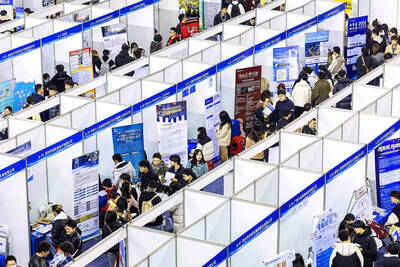
Stephen Garrett, a 27-year-old graduate student, always thought he would study in China, but first the country’s restrictive COVID-19 policies made it nearly impossible and now he has other concerns. The cost is one deterrent, but Garrett is more worried about restrictions on academic freedom and the personal risk of being stranded in China. He is not alone. Only about 700 American students are studying at Chinese universities, down from a peak of nearly 25,000 a decade ago, while there are nearly 300,000 Chinese students at US schools. Some young Americans are discouraged from investing their time in China by what they see
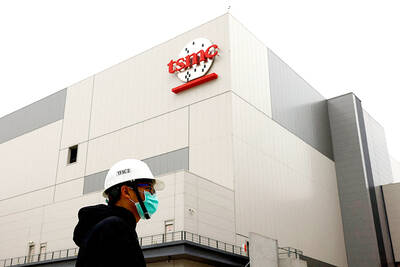
Taiwan Semiconductor Manufacturing Co (TSMC, 台積電), the world’s largest contract chipmaker, yesterday reported record sales for the first quarter, which analysts attributed to solid demand for emerging technologies. Consolidated revenue totaled NT$592.64 billion (US$18.51 billion) in the January-to-March period, up 16.5 percent from a year earlier, but down 5.26 percent from the previous quarter, TSMC said in a statement. The first-quarter revenue beat analysts’ average projection of NT$579.5 billion, Bloomberg News reported. That performance lends weight to expectations that the world’s most valuable chipmaker would return to solid growth this year after weathering a post-COVID-19-pandemic cratering of smartphone and computer sales. TSMC is budgeting
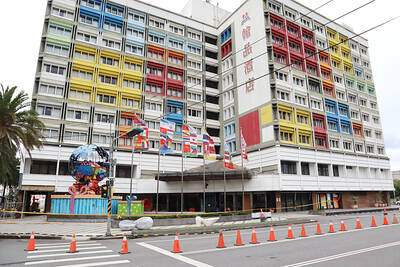
HUALIEN BRANCH: The company had been planning to rebuild the hotel before it was damaged in the quake and vowed to give affected employees the option to transfer The owner of Chateau de Chine Hualien (花蓮翰品酒店) is planning to lay off 86 workers after shutting down the hotel due to damage it sustained in a powerful earthquake on Wednesday last week, the Ministry of Labor said yesterday. The hotel has submitted a layoff report to the Hualien County Government and expects to let 69 workers go this month and 17 next month, the ministry said. LDC Hotels & Resorts Group (雲朗觀光集團), the owner of Chateau de Chine Hualien, confirmed the layoff plan in a statement yesterday. LDC said the hotel has been closed since Wednesday last week when the temblor occurred
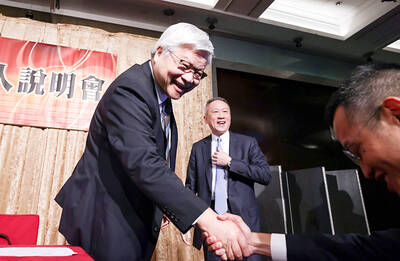
US CONSCULTANT: The US Department of Commerce’s Ursula Burns is a rarely seen US government consultant to be put forward to sit on the board, nominated as an independent director Taiwan Semiconductor Manufacturing Co (TSMC, 台積電), the world’s largest contract chipmaker, yesterday nominated 10 candidates for its new board of directors, including Ursula Burns from the US Department of Commerce. It is rare that TSMC has nominated a US government consultant to sit on its board. Burns was nominated as one of seven independent directors. She is vice chair of the department’s Advisory Council on Supply Chain Competitiveness. Burns is to stand for election at TSMC’s annual shareholders’ meeting on June 4 along with the rest of the candidates. TSMC chairman Mark Liu (劉德音) was not on the list after in December last


 RSS
RSS