


Taipei Times: After successfully building a world-famous brand and the top brand in Taiwan, what is your advice to Taiwanese companies that are keen to create their own brands?
Steve Chang
Thus, before creating a brand, company executives should know who they are, how they can differentiate from competitors, and what their core-competences are. The executives should also have passion for what they do, so they will keep improving the company.
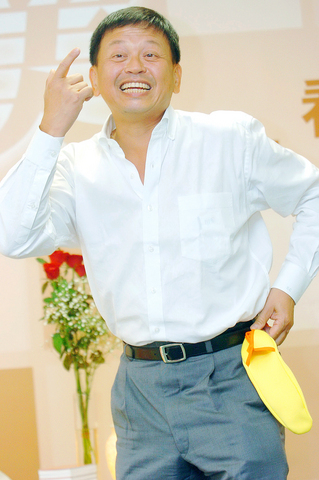
PHOTO: CHANG CHIA-MING, TAIPEI TIMES
After setting the tone for the company, the second step is execution. Many companies market their brands by budgeting big money in advertising or acquiring brands of other firms.
Out of the various methods, I think the most fundamental and effective way is establishing a relationship of trust with customers, although it may take a lot of time to build the relationship.
In marketing, word-of-mouth can deliver the highest results. So we can call a brand successful when its customers are willing to recommend its products or services to their friends.
TT: At the award ceremony for Taiwan's top 10 global brands last week, you suggested local companies apply a "blue ocean strategy" instead of a "red ocean strategy." Can you elaborate more on this point?
[Ed. note: In the recent best-selling business book Blue Ocean Strategy, authors suggested companies adopt a "blue ocean strategy" to create an uncontested market space and make the competition irrelevant, rather than the "red ocean strategy," with which companies compete in an existing market and undercut competitors as most companies do now].
Chang: The book discusses good business strategies by using simple examples. However, one should understand the concept carefully. Before entering into an untapped market, companies should do a thorough risk-management assessment instead of a judgment based on superficial factors.
One experience I could apply to this concept involves a banana pocket. Once, while meeting with a client in Japan, he presented me with a banana pocket, which he claimed to facilitate the needs of people who love bananas and want to hang one at their waist. The idea sounds good, given a large number of people in Asia are fond of bananas. But the fact is, people have no demand for such a product. Nevertheless, I bought some of the pockets as an example to remind my employees not to repeat the same mistake.
TT: As a Taiwanese, you chose to start your business in the highly competitive US market and to locate your corporate headquarters in Japan. From your perspective, what are the challenges for starting a software business in Taiwan?
Chang: At the time I started my business, Taiwan had very serious problems in software piracy, which hampered the growth of the industry. The US market, though full of tough challenges, has a key role in the development of the software industry.
We cannot reach the highest standards without passing the strictest tests in the US. This is what is described in Chinese as: "One can't catch a tiger without entering the tiger's lair;" or the Western equivalent, "nothing ventured, nothing gained." We also learned how to develop branding and marketing strategies in the US. Today, the piracy problem still exists in Taiwan. Another factor for Taiwan to develop in the software business is the small market; especially in the Internet era, where users in the world are using the same applications. In other words, software developers need to come up with products that can be adopted not only by local users, but by users worldwide.
Difficulty also brings opportunity. With a lot of new technology -- such as third-generation mobile phones -- local companies can try to create new, user-friendly applications that help resolve problems occurring in today's operations.
TT: Trend Micro has secured high market shares in Taiwan, Japan and Australia, but has vowed to expand the US market. What is the progress so far?
Chang: Tapping into the US market has always been our goal, and we have established good results. The US market had the highest growth rate at 50 percent last year, and is now our second largest market after Japan. Revenue from the US market accounted for 22 percent overall, and I believe that share will keep increasing. Instead of traveling around a network of operations in the world, our CEO Eva Chen (陳怡樺) stayed in the US for a long time to exploit the massive marketplace.
Our major achievements include teaming up with Cisco Systems Inc to develop network security services last month, partnering with Dell Inc to pre-install our Internet security products in their new desktop and notebook computers starting in late August, and becoming the security system for Microsoft Corp's Hotmail e-mail service last year.
Our focus in the US is still on enterprise users, but our products for general consumers are now available in major retail channels, such as Best Buy Co, which is expected to boost our individual-user sector.
TT: Like many companies in the world, Trend Micro is trying to expand in the lucrative Chinese market. Can you give us an outlook of that market?
Chang: Currently, we have invested a lot in China and have set up an operation of 300 employees and a research crew. But we still have huge problems in exploiting the market. One old problem is rampant piracy, and the second one is the user mindset and habits. This is despite the fact that we share a common language and culture, an advantage we hold over our competitors there.
Although the virus problem is getting serious in China, users there are still reluctant to pay for software, let alone pay for security software. In Japan, where the online security level is the highest, consumers are still willing to pay a lot to protect their computers from viruses.
I estimate our business in China will grow by 60 percent next year, which is slower than our expectations. Within such a difficult market, I can still see our niche.
One is large enterprises that usually set up a large network, and therefore have a higher awareness of security issues.
The second is the mobile sector, considered the reason for the stunning growth in the number of China's mobile phone users. Accordingly, China may take us a lot of investment, but it's a must-do.
TT: As a big multinational company, how do you manage to resolve cultural differences and create synergy for your operations in different countries?
Chang: Trend Micro is a transnational company. Founded by a Taiwanese in the US, headquartered in Tokyo, it has operations in 26 countries. Within such a complex system, we need to deal with various cultural differences -- ? and sometimes conflict -- ? to make our operations run smoothly.
Over many years, we have tried to build up a "core enterprise culture," the so-called four Cs and one T -- creativity, communication, change and customers, as well as trustworthiness. We believe there is universal merit in the concept of respect.
We value the expertise of our management team, and break up company hierarchy in order to improve the understanding of staffmembers who are coming from different ethnic backgrounds and languages. This marvelous fusion has become one of the reasons that many talented people have joined Trend Micro.
TT: The form that viruses take changes swiftly these days. From your perspective, what kind of attacks might computer users expect in the near future? How much output value would the more frequent and larger scale virus attacks create for the industry in the short-term?
Chang: Unlike worms that merely play pranks or paralyze computers, now virus attacks are more involved in financial issues, such as spyware that tries to steal confidential data from corporate networks, or "phishing" to trick users into divulging their banking information.
The attacks also spread to mobile phones and may further expand to any digital device that is connected to the Internet. The anti-virus and network security industry now grows by 30 to 40 percent annually, and will keep growing up with more unexpected forms of viruses on the way.
TT: In recent years, there have been a lot of mergers and acquisitions among companies across the world, especially in the IT industry. Do you expect any M&As going on in your company?
Chang: We don't rule out the possibility of M&As, as long as the measure can create more shareholder wealth. Currently, we tend to buy more technology to strengthen our product line.
For example, we bought Kelkea Inc in June to tackle spam, and acquired InterMute Inc to bolster our anti-spyware portfolio last month.
As for something we have acquired, I think so far we have maintained smooth operations. And at any rate, Trend Micro would be rather expensive to purchase now.
TT: Trend Micro announced last week it was setting up the world's first chief culture officer (CCO). How do you expect the post to contribute to your company?
Chang: In the past, we have used our products and technology to lead the company, but in recent years we realized that providing what customers need and understanding how they feel is more important.
Based on that concept, starting this year we have restructured our department into five sections based on customers, instead of regions.
The effect has been overwhelmingly beneficial, as we can better cater to customer needs now. To sustain such fruitful results, all company employees, who usually think with their brains, should start to use their hearts.
Through the establishment of the CCO to hold a series of cultural and art events, we expect to inspire employees' sensitivity and further spark their creativity, which would instill more vitality in the company.
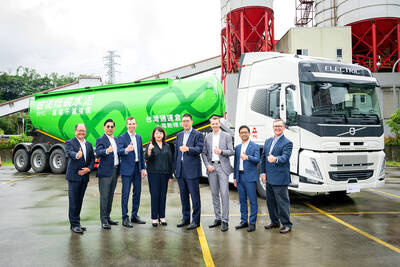
Taiwan Transport and Storage Corp (TTS, 台灣通運倉儲) yesterday unveiled its first electric tractor unit — manufactured by Volvo Trucks — in a ceremony in Taipei, and said the unit would soon be used to transport cement produced by Taiwan Cement Corp (TCC, 台灣水泥). Both TTS and TCC belong to TCC International Holdings Ltd (台泥國際集團). With the electric tractor unit, the Taipei-based cement firm would become the first in Taiwan to use electric vehicles to transport construction materials. TTS chairman Koo Kung-yi (辜公怡), Volvo Trucks vice president of sales and marketing Johan Selven, TCC president Roman Cheng (程耀輝) and Taikoo Motors Group

Among the rows of vibrators, rubber torsos and leather harnesses at a Chinese sex toys exhibition in Shanghai this weekend, the beginnings of an artificial intelligence (AI)-driven shift in the industry quietly pulsed. China manufactures about 70 percent of the world’s sex toys, most of it the “hardware” on display at the fair — whether that be technicolor tentacled dildos or hyper-realistic personalized silicone dolls. Yet smart toys have been rising in popularity for some time. Many major European and US brands already offer tech-enhanced products that can enable long-distance love, monitor well-being and even bring people one step closer to
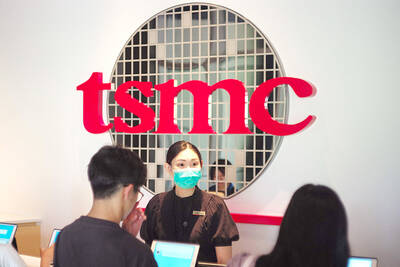
RECORD-BREAKING: TSMC’s net profit last quarter beat market expectations by expanding 8.9% and it was the best first-quarter profit in the chipmaker’s history Taiwan Semiconductor Manufacturing Co (TSMC, 台積電), which counts Nvidia Corp as a key customer, yesterday said that artificial intelligence (AI) server chip revenue is set to more than double this year from last year amid rising demand. The chipmaker expects the growth momentum to continue in the next five years with an annual compound growth rate of 50 percent, TSMC chief executive officer C.C. Wei (魏哲家) told investors yesterday. By 2028, AI chips’ contribution to revenue would climb to about 20 percent from a percentage in the low teens, Wei said. “Almost all the AI innovators are working with TSMC to address the
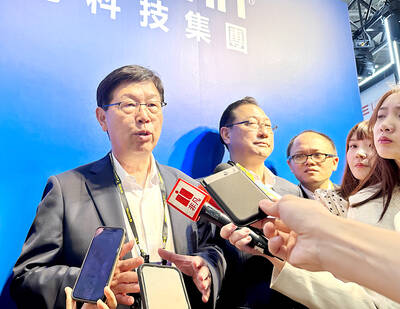
FUTURE PLANS: Although the electric vehicle market is getting more competitive, Hon Hai would stick to its goal of seizing a 5 percent share globally, Young Liu said Hon Hai Precision Industry Co (鴻海精密), a major iPhone assembler and supplier of artificial intelligence (AI) servers powered by Nvidia Corp’s chips, yesterday said it has introduced a rotating chief executive structure as part of the company’s efforts to cultivate future leaders and to enhance corporate governance. The 50-year-old contract electronics maker reported sizable revenue of NT$6.16 trillion (US$189.67 billion) last year. Hon Hai, also known as Foxconn Technology Group (富士康科技集團), has been under the control of one man almost since its inception. A rotating CEO system is a rarity among Taiwanese businesses. Hon Hai has given leaders of the company’s six


 RSS
RSS