


LG Electronics Co, the Korean consumer electronics giant, is considering expanding its manufacturing partnership with Taiwanese television makers in a bid to further trim costs, a high-ranking official said in Taipei this week.
LG's current partnership with Taiwanese TV maker Ya Hsin Industrial Co (
"It's a trend to manufacture the sleek TVs locally to fend off the intensive competition by saving costs," said Sam Park, an assistant general-manager of LG Electronics' Taiwan branch, during an interview with the Taipei Times on Wednesday.
Competition in the Taiwanese market in particular is heating up this year after a group of other local brands mushroomed, he said, as companies here get easier access to LCD panel supplies from AU Optornics Corp (
Besides, there are a lot of good TV makers in Taiwan, he continued.
After launching the mainstream 32-inch models through such a partnership, "It's worth thinking about extending the partnership to the manufacture of 37-inch models in the future," Park said. But, no final decision has been made by LG's headquarters yet, he added.
LG has already stopped shipping 32-inch models into Taiwan from Korea, although it still imports flat panels made by its slim-screen manufacturing affiliate, LG Philips LCD Co, as well as other components, Park said.
The company started introducing its LCD-TVs in the middle of this year to Taiwan, after grabbing a significant share of the plasma-display-panel (PDP) TV market.
An LG 32-inch LCD-TV is now priced at NT$59,990 (US$1,800), the same as Sony's new Bravia flat TV series with a similar specification.
With the new series, Sony aims to reclaim top position in the world's TV market, wooing price-sensitive consumers. Sony has targeted a 30-percent share of the worldwide market.
Sony's move could trigger a new price war in Taiwan's LCD-TV market, currently led by Matsushita Electric Industrial Co, which makes the well-known Panasonic brand.
Though Taiwan is a small market it provides a miniature overview of the world's major LCD markets, Park said.
To counter Sony's relatively low-priced models, Tatung Co (
Other local TV vendors including Sampo Corp (
LG, however, is not rushing to join the price war.
"We haven't seen a sales setback since Sony launched the Bravia series. But we are concerned about Sony's ambition to regain market share and we are closely monitoring its impact on the market," Park said.
Park admitted that Sony's new series has already received a positive response from local consumers, just days after the launch, mostly because of its strong brand name.
"But, we don't plan to cut prices as a countermeasure yet," he said, adding that LG would not rule out the possibility of slashing prices to vie for a bigger share.
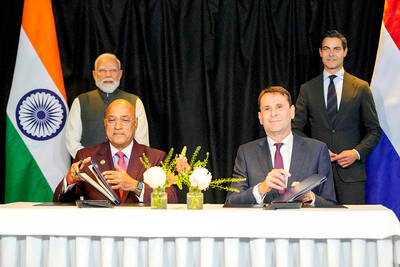
NEW MARKET: The partnership opens up India to the Dutch company, which already has a strong hold in the semiconductor market of South Korea, Taiwan and China ASML Holding NV entered into a partnership agreement with Tata Electronics Pvt Ltd aimed at ramping up India’s goal to develop domestic chip-manufacturing capabilities. The Dutch company’s technology would help power Tata Electronics’ planned 300 millimeter (mm) semiconductor foundry in Gujarat, according to a joint statement from the two companies on Saturday. The signing of a memorandum of understanding coincides with a visit by Indian Prime Minister Narendra Modi to the Netherlands, which is looking to deepen bilateral relations with New Delhi. ASML, whose top customers include Taiwan Semiconductor Manufacturing Co (台積電) and Samsung Electronics Co, makes lithography machines that can print
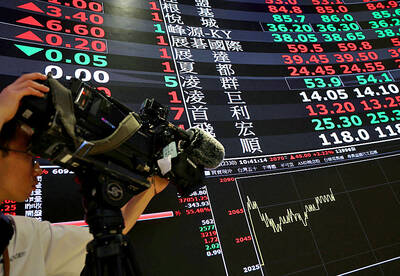
After several years flying high as Asia’s best Nvidia Corp proxy, Taiwan Semiconductor Manufacturing Co (TSMC, 台積電) is increasingly vying with other artificial intelligence (AI) stocks for investor attention. Stock traders are chasing a wider array of beneficiaries as mainstream usage of AI creates demand for hardware beyond the most-advanced chips TSMC makes for Nvidia. Subthemes from the deepening memory crunch to advances in robotics are also luring bids. At the same time, investment caps on single stocks are pushing funds to diversify, while retail investors long familiar with TSMC through its US depositary receipts are being offered a broader set of
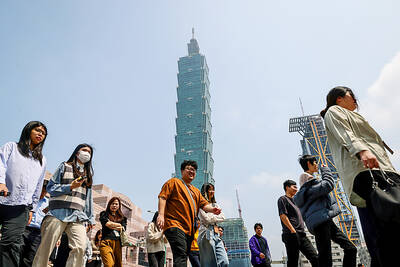
TECH RELIANCE: Growth is increasingly reflecting an unequal K-shaped distribution, where technology sectors outperform and other industries struggle, an expert said Standard Chartered Bank has significantly raised its forecast for Taiwan’s economic growth to 9.5 percent this year, up from 7.6 percent previously, citing surging artificial intelligence (AI) demand driving exports, semiconductor production and investment. The upgrade reflects a sustained AI supercycle that continues to fuel demand for advanced chips and technology infrastructure, which form the backbone of Taiwan’s exports, the bank said in a report this week. “We raise our 2026 growth forecast to reflect a much stronger-than-expected first-quarter GDP figure,” Standard Chartered senior economist for greater China and Asia Tommy Wu (胡東安) said in the report. Driven largely by a 35.3 percent
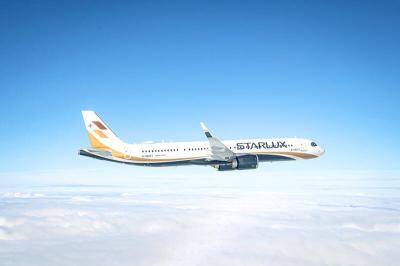
Two of Taiwan’s international carriers, Starlux Airlines Co (星宇航空) and EVA Airways Corp (長榮航空), have retained the five-star airline rating awarded by international airline review organization Skytrax. Starlux was awarded the distinction for a second consecutive year, while EVA Air received it for the 11th straight year, Skytrax said in statements released yesterday and on Thursday last week, respectively. The five-star rating is considered one of the airline industry's highest honors and is awarded following professional audits of airline product and frontline service standards, Skytrax said. The ratings are based on in-depth assessments using unified global quality standards rather than customer review scores


 RSS
RSS