


Like any given day in her past 10-year coffee career, Liu Fu-mei (劉富美) on a normal Saturday afternoon was making coffee using siphon brewers to serve customers in Gukeng (古坑) Township, Yunlin County.
However, this shopkeeper at Barden Coffee (巴登咖啡) was not brewing coffee imported from just any coffee-growing place, like Columbia or Indonesia, but the Arabica coffee grown locally in Taiwan.
"Unknown to even most natives, Taiwan actually grows coffee beans," said Barden's owner Chang Lai-en (張萊恩), who recalled when he was a child his father and other local coffee farmers planted the trees in Gukeng's Hobaoshan (荷苞山) region, also nicknamed 'Coffee Hill.'
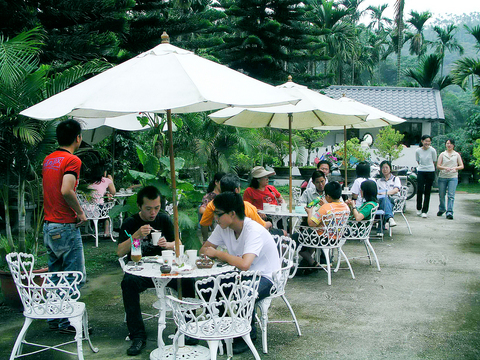
PHOTO: CHUANG YU-FENG, TAIPEI TIMES
"When the coffee matures, you can see the mountain covered with beautiful ruby-red beans," 50-year-old Chang said.
The history of coffee production in Taiwan dates back to the Qing Dynasty in the 1880s, when a British businessman for Tait & Co brought several nursery coffee plants to be grown in what was then Taipei County, but on a very small scale.
The golden age of the nation's coffee industry started in 1902, when the colonial Japanese government decided to develop this lucrative crop, mainly in Gukeng, which had suitable soil and a subtropical climate. More than 1,000 hectares of coffee were planted at the time, of which Gukeng alone made up more than 700 hectares.
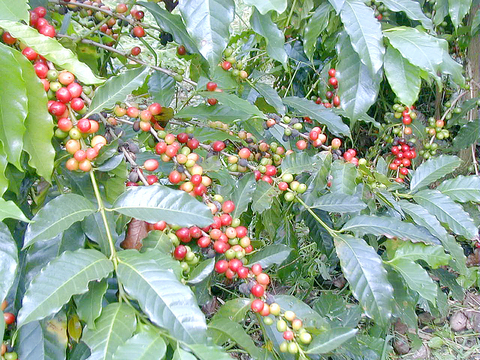
PHOTO: LIAO SHU-LING, TAIPEI TIMESN
Apart from supporting the development of the coffee industry, Japanese rulers also set up factories to process, grind and roast the beans, and established distribution channels to ship the coffee back to Japan. Taiwan became the capital of coffee production in the Ear East at the time.
The good old days, however, did not last long. Following the end of the Japanese 50 year-rule in 1945, coffee producers faced a disruption in export ties with Japan, while domestically they were in a very awkward position to produce coffee with only a very limited market for their crops. Coffee production slowed, while other crops, such as green oranges and bamboo shoots, continued to thrive.
As a pioneer in revitalizating the industry, Chang started a coffee venture in 1984 but sustained years of slow growth. Today, he has over 10 Barden outlets across the nation and his store is known for the rare and more pricey "Taiwan Coffee" made from beans which Chang has grown, harvested and baked himself for over 20 years. He admitted that it was not an easy road, with the way paved for him.
"Taiwan was a desert of coffee culture at that time," he said.
But things changed after a meeting with Hsieh Shu-ya (
With Chang's assistance, Hsieh tried a new strategy: the launch of a "Taiwan Coffee Festival" in 2003, designed to raise the visibility of the rural township, and to put a spotlight on the industry.
Last year, the 50-day Taiwan Coffee Festival drew over a million tourists and infused NT$1 billion into the local economy -- ? more than three times the amount made in 2003 (NT$300 million).
Hsieh said she expected to see a similar or an even greater response to this year's festival, which is slated to kick off on Sept. 30 and run through the end of November.
Thanks to the `brown gold,' the size of the coffee-growing area in Gukeng has now shot to over 150 hectares from the original 4.5-hectares owned by Chang.
Over the past few years, around 70 coffee shops have been springing up all over Gukeng's Huashan area (華山). Crowds of people are now surging to Gukeng just to sip a cup of coffee. The downside, however, is the traffic congestion to get there on weekends.
"Coffee is such a magic bean! Isn't it?" Hsieh said.
Janfusan Fancy World (
"We saw our revenues in the fourth quarter of last year jump by 20 percent from a year ago, thanks to the increasingly grander festival," Janfusan's president James Hsiao (蕭柏勳) said.
The amusement park expected its sales in the last quarter of this year to increase by 10 percent or more year-on-year, Hsiao said.
"We run the event as if building a brand, and work to ensure high quality standards are maintained, so that we keep attracting people," he said.
Despite all the seeming prosperity, the business of coffee production has its limitations in Taiwan.
"Taiwan's coffee production has no pricing edge over imported coffee," said Wu Yi-ling (
The cost of land and manpower to grow coffee in Taiwan is 30 to 40 times that of other countries like Indonesia, Vietnam, Brazil or other Central and Southern American nations, Wu explained.
Taiwan is also subject to natural disasters, like typhoons, which can cause extensive crop damage, further reducing the efficiency of a single growing area, and in turn raising the cost, she said.
Take the locally grown coffee, or the so-called "Taiwan Coffee." This mild-roast coffee is known for its rich flavor, said to be similar in taste to Jamaican Blue Mountain. But because of a high production cost and a small-scale production that can only fulfill domestic consumption, Taiwan Coffee is usually priced at over NT$1,000 per pound, compared to imported beans sold for about NT$500 to NT$600 per pound, according to Chang.
Instead of relying on domestic consumption alone, Taiwan's coffee-growing business should take advantage of its refined, small-scale and tourism-oriented agriculture in order to attract Japanese and Chinese visitors, Wu said.
"It is quality, not quantity that matters. The business can position itself as a specialty coffee to tap into the niche market," she said.
Another risk facing the sector is the farmers' lack of awareness in brand-building, as consumers discovered in October last year when some instant coffee powders labeled "Taiwan Coffee" were found to be inferior products mixed with imported, low-grade coffee. The incident to some extent hurt consumer confidence in Gukeng's coffee.
In response, the township authority required farmers and manufacturers to clearly and correctly label blended coffee products, which they agreed to do, Hsieh said.
"Do as internationalized standards do," and then farmers and producers can be more alert to protecting goodwill toward the industry, and helping good business practices prevail, Wu said.
There remains the concern that the fledgling sector could fade after Mayor Hsieh's term ends at the end of this year, entailing the loss of one of the industry's most tireless promoters.
But Hsieh responded that the public sector has already "lit the fire," and that she hoped to eventually pass on the torch to the private sector to share the benefits and prosperity, including local coffee businesses and tour operators.
Also, developing diverse coffee by-products such as sweets, food or even decorations could be the way to go in the future, she said.
Taiwan, which manufactures over 70 percent of the world's espresso machines, could be an ideal place to hold global coffee fairs to gather together upscale and to small-scale coffee-related businesses, and this could help the nation's coffee commerce continue rolling, Hsieh said with optimism.

Taiwan Transport and Storage Corp (TTS, 台灣通運倉儲) yesterday unveiled its first electric tractor unit — manufactured by Volvo Trucks — in a ceremony in Taipei, and said the unit would soon be used to transport cement produced by Taiwan Cement Corp (TCC, 台灣水泥). Both TTS and TCC belong to TCC International Holdings Ltd (台泥國際集團). With the electric tractor unit, the Taipei-based cement firm would become the first in Taiwan to use electric vehicles to transport construction materials. TTS chairman Koo Kung-yi (辜公怡), Volvo Trucks vice president of sales and marketing Johan Selven, TCC president Roman Cheng (程耀輝) and Taikoo Motors Group

Among the rows of vibrators, rubber torsos and leather harnesses at a Chinese sex toys exhibition in Shanghai this weekend, the beginnings of an artificial intelligence (AI)-driven shift in the industry quietly pulsed. China manufactures about 70 percent of the world’s sex toys, most of it the “hardware” on display at the fair — whether that be technicolor tentacled dildos or hyper-realistic personalized silicone dolls. Yet smart toys have been rising in popularity for some time. Many major European and US brands already offer tech-enhanced products that can enable long-distance love, monitor well-being and even bring people one step closer to

RECORD-BREAKING: TSMC’s net profit last quarter beat market expectations by expanding 8.9% and it was the best first-quarter profit in the chipmaker’s history Taiwan Semiconductor Manufacturing Co (TSMC, 台積電), which counts Nvidia Corp as a key customer, yesterday said that artificial intelligence (AI) server chip revenue is set to more than double this year from last year amid rising demand. The chipmaker expects the growth momentum to continue in the next five years with an annual compound growth rate of 50 percent, TSMC chief executive officer C.C. Wei (魏哲家) told investors yesterday. By 2028, AI chips’ contribution to revenue would climb to about 20 percent from a percentage in the low teens, Wei said. “Almost all the AI innovators are working with TSMC to address the

Malaysia’s leader yesterday announced plans to build a massive semiconductor design park, aiming to boost the Southeast Asian nation’s role in the global chip industry. A prominent player in the semiconductor industry for decades, Malaysia accounts for an estimated 13 percent of global back-end manufacturing, according to German tech giant Bosch. Now it wants to go beyond production and emerge as a chip design powerhouse too, Malaysian Prime Minister Anwar Ibrahim said. “I am pleased to announce the largest IC (integrated circuit) Design Park in Southeast Asia, that will house world-class anchor tenants and collaborate with global companies such as Arm [Holdings PLC],”


 RSS
RSS