


China's investment environment has improved slightly over the past year, as living standards and judicial systems have progressed, according to a survey of Taiwanese businesspeople released yesterday.
"Compared to last year, this has been a better year for Taiwanese companies to invest in China," Leu Horng-der (
Increased market visibility, improvements in the judicial system and rising living standards have further benefited Taiwanese investors across the Strait, he said, adding that enterprises around the globe have also been pumping investment into China.
Shanghai, Guangzhou, Beijing, Tianjin and Shenzhen remain the most competitive cities in China, Leu said, citing a report he commissioned for the Taiwan Electrical and Electronic Manufacturers Association (TEEMA,
The annual survey, which is in its sixth year this year, is intended to serve as a reference tool for local business groups that have investments in China, or are planning to enter the market. The survey polled 2,073 Taiwanese companies that do business in China,
Respondents recommended the Minhang area of Shanghai, Hangzhou's Xiaoshan district and Suzhou's Kunshan as the top three investment destinations, the report said.
Though shortages of water and electricity have long plagued Taiwanese doing business in China, Shanghai is not affected by this and offers an open economy, making it one of the most ideal investment destinations in China, Leu said.
Of the top 18 destinations recommended by those surveyed, 10 are in provinces along the eastern coast of China. The region, which has taken over from the northern coast as the most competitive region in China, has a better financial and investment environment, the survey said.
Dongguan earned the dubious honor of being named the worst investment destination, because of the loose enforcement of regulations in the business sector, Leu said.
To ensure success in China's huge market, local businesses should consider human resources as their most basic, yet critical, asset, TEEMA chairman Rock Hsu (許勝雄) said.
They should also evaluate whether available logistics and customs clearance services run smoothly, he said.
The revaluation of the Chinese yuan will eat into Taiwanese companies' profits, said Chen Miao (
If the currency continues to rise -- as many research institutions expect it will -- smaller Taiwanese companies may move their factories to other Southeast Asian countries, such as Vietnam, where labor and raw materials are cheaper, Chen said.
Taiwanese investment in China reached US$43.88 billion as of June, accounting for 50.4 percent of overseas investment this year, according to the Ministry of Economic Affairs.
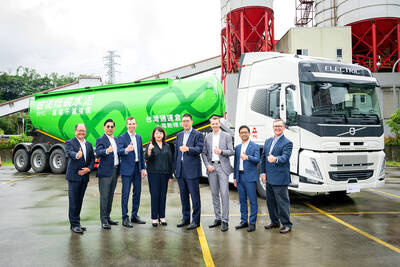
Taiwan Transport and Storage Corp (TTS, 台灣通運倉儲) yesterday unveiled its first electric tractor unit — manufactured by Volvo Trucks — in a ceremony in Taipei, and said the unit would soon be used to transport cement produced by Taiwan Cement Corp (TCC, 台灣水泥). Both TTS and TCC belong to TCC International Holdings Ltd (台泥國際集團). With the electric tractor unit, the Taipei-based cement firm would become the first in Taiwan to use electric vehicles to transport construction materials. TTS chairman Koo Kung-yi (辜公怡), Volvo Trucks vice president of sales and marketing Johan Selven, TCC president Roman Cheng (程耀輝) and Taikoo Motors Group

Among the rows of vibrators, rubber torsos and leather harnesses at a Chinese sex toys exhibition in Shanghai this weekend, the beginnings of an artificial intelligence (AI)-driven shift in the industry quietly pulsed. China manufactures about 70 percent of the world’s sex toys, most of it the “hardware” on display at the fair — whether that be technicolor tentacled dildos or hyper-realistic personalized silicone dolls. Yet smart toys have been rising in popularity for some time. Many major European and US brands already offer tech-enhanced products that can enable long-distance love, monitor well-being and even bring people one step closer to
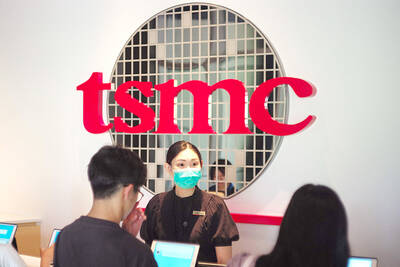
RECORD-BREAKING: TSMC’s net profit last quarter beat market expectations by expanding 8.9% and it was the best first-quarter profit in the chipmaker’s history Taiwan Semiconductor Manufacturing Co (TSMC, 台積電), which counts Nvidia Corp as a key customer, yesterday said that artificial intelligence (AI) server chip revenue is set to more than double this year from last year amid rising demand. The chipmaker expects the growth momentum to continue in the next five years with an annual compound growth rate of 50 percent, TSMC chief executive officer C.C. Wei (魏哲家) told investors yesterday. By 2028, AI chips’ contribution to revenue would climb to about 20 percent from a percentage in the low teens, Wei said. “Almost all the AI innovators are working with TSMC to address the

Malaysia’s leader yesterday announced plans to build a massive semiconductor design park, aiming to boost the Southeast Asian nation’s role in the global chip industry. A prominent player in the semiconductor industry for decades, Malaysia accounts for an estimated 13 percent of global back-end manufacturing, according to German tech giant Bosch. Now it wants to go beyond production and emerge as a chip design powerhouse too, Malaysian Prime Minister Anwar Ibrahim said. “I am pleased to announce the largest IC (integrated circuit) Design Park in Southeast Asia, that will house world-class anchor tenants and collaborate with global companies such as Arm [Holdings PLC],”


 RSS
RSS