


It started with walks along China's Great Wall and culminated at California's Pebble Beach resort, where Yahoo Inc! cofounder Jerry Yang (
The friendship the two formed on their Wall hikes led to Yahoo's purchase of 40 percent of Ma's privately held Alibaba, China's biggest electronic-commerce company and No. 2 online auctioneer. Now the question is whether the goodwill that spurred the acquisition will help Yahoo overtake EBay Inc, China's leading online auctioneer, and win more search-engine customers in the second-biggest Internet market after the US.
"The Alibaba purchase gives Yahoo a strong local entrepreneur, a heavyweight in the industry, who can drive the company to success," says Duncan Clark, managing director of Beijing-based technology consultant BDA China Ltd. "China is a high-maintenance market. It is highly regulated, highly sensitive and difficult to manage from 15 hours' time difference away."
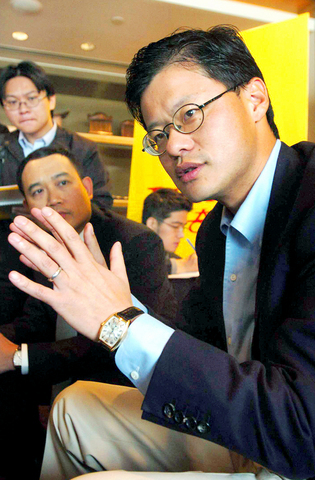
TAIPEI TIMES FILE PHOTO BY CHIANG YING-YING
Yahoo controls just 3 percent of China's online auction market and ranks second among search engines. To turn the company from a laggard into a leader, Ma, 40, faces the challenges of winning the loyalty of Yahoo's 600 China-based employees and attracting customers in a relatively undeveloped electronic-commerce market.
"Chinese Internet users tend to focus on online games and spend a lot less on e-commerce," says Frank Shi (
Ma also has to ensure that Yahoo employees in China don't defect, says Victor Gao, CEO of China State-Owned Enterprise Investment Co, a Beijing-based merger consultant. "There is a risk that the staff at Yahoo China may not want to follow Ma," Gao says. "He needs to move quickly to win them over."
Zhou Hongyi (
"Alibaba has its own business-to-business and consumer-to-consumer revenue models, while Yahoo is strong in search engines and e-mails," says Zhou, who sold 3721 Network Software Co, the operator of a Chinese search engine, to Yahoo in 2003. "The revenue models don't match."
Sunnyvale, California-based Yahoo agreed on Aug. 11 to swap US$1 billion in cash and its local unit for 40 percent of Hangzhou-based Alibaba. In addition to its auction site, Taobao.com (
Yahoo, which runs the world's most-visited Web portal, is expanding in China to tap a market where the number of Web users has grown sevenfold in eight years to 94 million. China's online auction market will expand sixfold to US$2.6 billion by 2007, Beijing-based market researcher iResearch Inc forecasts.
Yang, 36, is turning Yahoo China over to a local partner after the company failed to raise its share of the nation's Internet auction market above the 3 percent iResearch estimates it has.
Yahoo began competing in that market last year, investing an undisclosed amount to form online auctioneer 1pai.com through a venture with Sina Corp (
Together, Alibaba and Yahoo will knock San Jose, California-based EBay from the No. 1 spot. EBay's EachNet site controlled 39 percent of China's consumer online auction market at the end of 2004, and Alibaba's Taobao.com had 37 percent. EachNet charges a fee, while Taobao.com and 1pai.com are free.
Yahoo doesn't routinely disclose its Chinese unit's market share. EBay had been detailing sales in the country until the recent quarter.
Alibaba also releases scant information on its financial performance. The company said in a press release earlier this year that it had sales of US$46 million in 2004, mostly from online advertising. It didn't provide a year-earlier figure.
Laurence Brahm, a lawyer and the chairman of Beijing-based investment company Naga Group, says Chinese companies often aren't accountable to shareholders.
"Corporations are run like personal bank accounts in China," says Brahm, who helps multinationals set up in China. "There is no accountability." Government censorship makes the Internet market especially risky for overseas investors, Brahm says.
Yahoo entered China when it bought Zhou's Hong Kong-based 3721 Network Software for about US$120 million in November 2003, gaining control of what's now China's No. 2 Internet search engine.
3721, China's biggest search engine when Yahoo bought it, had a 32 percent market share as of March 31, according to iResearch. Market leader Baidu.com Inc (
Ma says he plans to spend some of the proceeds from Yahoo's investment to strengthen the search-engine unit.
"We're going after Baidu.com for the No. 1 spot in China," Ma said at the Aug. 11 Beijing press conference announcing the Alibaba deal. "Google is history as far as I'm concerned."
Alibaba's trading site -- which lets small- and medium-sized companies exchange and export goods -- has more than 15 million subscribers worldwide, according to the company. Alibaba.com is the nation's No. 1 business-to-business site, according to Analysys International, a Beijing-based technology consulting firm. Yahoo China doesn't have a site that lets companies trade with each other.
Alibaba also runs an online payment site, alipay.com, that allows companies to complete transactions on line -- also a service Yahoo lacks in China. Alibaba.com and Taobao, which means "digging for treasure" in Chinese, will keep their existing names, according to Yang.
Combining with Alibaba gives Yahoo millions of new customers for its e-mail and search services, says Analysys CEO Edward Yu.
"Yahoo's search engines, combined with Alibaba's more than 6 million Chinese online businesses, provide Yahoo with a powerful combination," Yu says. "Ma and his executives are a strong team."
A native of Hangzhou in southeastern Zhejiang Province, Ma studied English at Hangzhou Teachers' Institute, graduating in 1988, according to Porter Erisman, Alibaba's vice president of marketing in Shanghai. To improve his English, Ma gave foreigners free tours of Hangzhou. The Yahoo-Alibaba deal, negotiated over the past three months by Ma and Yang, was hatched in early May during the US-China IT Executive Summit in Pebble Beach, Erisman says.
Ma says he became friends with Yang in 1998, four years after Yahoo's founding. Yang, who was born in Taiwan and grew up in San Jose, was visiting China to explore his cultural homeland and the country's Internet market, Erisman says.
At the time, Ma's first project -- Hangzhou Hope Networks Consulting, an online directory of Chinese businesses that he founded in 1995 -- had just been shut in a government crackdown on Internet sites.
Ma founded Alibaba in 1999 with US$25 million from venture capitalists, according to Alibaba's Web site. Current shareholders include Fidelity Capital, a unit of Boston-based Fidelity Investments; Granite Global Ventures, based in Menlo Park, California; and Singapore-based Venture TDF Pte and Transpac Capital Ltd, according to the Web site.
"We used to take these great hikes on the Great Wall," Ma says. "From our hikes, we developed a friendship that ended up with us combining forces in forming this new Chinese company."
A photo of the two together on the Great Wall was displayed at the press conference announcing the deal. The final agreement was signed at the offices of Skadden, Arps, Slate, Meagher & Flom LLP, Yahoo's law firm, in Palo Alto, California, at 11:20pm local time on Aug. 10, just after the press release was issued, Alibaba Chief Financial Officer Joseph Tsai (
At the same, Ma and Yahoo Chief Operating Officer Daniel Rosensweig were in Beijing announcing the deal. Yahoo expects the transaction to be completed in the fourth quarter of 2005.
Ma will be the chief executive officer of the combined company and sit on the board of directors with Yang, Softbank Corp President Masayoshi Son -- an original Yahoo shareholder -- and Tsai, the companies say. Unlike Yahoo China's Zhou, who ultimately reported to Semel, Ma will be accountable only to the Alibaba board, Rosensweig says.
Ma is the man to take Yahoo forward in China, says Son, whose Tokyo-based Softbank is Japan's No. 2 provider of high-speed Internet access. Son is also chairman of Yahoo! Japan Corp, which is 42 percent owned by Softbank.
"There were many companies that wanted to talk to us when we first started doing business in China," Son says. "Jack Ma was the only one I spoke to, or wanted to speak to, directly."
Softbank is selling part of its 40 percent stake in Taobao to Yahoo for US$360 million, the Japanese company said Aug. 11. It will have a 27 percent stake in the merged company.
"Jack, Jerry and I had been talking about the merger for a while," says Son, adding that he also considers Ma a friend. "Jerry and I would like to leave the operation up to Jack. We trust his skills."
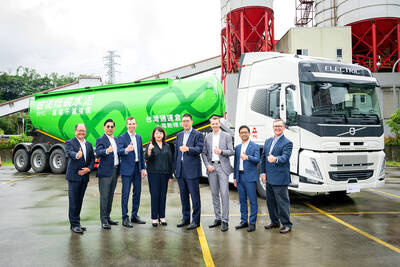
Taiwan Transport and Storage Corp (TTS, 台灣通運倉儲) yesterday unveiled its first electric tractor unit — manufactured by Volvo Trucks — in a ceremony in Taipei, and said the unit would soon be used to transport cement produced by Taiwan Cement Corp (TCC, 台灣水泥). Both TTS and TCC belong to TCC International Holdings Ltd (台泥國際集團). With the electric tractor unit, the Taipei-based cement firm would become the first in Taiwan to use electric vehicles to transport construction materials. TTS chairman Koo Kung-yi (辜公怡), Volvo Trucks vice president of sales and marketing Johan Selven, TCC president Roman Cheng (程耀輝) and Taikoo Motors Group

Among the rows of vibrators, rubber torsos and leather harnesses at a Chinese sex toys exhibition in Shanghai this weekend, the beginnings of an artificial intelligence (AI)-driven shift in the industry quietly pulsed. China manufactures about 70 percent of the world’s sex toys, most of it the “hardware” on display at the fair — whether that be technicolor tentacled dildos or hyper-realistic personalized silicone dolls. Yet smart toys have been rising in popularity for some time. Many major European and US brands already offer tech-enhanced products that can enable long-distance love, monitor well-being and even bring people one step closer to

RECORD-BREAKING: TSMC’s net profit last quarter beat market expectations by expanding 8.9% and it was the best first-quarter profit in the chipmaker’s history Taiwan Semiconductor Manufacturing Co (TSMC, 台積電), which counts Nvidia Corp as a key customer, yesterday said that artificial intelligence (AI) server chip revenue is set to more than double this year from last year amid rising demand. The chipmaker expects the growth momentum to continue in the next five years with an annual compound growth rate of 50 percent, TSMC chief executive officer C.C. Wei (魏哲家) told investors yesterday. By 2028, AI chips’ contribution to revenue would climb to about 20 percent from a percentage in the low teens, Wei said. “Almost all the AI innovators are working with TSMC to address the

Malaysia’s leader yesterday announced plans to build a massive semiconductor design park, aiming to boost the Southeast Asian nation’s role in the global chip industry. A prominent player in the semiconductor industry for decades, Malaysia accounts for an estimated 13 percent of global back-end manufacturing, according to German tech giant Bosch. Now it wants to go beyond production and emerge as a chip design powerhouse too, Malaysian Prime Minister Anwar Ibrahim said. “I am pleased to announce the largest IC (integrated circuit) Design Park in Southeast Asia, that will house world-class anchor tenants and collaborate with global companies such as Arm [Holdings PLC],”


 RSS
RSS