


The share price of Taiwan Business Bank (台灣企銀) plummeted on the local bourse yesterday, as the bank's complicated rules for its share sale were met with a lack of enthusiasm from investors.
The bank's shares plunged 5.84 percent to NT$12.10 on the Taiwan Stock Exchange.
The board of directors at Taiwan Business Bank, in which the government currently controls a 44-percent stake, decided to sell the state-owned shares in a 100 percent share swap, the bank said in a statement released late Thursday.
According to the rules of the sale announced on Thursday, the bid-winning buyer will have to acquire the bank's shares with both its common shares and new preferred shares priced at NT$10 per share, valid for six months after issuance.
The buyer will need to pay in cash to redeem the preferred shares when they are due, the statement read.
The value of the preferred shares must make up between 25 percent and 55 percent of the value of the transaction, the bank said.
Meanwhile, the bank demanded that the buyer not change employment conditions or lay off staff within two years after the takeover, and retain the policy of granting loans amounting to a total of NT$320 billion (US$9.94 billion) per year to small and medium enterprises (SMEs).
"We think these complicated game rules for the share sale have more disadvantages than advantages for buyers," Yuanta Core Pacific Securities Co (
Interested bidders did not seem positive about the conditions, which would likely give the government a continued say in the buyer's business activities because of the requirement to maintain the policy of granting loans to SMEs. It would also result in huge pension costs stemming from the job-security guarantees to the bank's employees, Wang said.
The strict conditions could make bidders more conservative about making offers, Wang said.
He added that buying back preferred shares and the personnel costs could result in buyers spending nearly NT$20 billion on the deal.
However, Chu Yu-chun (朱玉君), a finance analyst at SinoPac Securities Corp (建華證券), seemed more positive about the requirements, saying that the market overreacted and consequently depressed the bank's share price yesterday.
The strategy of conducting a share swap using both common and preferred shares can prevent buyers' shareholdings from being seriously diluted, which meets most of the interested financial holdings firms' needs, Chu said.
Nonetheless, the bank's accumulated bad loans, which could amount to more than NT$50 billion, could pose a risk to interested buyers planning to expand their operations by means of the acquisition deal, she said.
Taiwan Business Bank, which has assets worth US$32.3 billion and 124 branches nationwide, is slated to open the bidding next month as part of the government's policy of reducing the number of state-run banks to six by the end of the year.
The bank has reportedly attracted bids from six local financial holdings: Fubon Financial Holding Co (
Both analysts said Chinatrust Financial could be the most aggressive player and the beneficiary of the bank's SME client lineups after the takeover.
However, the company remained evasive about the deal, with its spokesman Lin Shiaw-pin (
Lin declined to comment on the bank's conditions for the share sale.
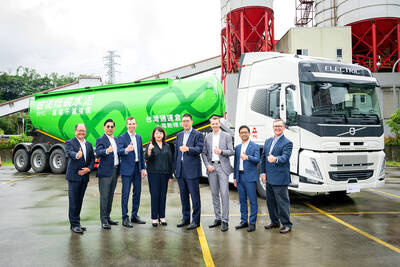
Taiwan Transport and Storage Corp (TTS, 台灣通運倉儲) yesterday unveiled its first electric tractor unit — manufactured by Volvo Trucks — in a ceremony in Taipei, and said the unit would soon be used to transport cement produced by Taiwan Cement Corp (TCC, 台灣水泥). Both TTS and TCC belong to TCC International Holdings Ltd (台泥國際集團). With the electric tractor unit, the Taipei-based cement firm would become the first in Taiwan to use electric vehicles to transport construction materials. TTS chairman Koo Kung-yi (辜公怡), Volvo Trucks vice president of sales and marketing Johan Selven, TCC president Roman Cheng (程耀輝) and Taikoo Motors Group

Among the rows of vibrators, rubber torsos and leather harnesses at a Chinese sex toys exhibition in Shanghai this weekend, the beginnings of an artificial intelligence (AI)-driven shift in the industry quietly pulsed. China manufactures about 70 percent of the world’s sex toys, most of it the “hardware” on display at the fair — whether that be technicolor tentacled dildos or hyper-realistic personalized silicone dolls. Yet smart toys have been rising in popularity for some time. Many major European and US brands already offer tech-enhanced products that can enable long-distance love, monitor well-being and even bring people one step closer to

RECORD-BREAKING: TSMC’s net profit last quarter beat market expectations by expanding 8.9% and it was the best first-quarter profit in the chipmaker’s history Taiwan Semiconductor Manufacturing Co (TSMC, 台積電), which counts Nvidia Corp as a key customer, yesterday said that artificial intelligence (AI) server chip revenue is set to more than double this year from last year amid rising demand. The chipmaker expects the growth momentum to continue in the next five years with an annual compound growth rate of 50 percent, TSMC chief executive officer C.C. Wei (魏哲家) told investors yesterday. By 2028, AI chips’ contribution to revenue would climb to about 20 percent from a percentage in the low teens, Wei said. “Almost all the AI innovators are working with TSMC to address the

Malaysia’s leader yesterday announced plans to build a massive semiconductor design park, aiming to boost the Southeast Asian nation’s role in the global chip industry. A prominent player in the semiconductor industry for decades, Malaysia accounts for an estimated 13 percent of global back-end manufacturing, according to German tech giant Bosch. Now it wants to go beyond production and emerge as a chip design powerhouse too, Malaysian Prime Minister Anwar Ibrahim said. “I am pleased to announce the largest IC (integrated circuit) Design Park in Southeast Asia, that will house world-class anchor tenants and collaborate with global companies such as Arm [Holdings PLC],”


 RSS
RSS