


Chunghwa Telecom Co (
This is the first time Hochen detailed the company's operational changes and vision for the future, after the nation's largest telecommunications service provider successfully released a 17 percent stake originally owned by the government to both local and overseas investors last week, taking the government's shareholding in the company to under 50 percent.
"Now Chunghwa can enjoy more operational flexibility as company budgets need not be constrained by the Procurement Act (採購法) and legislative oversight," he said.
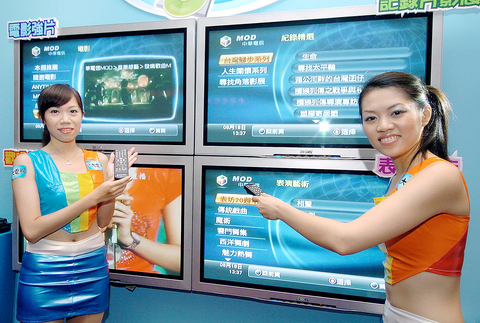
PHOTO: LIAO CHEN-HUI, TAIPEI TIMES
Some lawmakers criticized the privatization move and said Chunghwa will eventually fall into the hands of business conglomerates following several rounds of share sales, but Hochen refuted such claims as nonsense.
"Cathay Financial Holding Co's (國泰金控) shareholding in Chunghwa has dropped from the original 6.75 percent to 3.9 percent. The combined stake of Fubon Financial Holding Co (富邦金控) and its subsidiary Taiwan Mobile Co (台灣大哥大) has also shrunk by one-third to the current 2 percent. The theory that the company is being controlled by conglomerates is ridiculous," he said.
To boost operational efficiency and reduce personnel costs, the company plans to encourage 3,000 employees to take up an offer of early preferential retirement -- including 875 employees who quit last week following the company's privatization -- over the next three years.
Hochen said the job cuts will enable the company to streamline its organizational headcount to 25,000 while allowing it to recruit more management professionals.
"We have already been a vigorous company but now we can jump even higher," Hochen said, reiterating his confidence that employees' mindsets have been well adjusted to brace for stiff competition from other telecom players.
The newly privatized entity is now working on developing digital-content applications, such as MOD services, to serve local consumers. Chunghwa also plans to develop its terminal-equipment business and enter overseas markets to offer services for Taiwanese businesspeople abroad, Hochen said, without elaborating.
But he stressed that the company would have to nurture professionals specializing in international law and management before making the giant step.
"Now we would first strengthen our ability to provide telecom services for Taiwanese businesspeople" in China and other countries, he said.
Hochen said expanding into overseas markets will be the company's long-term goal. But no timetable has been finalized, considering the relatively higher operational risks and environmental uncertainties this would bring.
However, Chunghwa would start forging strategic alliances with international telecom companies, such as Japan's NTT DoCoMo, South Korea's Korea Telecom and Hong Kong's PCCW Ltd to offer better-quality cross-country services, he said.
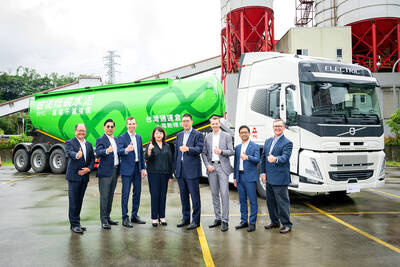
Taiwan Transport and Storage Corp (TTS, 台灣通運倉儲) yesterday unveiled its first electric tractor unit — manufactured by Volvo Trucks — in a ceremony in Taipei, and said the unit would soon be used to transport cement produced by Taiwan Cement Corp (TCC, 台灣水泥). Both TTS and TCC belong to TCC International Holdings Ltd (台泥國際集團). With the electric tractor unit, the Taipei-based cement firm would become the first in Taiwan to use electric vehicles to transport construction materials. TTS chairman Koo Kung-yi (辜公怡), Volvo Trucks vice president of sales and marketing Johan Selven, TCC president Roman Cheng (程耀輝) and Taikoo Motors Group

Among the rows of vibrators, rubber torsos and leather harnesses at a Chinese sex toys exhibition in Shanghai this weekend, the beginnings of an artificial intelligence (AI)-driven shift in the industry quietly pulsed. China manufactures about 70 percent of the world’s sex toys, most of it the “hardware” on display at the fair — whether that be technicolor tentacled dildos or hyper-realistic personalized silicone dolls. Yet smart toys have been rising in popularity for some time. Many major European and US brands already offer tech-enhanced products that can enable long-distance love, monitor well-being and even bring people one step closer to

RECORD-BREAKING: TSMC’s net profit last quarter beat market expectations by expanding 8.9% and it was the best first-quarter profit in the chipmaker’s history Taiwan Semiconductor Manufacturing Co (TSMC, 台積電), which counts Nvidia Corp as a key customer, yesterday said that artificial intelligence (AI) server chip revenue is set to more than double this year from last year amid rising demand. The chipmaker expects the growth momentum to continue in the next five years with an annual compound growth rate of 50 percent, TSMC chief executive officer C.C. Wei (魏哲家) told investors yesterday. By 2028, AI chips’ contribution to revenue would climb to about 20 percent from a percentage in the low teens, Wei said. “Almost all the AI innovators are working with TSMC to address the

Malaysia’s leader yesterday announced plans to build a massive semiconductor design park, aiming to boost the Southeast Asian nation’s role in the global chip industry. A prominent player in the semiconductor industry for decades, Malaysia accounts for an estimated 13 percent of global back-end manufacturing, according to German tech giant Bosch. Now it wants to go beyond production and emerge as a chip design powerhouse too, Malaysian Prime Minister Anwar Ibrahim said. “I am pleased to announce the largest IC (integrated circuit) Design Park in Southeast Asia, that will house world-class anchor tenants and collaborate with global companies such as Arm [Holdings PLC],”


 RSS
RSS