


While representing a Dutch industrial design company in Taiwan during the late 1990s, Case Engelen noticed there was an insurmountable communication gap between designers in the West and manufacturers in Taiwan.
"I realized that it would be useful to have the designers in Taiwan, so they could work more closely with the manufacturers," Engelen said. "That's what gave me the idea to start a company."
So five years ago, he took the leap and set up Titoma (提託馬), hiring designers from France, Germany, the UK and the US to work with local manufacturers on projects developed in the West.
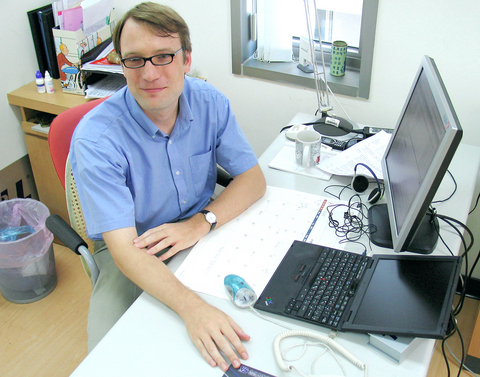
PHOTO: GRAHAM NORRIS
Now Engelen's company employs 10 people, with offices in the UK, Germany, the US and China, and had sales of US$1 million last year, a figure he expects to rise to around US$3 million this year.
Engelen is one of numerous foreigners who are taking advantage of Taiwan's entrepreneurial society and liberal, albeit slightly bureaucratic, regulations for companies.
Small and medium-sized enterprises make up 97 percent of all companies in Taiwan, but working out exactly how many of these are owned by foreigners is difficult, as the Ministry of Economic Affairs doesn't distinguish between companies that are owned by foreigners locally and those set up as subsidiaries of foreign multinationals.
Ann Hu (胡安嘉), a certified public accountant with Universal Law CPA Group (宇律會計師事務所), helps between 30 and 50 foreigners set up companies here every year. She said the process is quite simple, especially if you have an accountant or lawyer deal with the procedure for you.
"The government's attitude is quite welcoming," she said. "They will usually approve an application."
She said that in her experience, the most common type of company that foreigners set up was a trading company, but that the government was even more open to those who wanted to set up any kind of high-tech enterprise.
When Engelen set up his company nearly five years ago, he was lucky enough to have gone through the process with his former company, WeLL Design. He decided that, because he wanted to hire a lot of foreigners, it would be easier to persuade the government of his need to hire people from overseas if the parent company was foreign.
So he first set up a holding company in Hong Kong, and then set up its branch company here. He said the process was relatively simple, and required only time and a lot of documentation -- as well as NT$2.5 million. Even so, he said it was a struggle at first to get Alien Resident Certificates (ARC) for his foreign employees. He had to prove to the government he couldn't find Taiwanese employees suitable for the job, and that the foreigners he wanted to hire had years of experience.
One way around the problem was to use AIESEC, an international student organization that runs an exchange program to allow around 3,500 students a year to live and work in another country. Engelen said he employed a German student for a year through the program for one of his projects.
Most companies can apply for an ARC for the general manager, but if the company plans to hire other foreigners, the minimum investment requirement is usually NT$5 million.
Michael Lee (李家祥), a partner in the Pamir Law Group (帕米爾顧問), said that while there was no set limits on the hiring of foreigners, in practice the government would take into consideration a number of factors when deciding how many foreigners a company can hire.
The government, usually the Council of Labor Affairs, would look in particular at the company's revenues and ratio of foreign to local workers, Lee said. In the first year, the government will estimate the revenues of the company, but in further years the company will have to prove it's earning money to be able to hire more foreigners. The company will also have to prove the foreign workers they want to hire are qualified. Once a company is operating and making money, a further consideration is expansion and how to fund it.
Investing more money from abroad requires the approval of the MOEA's Investment Commission, although this isn't usually hard to get. The rules on raising money from Taiwanese individuals, if you can find them, are also quite relaxed. But institutional investors are not so welcoming.
Elias Ek, president of Enspyre (安石行動商務中心), which provides business services to small and medium-sized enterprises, encountered this problem when trying to raise expansion funding from banks.
"The banks here are basically racist," Ek said. "It doesn't matter what your business plan says, if you're a foreigner they just won't look at it."
He said banks had shown him regulations barring foreigners from borrowing money from them that were apparently based on law, but after extensive enquiries he could not find the law and assumed it had, unknown to the banks, been repealed some time ago.
Foreigners were disadvantaged in such a situation because, unlike Taiwanese, they could not so easily turn to family members for investment funds. And even when banks do lend money, they only do so if the entire loan is backed by collateral.
"There are no banks here, only pawn shops," Ek said, adding that to realize his plan of having 1,000 offices open in 10 years, he might have to move his headquarters out of Taiwan if financing from banks didn't become easier.
On the upside, Ek said, almost everything else here was simpler than in his home country, Sweden, and the entrepreneurial spirit in Taiwan was infectious.
"In Sweden people are very reluctant to take risks by starting a new business," he said. "But here there is a mentality, an optimism, that means Taiwanese are very good at taking the leap."
However, taking the leap in Taiwan can mean shouldering a lot more responsibility that entrepreneurs do in the West.
Lee at law firm Pamir said that while opening and running a company in Taiwan was no easier or more difficult than in other places, one main difference between operating a company here and in the West was that in Taiwan the general manager, registered as the "responsible person," is personally, and criminally, liable for the actions of the company.
"Everything that's stamped with the company chop also has to be stamped with the person's own chop, so that person is always responsible for what happens," Lee said. "That's probably the biggest thing for foreigners to think about."
He said the managers of some established foreign companies planning to set up subsidiaries or branches in Taiwan preferred to find locals to become the "responsible person" because they weren't used to the idea that they would be personally responsible for the company's actions.
"If the company defrauds somebody, the `responsible person' potentially could go to jail, and that's something that doesn't happen in Western countries," Lee said, adding that in practice the jailing of the "responsible person" happened only in extreme cases.
Foreign entrepreneurs in Taiwan say the environment here is conducive to doing business, with the costs of operating a company quite low and regulations reasonably clear. Hu of Universal Law said that while accountants or lawyers could take care of most of the bureaucratic burden, foreigners, just like any entrepreneurs anywhere, had to think clearly about what they were doing before embarking on starting a company.
"The registration part is quite straightforward," she said. "The important thing is that you have a plan for your business, how much money you will need and what the key issue will be to make your company succeed."
Some sectors of the economy are off-limits to foreigners, either because they are sensitive, dangerous or protected. Foreigners may not invest, for example, in companies related to the production of various kinds of chemicals, the postal service, certain agricultural products, radio and television broadcasting, and various kinds of military equipment.
As for the tax issue, companies basically have to pay 25 percent tax on profit every year and a 5 percent sales tax every two months, said Ann Hu. Deductibles are quite clear, and there's not much you can deduct from your taxes anyway.
Tips on getting your own business started
* Many companies choose the same route as Titoma, by setting up a holding company overseas, usually a PO Box address in Hong Kong or a tax haven, and then creating a branch of the company in Taiwan. The company must apply to the Ministry of Economic Affairs' Department of Commerce for a Chinese name, company licence and an operating licence, thereby obtaining an identification card for the company.
* The next step is to find a location for the company that complies with zoning laws, and apply to the local government for a permit to set up operations there. Another way is to set up a "subsidiary," which, despite the name, can mean creating a new company totally unrelated to any existing company overseas.
* There are two kinds of "subsidiary": a company limited by shares, similar to a corporation in the US, and a limited company, otherwise known as a limited liability company.
* The minimum investment required for a company limited by shares is NT$1 million, and for a limited company it is NT$500,000.
* While a limited company has lower minimum investment requirements, some decisions need to be made unanimously by shareholders and the company can't go public. Setting up a "subsidiary," unlike a branch, requires approval of the MOEA's Investment Commission, which wants to know what kind of business it is, how much is being invested, and where the money's from.
* Depending on how much business the company does overseas, a branch company may be able to avoid some taxes that "subsidiaries" have to pay, but they are prevented from doing things, like owning real estate. Foreigners can also set up representative offices in Taiwan for companies based overseas, but as the name suggests, its functions are restricted, mainly to functions such as collecting orders.
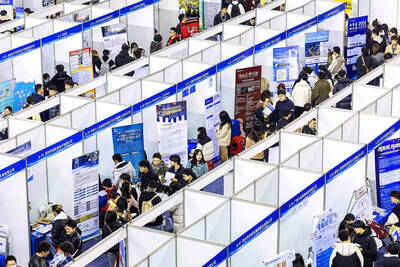
Stephen Garrett, a 27-year-old graduate student, always thought he would study in China, but first the country’s restrictive COVID-19 policies made it nearly impossible and now he has other concerns. The cost is one deterrent, but Garrett is more worried about restrictions on academic freedom and the personal risk of being stranded in China. He is not alone. Only about 700 American students are studying at Chinese universities, down from a peak of nearly 25,000 a decade ago, while there are nearly 300,000 Chinese students at US schools. Some young Americans are discouraged from investing their time in China by what they see
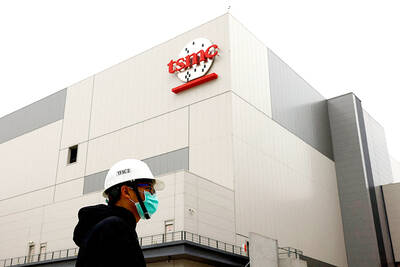
Taiwan Semiconductor Manufacturing Co (TSMC, 台積電), the world’s largest contract chipmaker, yesterday reported record sales for the first quarter, which analysts attributed to solid demand for emerging technologies. Consolidated revenue totaled NT$592.64 billion (US$18.51 billion) in the January-to-March period, up 16.5 percent from a year earlier, but down 5.26 percent from the previous quarter, TSMC said in a statement. The first-quarter revenue beat analysts’ average projection of NT$579.5 billion, Bloomberg News reported. That performance lends weight to expectations that the world’s most valuable chipmaker would return to solid growth this year after weathering a post-COVID-19-pandemic cratering of smartphone and computer sales. TSMC is budgeting

MAJOR DROP: CEO Tim Cook, who is visiting Hanoi, pledged the firm was committed to Vietnam after its smartphone shipments declined 9.6% annually in the first quarter Apple Inc yesterday said it would increase spending on suppliers in Vietnam, a key production hub, as CEO Tim Cook arrived in the country for a two-day visit. The iPhone maker announced the news in a statement on its Web site, but gave no details of how much it would spend or where the money would go. Cook is expected to meet programmers, content creators and students during his visit, online newspaper VnExpress reported. The visit comes as US President Joe Biden’s administration seeks to ramp up Vietnam’s role in the global tech supply chain to reduce the US’ dependence on China. Images on
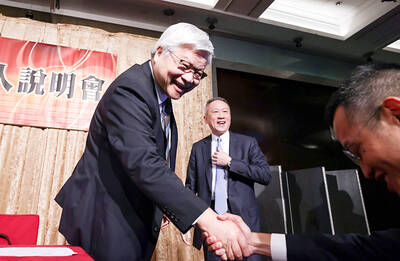
US CONSCULTANT: The US Department of Commerce’s Ursula Burns is a rarely seen US government consultant to be put forward to sit on the board, nominated as an independent director Taiwan Semiconductor Manufacturing Co (TSMC, 台積電), the world’s largest contract chipmaker, yesterday nominated 10 candidates for its new board of directors, including Ursula Burns from the US Department of Commerce. It is rare that TSMC has nominated a US government consultant to sit on its board. Burns was nominated as one of seven independent directors. She is vice chair of the department’s Advisory Council on Supply Chain Competitiveness. Burns is to stand for election at TSMC’s annual shareholders’ meeting on June 4 along with the rest of the candidates. TSMC chairman Mark Liu (劉德音) was not on the list after in December last


 RSS
RSS