


Wall Street retrenched on Friday as the US trade deficit widened and oil prices surged, while a weak quarterly report from Dell Inc also disheartened the market.
Traders were displeased when the US Commerce Department reported that the trade deficit, the imbalance between what the US sells abroad and what it imports, is running higher than last year's all-time record. The US trade deficit rose to US$58.8 billion in June, an increase of 6.1 percent from the May deficit of US$55.4 billion.
More than half the deterioration in June reflected the US' surging foreign oil bill, which hit a record high of US$19.9 billion, an increase of almost 10 percent from May. Analysts say climbing oil prices will send that figure higher in coming months.
Crude oil futures hit new records on reports of US refinery outages. A barrel of light crude closed at US$66.86, up US$1.06, on the New York Mercantile Exchange.
In company news, a rare disappointment from Dell sent its stock sharply lower and sparked selling in other tech stocks. Its second-quarter revenue was nearly US$300 million below analysts' forecast and its third-quarter outlook was also well below projections. And McDonald's Corp fell after soaring on Thursday on speculation a real-estate company is eyeing its store locations and other property.
According to preliminary calculations, the Dow Jones industrial average dropped 85.58, or 0.80 percent, to 10,600.31 after gaining 91.48 points on Thursday.
Broader stock indicators also sagged. The Standard & Poor's 500 index fell 7.42, or 0.60 percent, to 1,230.39, and the tech-focused NASDAQ composite index dropped 17.65, or 0.8 percent, to 2,156.90.
Bonds rose, with the yield on the 10-year Treasury note falling to 4.25 percent from 4.33 percent late Thursday. The US dollar was up against the euro. Gold prices were higher.
"The volatility we're seeing has nothing to do with investors; it has everything to do with traders," said Sandy Lincoln, chief market strategist at Wayne Hummer Asset Management. "Investors are thinking two, three, four, five or 10 years out. Traders are thinking two, four, five or 10 hours out."
The market has been watching oil prices obsessively, afraid that higher energy costs could lower consumer spending and increase business expenses. The fear is that higher oil prices, coupled with the Fed's year-plus streak of interest rate hikes, could plunge the economy into a recession.
"The Fed raising interest rates at the same time oil is going up is like pumping the brakes twice," said Stephen Wood, portfolio strategist at Russell Investment Group. "If the Fed is raising rates, they will be successful in slowing down the economy. It will happen; it's like the law of gravity."
Wall Street is beginning to see hints those fears may be realized. Almost two-thirds of those surveyed for an AP-AOL poll expect fuel costs will cause them financial hardship in coming months, while in April, only half felt that way. Gas futures were trading up US$0.047 at US$1.99 on the New York Mercantile Exchange; the average price of a gallon (3.8 liters) of regular gasoline was more than US$2.40 per gallon at week's end, compared with US$1.86 a year ago, according to the auto club AAA.
Dell's report, after the close of regular trading on Thursday, sent the stock down US$2.94 to US$36.64. Its revenues dropped because prices for low-end consumer computers "really have dipped very, very low, and our teams were just too aggressive in following that down," CEO Kevin Rollins said on a conference call. Goldman Sachs Group Inc downgraded the stock.
McDonald's sagged US$1.44 to US$33.25 after analysts said the chain was unlikely to sell store locations and other property to rumored suitor Vornado Realty Trust. The stock had risen on Wednesday on reports of a possible deal.
Maytag Corp said it will back an offer by Whirlpool Corp to purchase Maytag for around US$1.7 billion, or US$21 a share, according to published reports. Maytag rose US$0.22 to US$19.01; Whirlpool rose US$3.70 to US$84.40.
The Russell 2000 index of smaller companies fell 6.37, or 0.96 percent, to 660.

Taiwan Transport and Storage Corp (TTS, 台灣通運倉儲) yesterday unveiled its first electric tractor unit — manufactured by Volvo Trucks — in a ceremony in Taipei, and said the unit would soon be used to transport cement produced by Taiwan Cement Corp (TCC, 台灣水泥). Both TTS and TCC belong to TCC International Holdings Ltd (台泥國際集團). With the electric tractor unit, the Taipei-based cement firm would become the first in Taiwan to use electric vehicles to transport construction materials. TTS chairman Koo Kung-yi (辜公怡), Volvo Trucks vice president of sales and marketing Johan Selven, TCC president Roman Cheng (程耀輝) and Taikoo Motors Group

Among the rows of vibrators, rubber torsos and leather harnesses at a Chinese sex toys exhibition in Shanghai this weekend, the beginnings of an artificial intelligence (AI)-driven shift in the industry quietly pulsed. China manufactures about 70 percent of the world’s sex toys, most of it the “hardware” on display at the fair — whether that be technicolor tentacled dildos or hyper-realistic personalized silicone dolls. Yet smart toys have been rising in popularity for some time. Many major European and US brands already offer tech-enhanced products that can enable long-distance love, monitor well-being and even bring people one step closer to
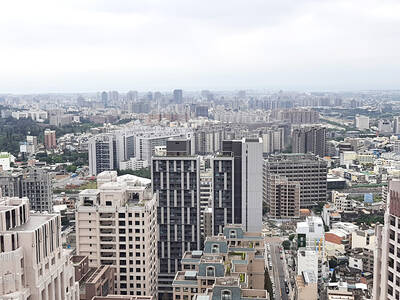
New apartments in Taiwan’s major cities are getting smaller, while old apartments are increasingly occupied by older people, many of whom live alone, government data showed. The phenomenon has to do with sharpening unaffordable property prices and an aging population, property brokers said. Apartments with one bedroom that are two years old or older have gained a noticeable presence in the nation’s six special municipalities as well as Hsinchu county and city in the past five years, Evertrust Rehouse Co (永慶房產集團) found, citing data from the government’s real-price transaction platform. In Taipei, apartments with one bedroom accounted for 19 percent of deals last

RECORD-BREAKING: TSMC’s net profit last quarter beat market expectations by expanding 8.9% and it was the best first-quarter profit in the chipmaker’s history Taiwan Semiconductor Manufacturing Co (TSMC, 台積電), which counts Nvidia Corp as a key customer, yesterday said that artificial intelligence (AI) server chip revenue is set to more than double this year from last year amid rising demand. The chipmaker expects the growth momentum to continue in the next five years with an annual compound growth rate of 50 percent, TSMC chief executive officer C.C. Wei (魏哲家) told investors yesterday. By 2028, AI chips’ contribution to revenue would climb to about 20 percent from a percentage in the low teens, Wei said. “Almost all the AI innovators are working with TSMC to address the


 RSS
RSS