


Despite vehement opposition from its labor union, the state-controlled Chunghwa Telecom Co (中華電信) yesterday auctioned off a 3 percent government stake, or 289.43 million shares, to domestic investors at a floor price of NT$56.3 (US$1.76) a share, injecting around NT$16.29 billion into the state's coffers.
The auction price represents a 7.71 percent discount on the company's closing share price yesterday and a 12.73 percent discount on the average share price over the last 10 days, company vice-president and spokesman Hank Wang (王漢朝) said.
Chunghwa shares closed 0.81 percent down at NT$61 on the Taiwan Stock Exchange. The telecom giant's average closing price over the last 10 days was NT$64.51.
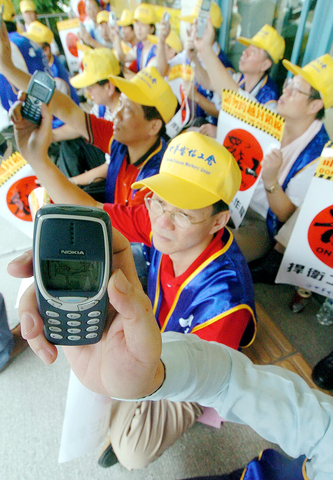
PHOTO: WANG MING-WEI, TAIPEI TIMES
"The discount [of 12.73 percent] is larger than expected and therefore buyers are getting a bigger benefit," Wang said. He was speaking at a press conference following the after-hours auction of the company's shares -- part of the government's privatization efforts.
The sizable discounts will not cause losses to the treasury and are within an acceptable range, Wang said.
The Ministry of Transportation and Communications, the company's biggest shareholder, originally expected to make NT$17.5 billion through the domestic sale.
According to Capital Securities Corp (群益證券), which managed the sale, 76.6 percent of the shares went to retail investors while institutional investors bought the rest.
Jonathan Liao (廖俊傑), an analyst with SinoPac Securities Corp (建華證券), said Chunghwa Telecom has finally stepped into the last phase of its long-winded privatization history. It will set an example for stimulating the government's plans of privatizing other state-controlled entities in the future, he said.
"To enhance the company's competitive edge by means of privatization, management cannot give in too much to the [labor] union, which would naturally resort to fierce protests to safeguard their interests," Liao said.
To protest the share sale, members of the Chunghwa Telecom Workers' Union (中華電信工會) staged strikes nationwide yesterday morning. Some employees gathering outside the main offices in northern, central and southern Taiwan chanted slogans and held posters accusing the government of illegally selling nearly 14 percent of the company's shares to overseas investors in the form of American Depositary Receipts (ADRs).
Union members swarmed into branches to interrupt operations and made phone calls en masse three times in an attempts to paralyze the telephone networks of the Executive Yuan, the Ministry of Transportation and Communications, and some of Chunghwa's operation units.
Company executives yesterday claimed that the union's strike action was under control and phone services remained normal.
"The rate of attendance [to work] reached a high point of 95 percent today [yesterday] and the strike has been carried on in a rational and peaceful mode," vice-president Chang Feng-hsiung (張豐雄) told a press briefing.
The directory service line (telephone number 104) was temporarily affected because of a personnel shortage but normal services resumed at noon yesterday, Chang said.
As the strike's smaller-than-expected turnout seemingly failed to catch management's attention, the union decided to step up its protests by starting a hunger strike at 5:30pm yesterday.
The hunger strike is expected to last for two to three days as the US Securities and Exchange Commission (SEC) may approve the company's application to sell ADRs soon, according to Chang.
"We believe that more than half of the company's employees are disgruntled about the government's illegal share sales overseas, but most of them dare not stand up to voice their indignation. We just want to present the truth," said Simon Chang (張緒中), a union leader.
The company refused to give details on any discounts offered for the ADR sale, citing confidentiality.
After the 14 percent government stake has been sold through ADRs, the ministry's stake in the company will be reduced from the current 65 percent to around 48 percent, turning Chunghwa Telecom into a private entity.

Taiwan Transport and Storage Corp (TTS, 台灣通運倉儲) yesterday unveiled its first electric tractor unit — manufactured by Volvo Trucks — in a ceremony in Taipei, and said the unit would soon be used to transport cement produced by Taiwan Cement Corp (TCC, 台灣水泥). Both TTS and TCC belong to TCC International Holdings Ltd (台泥國際集團). With the electric tractor unit, the Taipei-based cement firm would become the first in Taiwan to use electric vehicles to transport construction materials. TTS chairman Koo Kung-yi (辜公怡), Volvo Trucks vice president of sales and marketing Johan Selven, TCC president Roman Cheng (程耀輝) and Taikoo Motors Group

Among the rows of vibrators, rubber torsos and leather harnesses at a Chinese sex toys exhibition in Shanghai this weekend, the beginnings of an artificial intelligence (AI)-driven shift in the industry quietly pulsed. China manufactures about 70 percent of the world’s sex toys, most of it the “hardware” on display at the fair — whether that be technicolor tentacled dildos or hyper-realistic personalized silicone dolls. Yet smart toys have been rising in popularity for some time. Many major European and US brands already offer tech-enhanced products that can enable long-distance love, monitor well-being and even bring people one step closer to

RECORD-BREAKING: TSMC’s net profit last quarter beat market expectations by expanding 8.9% and it was the best first-quarter profit in the chipmaker’s history Taiwan Semiconductor Manufacturing Co (TSMC, 台積電), which counts Nvidia Corp as a key customer, yesterday said that artificial intelligence (AI) server chip revenue is set to more than double this year from last year amid rising demand. The chipmaker expects the growth momentum to continue in the next five years with an annual compound growth rate of 50 percent, TSMC chief executive officer C.C. Wei (魏哲家) told investors yesterday. By 2028, AI chips’ contribution to revenue would climb to about 20 percent from a percentage in the low teens, Wei said. “Almost all the AI innovators are working with TSMC to address the

Malaysia’s leader yesterday announced plans to build a massive semiconductor design park, aiming to boost the Southeast Asian nation’s role in the global chip industry. A prominent player in the semiconductor industry for decades, Malaysia accounts for an estimated 13 percent of global back-end manufacturing, according to German tech giant Bosch. Now it wants to go beyond production and emerge as a chip design powerhouse too, Malaysian Prime Minister Anwar Ibrahim said. “I am pleased to announce the largest IC (integrated circuit) Design Park in Southeast Asia, that will house world-class anchor tenants and collaborate with global companies such as Arm [Holdings PLC],”


 RSS
RSS