


Think of Hewlett-Packard as the technology world's version of the Hydra, the nine-headed, marsh-dwelling serpent of Greek mythology.
The company sells a dizzying array of products, including printers and personal computers, of course, but also photocopiers, plasma televisions, digital projectors, and a catalog of hardware and software products so thorough and arcane it would make the geeks running your average corporate computer center drool like Homer Simpson eyeing a doughnut.
For good measure, the company also sells its own operating system, HP-UX 11i, and what it calls a "printable tattoo," a decorative case to protect an Apple iPod music player from scuffs and scratches.
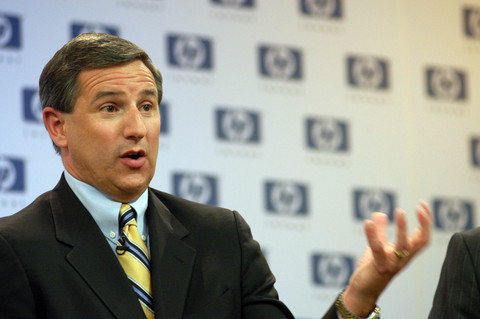
PHOTO: NY TIMES
Unwieldiness
This week, Mark Hurd took his first bold step as Hewlett's new chief executive, attacking its unwieldiness like a cold-hearted Hercules, when he announced that he would lay off nearly 10 percent of the company's employees over the next year and a half.
At the same time, Hurd declared the company would no longer offer a pension and shifted the responsibilities of its global sales team.
But for the moment, at least, he is ignoring those on Wall Street and in academia's ivory towers calling on the company to sell parts of itself, if not chop itself into more manageable pieces -- something to give focus to a company only loosely tied together by a jumble of marketing messages.
Steven Milunovich of Merrill Lynch might best be described as the resident crank among financial analysts following Hewlett-Packard.
Milunovich has found himself the de facto leader among a small band on Wall Street who are convinced that more drastic measures are needed, and soon.
This week's moves buy Hurd maybe six months.
By year's end, Milunovich said, he will once again start clamoring for the company to break itself into two -- ? his preferred solution -- unless Hurd unveils the kind of sweeping overhaul in strategy conspicuously absent from his pronouncements four months into the job.
"I have no doubt that HP will do a better job of executing under Mark," Milunovich said of Hurd.
"But it's our view that turning things around isn't just a matter of execution. We think the strategy is a problem as well," Milunovich added.
That view was echoed by any number of observers, including M. Eric Johnson, a management professor at Dartmouth's Tuck School of Business.
Johnson, who worked at Hewlett-Packard for several years starting in the late 1980s, is currently a part-time consultant to the company.
Preliminary step
"This is a good preliminary step," he said of this week's announcement. "But I don't see how anything we've heard so far is going to cause people to write a year from now, `Mr. Hurd has transformed HP.'"
Indeed, the entire layoff process will not be complete until November 2006.
The company estimates it will save US$1.6 billion annually on labor costs with an additional US$300 million in annual savings from reduced pension costs.
Inside Hewlett-Packard, executives talk a lot about synergies. The digital photos someone snaps with one of the company's cameras can be published on a Hewlett printer, uploaded to one of its personal computers or displayed on one of its plasma television screens.
The company also sells the top-end computers and data storage equipment corporations need to run their operations, as well as select software products and the services of consultants who can make the component parts work in harmony.
Hewlett executives argue that its presence in both the consumer and business markets helps them sell to corporate customers who recognize that the company's deep understanding of the consumer market is essential to their overall success. Others, however, are not so sure.
"Few companies are able to successfully compete simultaneously in so many different areas like HP is trying to do," said Andrew McAfee, an associate professor who teaches technology and operations management at the Harvard Business School.
"The fact that they're all computer-related doesn't change the fact that these really are different industries," he added.
"If this whole notion of synergies were super-valuable, then we'd see it show up in its results, but we don't," McAfee said. "It seems the market is speaking on this issue."
That it has. The company is doing a robust business in select areas, such as consulting services, but its computer storage business, once tops in the industry, has fallen on hard times, and its software division consistently loses money.
In May, when Hewlett released its most recent quarterly earnings report, Hurd acknowledged that even the company's printer business, its most consistently profitable unit, was suddenly an area of concern. The company next reports earnings on Aug. 16.
Dell, one of Hewlett's main competitors, sells a similarly long list of products, from plasma televisions to personal computers to the equipment corporations and large institutions need to run their data centers.
Marketing message
Yet McAfee and others note that Dell communicates a consistent marketing message that casts the company as a low-cost leader whose core strength is efficiently stamping out commodity technology goods.
Hewlett's other main rival, IBM, also sells an array of products, ranging from hardware to software to consulting services.
Yet IBM, recognizing that competing with Dell on price was a losing proposition, sold its personal computer unit last year. That allowed the company to focus exclusively on the corporate market and hone its message as a provider of premium services and products.
Hewlett's personal computer unit eked out US$210 million in profits in the fiscal year ending Oct. 30 on more than US$24 billion in sales.
"To us, HP's main challenge is right now they are neither fish nor fowl," said Frank Gillett, who is an analyst at Forrester Research, a computer industry research firm that is based in Cambridge, Massachusetts.
"They're neither a pure commodity technology supplier like Dell, nor a premium-based supplier like an IBM, Apple, or Sony, all companies they must compete with given their strategy," Gillett said.
"From our perspective, unlike any other player in the technology industry, HP is trying to satisfy both consumer and business with products that span from the commodity end of the spectrum to the premium end of the spectrum. They're stuck in the mushy middle," he added.
Hewlett-Packard's board stated before they hired Hurd that execution, and not the core strategy, was the reason they felt obliged to replace Carly Fiorina as chief executive.
"I came here to follow a path that said, `Let's focus on what we have, let's focus to make the company the best company we can make it,"' Hurd said in an interview earlier this week.
Sharper focus
Yet the president of Forrester Research, George Colony, who met last week with Hurd, is convinced that the company's new chief will impose a sharper focus on Hewlett when he unveils Phase 2 of his plans for the company.
The only reason he did not do so earlier this week, Colony said, is that he has not been there long enough to devise a new strategy.
"If I were a really smart guy who talked to the board about being CEO," said Mark Anderson, the editor of the influential technology newsletter The Strategic News Service, "and they told me don't change the strategy, I'd laugh at them. Except I wouldn't be able to laugh at them and get the job, so instead I'd be very quiet and then a few months later I'd announce my new strategy."
What that new strategy should be -- whether the company should sell its personal computer division, as some argue, or spin out its printer and imaging division, which accounts for about three-quarters of its profits, as Milunovich argues -- depends on whom you ask.
"If you had a few drinks with the guy," Colony said of Hurd, "I think even he'd tell you he doesn't know yet what the answer is."
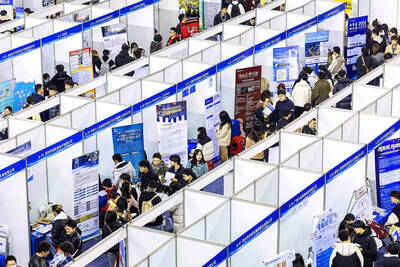
Stephen Garrett, a 27-year-old graduate student, always thought he would study in China, but first the country’s restrictive COVID-19 policies made it nearly impossible and now he has other concerns. The cost is one deterrent, but Garrett is more worried about restrictions on academic freedom and the personal risk of being stranded in China. He is not alone. Only about 700 American students are studying at Chinese universities, down from a peak of nearly 25,000 a decade ago, while there are nearly 300,000 Chinese students at US schools. Some young Americans are discouraged from investing their time in China by what they see

Taiwan Transport and Storage Corp (TTS, 台灣通運倉儲) yesterday unveiled its first electric tractor unit — manufactured by Volvo Trucks — in a ceremony in Taipei, and said the unit would soon be used to transport cement produced by Taiwan Cement Corp (TCC, 台灣水泥). Both TTS and TCC belong to TCC International Holdings Ltd (台泥國際集團). With the electric tractor unit, the Taipei-based cement firm would become the first in Taiwan to use electric vehicles to transport construction materials. TTS chairman Koo Kung-yi (辜公怡), Volvo Trucks vice president of sales and marketing Johan Selven, TCC president Roman Cheng (程耀輝) and Taikoo Motors Group

MAJOR DROP: CEO Tim Cook, who is visiting Hanoi, pledged the firm was committed to Vietnam after its smartphone shipments declined 9.6% annually in the first quarter Apple Inc yesterday said it would increase spending on suppliers in Vietnam, a key production hub, as CEO Tim Cook arrived in the country for a two-day visit. The iPhone maker announced the news in a statement on its Web site, but gave no details of how much it would spend or where the money would go. Cook is expected to meet programmers, content creators and students during his visit, online newspaper VnExpress reported. The visit comes as US President Joe Biden’s administration seeks to ramp up Vietnam’s role in the global tech supply chain to reduce the US’ dependence on China. Images on

New apartments in Taiwan’s major cities are getting smaller, while old apartments are increasingly occupied by older people, many of whom live alone, government data showed. The phenomenon has to do with sharpening unaffordable property prices and an aging population, property brokers said. Apartments with one bedroom that are two years old or older have gained a noticeable presence in the nation’s six special municipalities as well as Hsinchu county and city in the past five years, Evertrust Rehouse Co (永慶房產集團) found, citing data from the government’s real-price transaction platform. In Taipei, apartments with one bedroom accounted for 19 percent of deals last


 RSS
RSS