


The New Taiwan dollar saw its biggest gain in four years yesterday after China on Thursday evening unexpectedly revalued the yuan, which had been pegged to the US dollar for a decade.
Joining other Asian currencies that advanced in response to the yuan revaluation, the NT dollar gained NT$0.305, or 0.96 percent, to close at NT$31.648 against the greenback on the Taipei foreign-exchange market yesterday. This rate is the NT dollar's highest close since July 1, when the currency climbed to NT$31.644 against the US dollar.
Turnover grew to US$1.185 billion amid hectic trading, surging by 61.1 percent from US$735.5 million the previous day.

PHOTO: CHIEN JUNG-FONG, TAIPEI TIMES
The local currency opened at NT$31.70 versus its US counterpart and climbed to a high of NT$31.55 in the morning session, which later triggered intervention from the nation's central bank to cap the currency's rise, according to traders.
The central bank bought US dollars at around NT$31.50 via oil-importing firms, Reuters reported, citing traders.
"Unlike the yuan, the exchange rate of the NT dollar should be determined by the market," said George Chou (
"We will hold on to the rule and make some adjustments that allow the currency to reflect fundamental economic conditions," he said.
The NT dollar's rise came after the People's Bank of China announced on Thursday night that it was scrapping the yuan peg to the US dollar and setting the Chinese unit against a trade-weighted basket of currencies, although it did not reveal what these currencies were. The currency was fixed at 8.11 yuan to the US dollar compared to the old rate of 8.2765 yuan, effectively a 2 percent revaluation.
Local analysts said yesterday they don't expect the NT dollar to continue its gains in the long term.
"I don't think the local currency will keep going up," said Calvin Chen (
"The NT dollar has no ground to appreciate as a strong currency like the yuan due to Taiwan's weakening exports and economic growth," Chen said.
Taiwan saw a trade deficit last month as high prices for oil and raw materials weighed on exports. Exports grew 3.1 percent to US$14.88 billion last month, while imports rose 2.5 percent to US$15 billion last month from a year ago, the slowest pace since June 2003 and August 2003 respectively, according to the latest report released by the Ministry of Finance.
As a result, the government and various research institutions have been lowering their GDP forecasts for the export-dependent local economy, with the lowest prediction of 3.63 percent made by the statistics bureau, and the highest of 3.8 percent by the Chung-Hua Institution for Economic Research (CIER,
Under the circumstances, the central bank is likely to keep the NT dollar at low levels to limit the impact on the nation's economic growth.
The strong advance of the NT dollar yesterday will not have much of an impact on local manufacturers, as the exchange rate is close to its level at the end of last month, Minister of Economic Affairs Ho Mei-yueh (何美玥) said.
Taiwanese exporters will not fall behind competitors in neighboring countries as a result of the local currency's appreciation, as the yuan revaluation boosted all Asian currencies, Ho said.
The adjustment's small range will not hurt the large number of Taiwanese businesses in China, because most of them have taken precautions as a result of the extended period in which calls were made to float the yuan, she said.
But if the yuan continues to rise in a range between 4 percent and 7 percent by the end of the year, as foreign analysts have predicted, Taiwanese manufacturers in China will need to spend more on labor and raw materials, while earning less from exports, said Chou Ji (
The appreciation may hurt Taiwanese exports, especially to China, the nation's largest trading partner, if a revalued yuan limits companies' spending power, Chou said.
Stephen Garrett, a 27-year-old graduate student, always thought he would study in China, but first the country’s restrictive COVID-19 policies made it nearly impossible and now he has other concerns. The cost is one deterrent, but Garrett is more worried about restrictions on academic freedom and the personal risk of being stranded in China. He is not alone. Only about 700 American students are studying at Chinese universities, down from a peak of nearly 25,000 a decade ago, while there are nearly 300,000 Chinese students at US schools. Some young Americans are discouraged from investing their time in China by what they see

Taiwan Transport and Storage Corp (TTS, 台灣通運倉儲) yesterday unveiled its first electric tractor unit — manufactured by Volvo Trucks — in a ceremony in Taipei, and said the unit would soon be used to transport cement produced by Taiwan Cement Corp (TCC, 台灣水泥). Both TTS and TCC belong to TCC International Holdings Ltd (台泥國際集團). With the electric tractor unit, the Taipei-based cement firm would become the first in Taiwan to use electric vehicles to transport construction materials. TTS chairman Koo Kung-yi (辜公怡), Volvo Trucks vice president of sales and marketing Johan Selven, TCC president Roman Cheng (程耀輝) and Taikoo Motors Group

MAJOR DROP: CEO Tim Cook, who is visiting Hanoi, pledged the firm was committed to Vietnam after its smartphone shipments declined 9.6% annually in the first quarter Apple Inc yesterday said it would increase spending on suppliers in Vietnam, a key production hub, as CEO Tim Cook arrived in the country for a two-day visit. The iPhone maker announced the news in a statement on its Web site, but gave no details of how much it would spend or where the money would go. Cook is expected to meet programmers, content creators and students during his visit, online newspaper VnExpress reported. The visit comes as US President Joe Biden’s administration seeks to ramp up Vietnam’s role in the global tech supply chain to reduce the US’ dependence on China. Images on
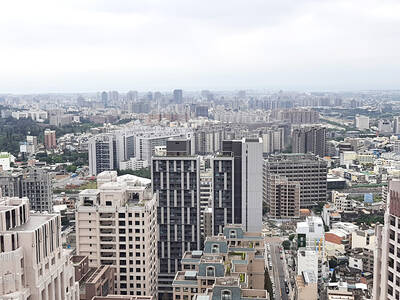
New apartments in Taiwan’s major cities are getting smaller, while old apartments are increasingly occupied by older people, many of whom live alone, government data showed. The phenomenon has to do with sharpening unaffordable property prices and an aging population, property brokers said. Apartments with one bedroom that are two years old or older have gained a noticeable presence in the nation’s six special municipalities as well as Hsinchu county and city in the past five years, Evertrust Rehouse Co (永慶房產集團) found, citing data from the government’s real-price transaction platform. In Taipei, apartments with one bedroom accounted for 19 percent of deals last


 RSS
RSS