


Motorola Inc, the world's second-largest manufacturer of mobile phones, yesterday announced a management reshuffle in Taiwan and China as part of the US handset vendor's strategies to focus on the fast-growing Asia-Pacific region.
During a press briefing in Taipei yesterday, Simon Leung (梁念堅), regional president for the Asia-Pacific, said that Tom Sun (孫大明), president of Motorola Electronics Taiwan Ltd, will be stationed in Beijing as of next month as the company's chief representative in China.
Sun will be the first to fill this position, which Motorola created to spearhead is plans to tap into China's massive handset market. He will have to report to Kao Ruey-bin (
Sun's vacancy will be filled by Tom Hsiao (
"The new leadership structure underlines our increasing emphasis on the Asia-Pacific, where half of the world's population lives, and the emerging markets of China, India and Indonesia will provide the most growth momentum," Leung said.
According to a Bloomberg report earlier this month citing market researcher Gartner Inc, Motorola, which sold more mobile phones in China than any other company from 1999 to 2001, saw its market share fall to 12.1 percent last year, putting it in the second place behind Nokia Oyj, the world's No.1 handset maker. Motorola's market share was about 20 percent in 2002.
"In China, around 4 million new customers sign up for mobile services every month, and its handset replacement market is also huge," said Sun, who led the initiatives to establish two research-and-development centers during his eight-year service in Taiwan.
China is the world's largest mobile-phone market by users, with 358.5 million subscribers at the end of May, 19 percent more than a year earlier.
By relocating Sun to China, Motorola plans to rely on his rich experience and networks built up in Taiwan to further extend the company's close cooperation with local partners, including Hon Hai Precision Industry Co (
However, rumors have long circulated that Motorola might shift more outsourcing orders to Foxconn International Holdings Inc (富士康), a unit of Hon Hai, threatening Compal Communications' profits. Compal Communications, a handset-manufacturing subsidiary of laptop computer maker Compal Electronics Inc (仁寶電腦), makes 80 percent of its sales by supplying handsets to Motorola.
Leung declined to comment on the widespread speculation.
"We'll work closely with our many partners in Taiwan and further push up our market share, revenues and shipments," he said.
Hsiao, who has worked at Motorola for 14 years, said he will prioritize the integration of resources in the company's four business divisions, namely connected home solutions, government and enterprise mobility solutions, mobile devices and networks.
"Our goal is to create value-added services to further expand our market share," Hsiao said, refusing to provide any detailed figures about the company's prospects.
Motorola handsets accounted for nearly 22 percent of the domestic market by the end of last year, outperforming the runner-up by about 5 percentage points, he said.
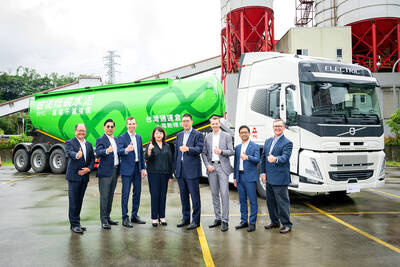
Taiwan Transport and Storage Corp (TTS, 台灣通運倉儲) yesterday unveiled its first electric tractor unit — manufactured by Volvo Trucks — in a ceremony in Taipei, and said the unit would soon be used to transport cement produced by Taiwan Cement Corp (TCC, 台灣水泥). Both TTS and TCC belong to TCC International Holdings Ltd (台泥國際集團). With the electric tractor unit, the Taipei-based cement firm would become the first in Taiwan to use electric vehicles to transport construction materials. TTS chairman Koo Kung-yi (辜公怡), Volvo Trucks vice president of sales and marketing Johan Selven, TCC president Roman Cheng (程耀輝) and Taikoo Motors Group

Among the rows of vibrators, rubber torsos and leather harnesses at a Chinese sex toys exhibition in Shanghai this weekend, the beginnings of an artificial intelligence (AI)-driven shift in the industry quietly pulsed. China manufactures about 70 percent of the world’s sex toys, most of it the “hardware” on display at the fair — whether that be technicolor tentacled dildos or hyper-realistic personalized silicone dolls. Yet smart toys have been rising in popularity for some time. Many major European and US brands already offer tech-enhanced products that can enable long-distance love, monitor well-being and even bring people one step closer to
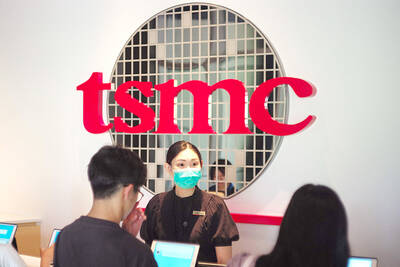
RECORD-BREAKING: TSMC’s net profit last quarter beat market expectations by expanding 8.9% and it was the best first-quarter profit in the chipmaker’s history Taiwan Semiconductor Manufacturing Co (TSMC, 台積電), which counts Nvidia Corp as a key customer, yesterday said that artificial intelligence (AI) server chip revenue is set to more than double this year from last year amid rising demand. The chipmaker expects the growth momentum to continue in the next five years with an annual compound growth rate of 50 percent, TSMC chief executive officer C.C. Wei (魏哲家) told investors yesterday. By 2028, AI chips’ contribution to revenue would climb to about 20 percent from a percentage in the low teens, Wei said. “Almost all the AI innovators are working with TSMC to address the
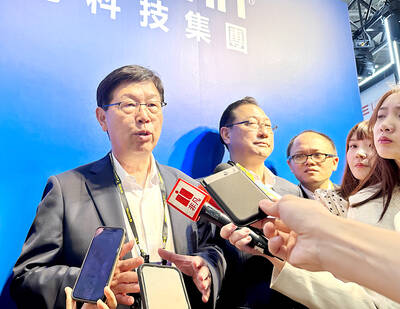
FUTURE PLANS: Although the electric vehicle market is getting more competitive, Hon Hai would stick to its goal of seizing a 5 percent share globally, Young Liu said Hon Hai Precision Industry Co (鴻海精密), a major iPhone assembler and supplier of artificial intelligence (AI) servers powered by Nvidia Corp’s chips, yesterday said it has introduced a rotating chief executive structure as part of the company’s efforts to cultivate future leaders and to enhance corporate governance. The 50-year-old contract electronics maker reported sizable revenue of NT$6.16 trillion (US$189.67 billion) last year. Hon Hai, also known as Foxconn Technology Group (富士康科技集團), has been under the control of one man almost since its inception. A rotating CEO system is a rarity among Taiwanese businesses. Hon Hai has given leaders of the company’s six


 RSS
RSS