


Fifteen years ago Saigon South was all marshland and paddy fields, worked by peasant farmers. But years of runaway growth have led to a remarkable transformation.
The area is now a fashionable district, resembling a neat US suburb, in Ho Chi Minh City, southern Vietnam's business capital, once called Saigon.
Alongside tree-lined avenues are the latest designs in apartment blocks, boutiques and luxury villas, albeit some built to garish tastes. Shopping complexes and a high technology park are leaving the drawing boards.
Saigon South is a fashionable area, said Kim, a 40-year-old businesswoman who declined to give her family name.
"For expatriates, especially South Koreans [who are present in large numbers in Vietnam], and for local yuppies and the young-at-heart, who have stable and good incomes," she said.
Kim gave up her house close to the airport in March and bought another featuring three rooms and a small garden in Saigon South.
"It's close to the city center and the prices are reasonable. It's a quiet neighborhood and a security guard keeps watch," she said.
Her husband found the essential requisites for well-heeled residents -- tennis courts and a golf course.
Promoted by Taiwanese developer Central Trading and Development Group (中央貿易開發), Saigon South covers 3,100 hectares and stands in contrast to the chaotic development elsewhere in Ho Chi Minh City.
The city's population has swollen from 500,000 in the 1940s to 3.5 million in 1975 -- when the Vietnam War ended -- and to the current seven million. But the growth has been supported by no planned development.
Between 1994 and 1997, it fattened further and witnessed an influx of foreign investors enamored by the prospect of another emerging Asian Tiger as the Communist government moved from a central planned to a more market oriented economy.
The city's property market bore an El Dorado air.
"But with the Asian financial crisis, the city experienced a recession between 1997 and 2000," said Mark Townsend, CB Richard Ellis Vietnam's managing director.
And like other major cities in Asia, Townsend said Ho Chi Minh was lined with unfinished buildings.
The crisis passed and by 2000 another round of growth began.
In the city center, luxury buildings are mushrooming at US$20 a square meter, much higher than in Bangkok.
"Residential districts have come up to the northwest and southwest of the city," said Pierre-Jean Malgouyres, deputy general manager of Archetype, a firm of architects and engineers.
"It's an often anarchic urbanization," he said, warning of serious problems for water treatment and waste disposal.
Ho Chi Minh City's planning and investment department acknowledges the problem, declaring recently on its Web site that the city "suffers from a worrying environmental deterioration."
Ho Chi Minh City is congested and polluted to near choking point but the authorities have not abandoned their ambition of making it a major city in the region.
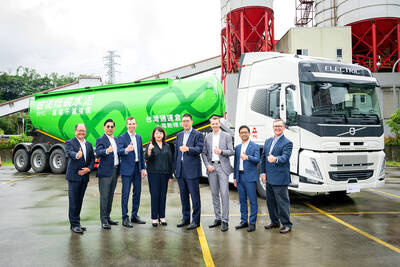
Taiwan Transport and Storage Corp (TTS, 台灣通運倉儲) yesterday unveiled its first electric tractor unit — manufactured by Volvo Trucks — in a ceremony in Taipei, and said the unit would soon be used to transport cement produced by Taiwan Cement Corp (TCC, 台灣水泥). Both TTS and TCC belong to TCC International Holdings Ltd (台泥國際集團). With the electric tractor unit, the Taipei-based cement firm would become the first in Taiwan to use electric vehicles to transport construction materials. TTS chairman Koo Kung-yi (辜公怡), Volvo Trucks vice president of sales and marketing Johan Selven, TCC president Roman Cheng (程耀輝) and Taikoo Motors Group

Among the rows of vibrators, rubber torsos and leather harnesses at a Chinese sex toys exhibition in Shanghai this weekend, the beginnings of an artificial intelligence (AI)-driven shift in the industry quietly pulsed. China manufactures about 70 percent of the world’s sex toys, most of it the “hardware” on display at the fair — whether that be technicolor tentacled dildos or hyper-realistic personalized silicone dolls. Yet smart toys have been rising in popularity for some time. Many major European and US brands already offer tech-enhanced products that can enable long-distance love, monitor well-being and even bring people one step closer to
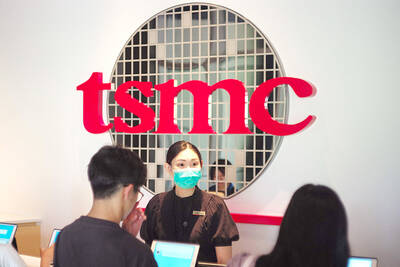
RECORD-BREAKING: TSMC’s net profit last quarter beat market expectations by expanding 8.9% and it was the best first-quarter profit in the chipmaker’s history Taiwan Semiconductor Manufacturing Co (TSMC, 台積電), which counts Nvidia Corp as a key customer, yesterday said that artificial intelligence (AI) server chip revenue is set to more than double this year from last year amid rising demand. The chipmaker expects the growth momentum to continue in the next five years with an annual compound growth rate of 50 percent, TSMC chief executive officer C.C. Wei (魏哲家) told investors yesterday. By 2028, AI chips’ contribution to revenue would climb to about 20 percent from a percentage in the low teens, Wei said. “Almost all the AI innovators are working with TSMC to address the

Malaysia’s leader yesterday announced plans to build a massive semiconductor design park, aiming to boost the Southeast Asian nation’s role in the global chip industry. A prominent player in the semiconductor industry for decades, Malaysia accounts for an estimated 13 percent of global back-end manufacturing, according to German tech giant Bosch. Now it wants to go beyond production and emerge as a chip design powerhouse too, Malaysian Prime Minister Anwar Ibrahim said. “I am pleased to announce the largest IC (integrated circuit) Design Park in Southeast Asia, that will house world-class anchor tenants and collaborate with global companies such as Arm [Holdings PLC],”


 RSS
RSS