


After four years of bailing out banks in the nation's crowded financial sector, the government's Financial Restructuring Fund (
Since the fund's establishment in July 2001 with an initial amount of NT$140 billion (US$4.4 billion), it has allocated NT$90 billion to rescue 47 struggling institutions.
In late May, the legislature passed the amendments to the Resolution Trust Committee Fund Regulatory Provisions (
The Financial Supervisory Commission has said that the additional money will help save the beleaguered Chung Shing Bank (
The NT$110 billion capital will come from a two-percent business tax on financial institutions that will be extended to 2010, based on the new rules.
Some have questioned whether the expiration of the RTC fund will dent investor confidence or hamper efforts to streamline the nation's financial services sector.
But Taiwan Ratings Corp (
"Taiwan's stable economic environment and the revitalized banking industry will also help mitigate any loss in investor confidence related to the exit of the RTC," Taiwan Ratings said in a report released last week.
Financial regulators have emphasized that the RTC fund was only a temporary, expedient measure and that such a fund easily gives rise to a moral hazard problem, since institutions and customers take more risks than otherwise if they know they will be bailed out in the event of bankruptcy.
Regulators have now replaced the fund's blanket guarantee with more limited protection. The public's deposits in banking institutions will now enjoy a maximum compensation of NT$1 million per bank account, instead of full-amount settlement, if the institutions go bankrupt.
The protection only applies to those banks which participate in the Central Deposit Insurance Corp's (CDIC, 中央存保) system.
The CDIC will now take over the RTC fund's role of dealing with the nation's problematic financial institutions.
As of the end of April, CDIC-guaranteed deposits accounted for 45 percent of overall deposits, the report said.
"The return to a limited-coverage deposit insurance system from a blanket guarantee system is likely to force depositors to more carefully consider risk factors when evaluating deposit products," thereby helping the market mechanism return to normal, the ratings agency analyzed.
According to financial regulators, CDIC has improved the deposit insurance mechanism by drawing on the experience of advanced countries, with key points including prompt corrective action, the promotion of public disclosure of information and an accelerated accumulation of a deposit insurance reserves fund.
In addition to the CDIC, other informal support mechanisms will remain in place to help stabilize the financial markets, Taiwan Ratings said in its report, adding that the nation's financial holdings companies also play a role as informal system stabilizers.
There are currently 14 financial holding companies nationwide.
With their stronger financial mechanisms, these financial holdings groups are capable of incorporating or merging poorly performing players to enhance their market share, as proven recently by E.Sun Financial Holding Co (玉山金控), which took over the Kaohsiung Business Bank (高雄企銀) and Chinatrust Financial Holding Co (中信金控), which acquired Fengshan Credit Cooperatives (鳳山信用合作社).
Taiwan Ratings, however, pointed out that the government's unpredictable behavior poses a risk, since the state may continue to intervene in the markets in order to stabilize the banking sector.
The government will need to strike a balance between stabilizing and reforming the banking industry, it said.
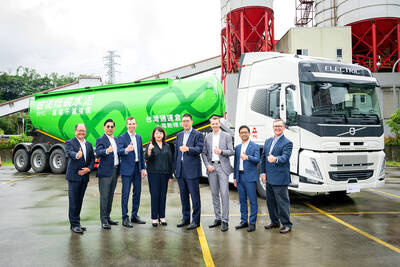
Taiwan Transport and Storage Corp (TTS, 台灣通運倉儲) yesterday unveiled its first electric tractor unit — manufactured by Volvo Trucks — in a ceremony in Taipei, and said the unit would soon be used to transport cement produced by Taiwan Cement Corp (TCC, 台灣水泥). Both TTS and TCC belong to TCC International Holdings Ltd (台泥國際集團). With the electric tractor unit, the Taipei-based cement firm would become the first in Taiwan to use electric vehicles to transport construction materials. TTS chairman Koo Kung-yi (辜公怡), Volvo Trucks vice president of sales and marketing Johan Selven, TCC president Roman Cheng (程耀輝) and Taikoo Motors Group

Among the rows of vibrators, rubber torsos and leather harnesses at a Chinese sex toys exhibition in Shanghai this weekend, the beginnings of an artificial intelligence (AI)-driven shift in the industry quietly pulsed. China manufactures about 70 percent of the world’s sex toys, most of it the “hardware” on display at the fair — whether that be technicolor tentacled dildos or hyper-realistic personalized silicone dolls. Yet smart toys have been rising in popularity for some time. Many major European and US brands already offer tech-enhanced products that can enable long-distance love, monitor well-being and even bring people one step closer to

RECORD-BREAKING: TSMC’s net profit last quarter beat market expectations by expanding 8.9% and it was the best first-quarter profit in the chipmaker’s history Taiwan Semiconductor Manufacturing Co (TSMC, 台積電), which counts Nvidia Corp as a key customer, yesterday said that artificial intelligence (AI) server chip revenue is set to more than double this year from last year amid rising demand. The chipmaker expects the growth momentum to continue in the next five years with an annual compound growth rate of 50 percent, TSMC chief executive officer C.C. Wei (魏哲家) told investors yesterday. By 2028, AI chips’ contribution to revenue would climb to about 20 percent from a percentage in the low teens, Wei said. “Almost all the AI innovators are working with TSMC to address the
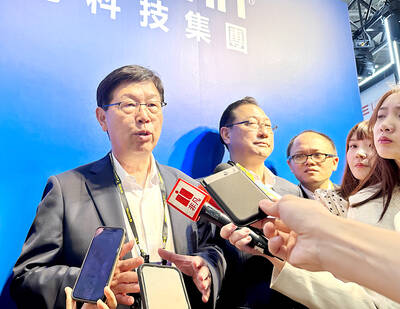
FUTURE PLANS: Although the electric vehicle market is getting more competitive, Hon Hai would stick to its goal of seizing a 5 percent share globally, Young Liu said Hon Hai Precision Industry Co (鴻海精密), a major iPhone assembler and supplier of artificial intelligence (AI) servers powered by Nvidia Corp’s chips, yesterday said it has introduced a rotating chief executive structure as part of the company’s efforts to cultivate future leaders and to enhance corporate governance. The 50-year-old contract electronics maker reported sizable revenue of NT$6.16 trillion (US$189.67 billion) last year. Hon Hai, also known as Foxconn Technology Group (富士康科技集團), has been under the control of one man almost since its inception. A rotating CEO system is a rarity among Taiwanese businesses. Hon Hai has given leaders of the company’s six


 RSS
RSS