


Wall Street was able to look past the horrific attacks in London and post solid gains over the past week as investors grew more confident on the economic outlook for the rest of the year.
But a budding summer rally faces a new test in the coming week with the first wave of corporate earnings reports for the second quarter.
The Dow Jones Industrial Average climbed 1.4 percent in the week to Friday to end at 10,449.14 while the Standard and Poor's 500 broad-market index got back to its starting level for this year, rising 1.46 percent to 1,211.86.
The tech-heavy NASDAQ index rose to its highest level since January 3, with a rally of 2.7 percent to 2,112.88.
Markets were jolted by Thursday's deadly attacks in central London that brought back memories of the Madrid bombings last year and the Sept. 11, 2001 attacks in New York and Washington.
But financial markets, having seen similar events in the past, showed resilience. Wall Street struggled higher the day of the attacks and then rallied the next day as a softer-than-expected report on US payroll growth suggested steady if less than spectacular growth.
"There are many explanations, but it is still hard to explain. The markets have been worried for years about another terrorist attack and yet when one comes, the stock market ends higher on the day," said Dick Green at Briefing.com.
"This may be due to the fact that there is already a large risk premium in the market because of terrorist concerns ... There may not be a clear cut explanation. But the response to the London attacks does show that there is good underlying demand for stocks," he said.
"There were plenty of investors and traders looking to take advantage of the opportunity of the lower open on expectations of a quick rebound," Green said.
Craig Alexander, chief economist at TD Bank Financial, said the US economy remains solid and sees no major impact from the London bombings.
"The US economy is on track to deliver a close to 3.5 per cent annualized gain in the second quarter," he said. "And, with the strength evident in the final month of the quarter, it looks like there will be a healthy kick off to the third quarter."
The big rally of the week was sparked by a payrolls report that seemed unimpressive at first -- 146,000 new jobs were created in June, well below market expectations and the second disappointing report in a row.
Yet some said the data suggest a moderate pace of growth that will not ignite inflation and may allow the Federal Reserve to ease up on its rate-boosting cycle -- the so-called "Goldilocks" economy that is neither too hot nor too cold.
"The US economy's performance may once again start inspiring the Goldilocks metaphor, with growth and hiring both running at a pace that is nearly just right for the Fed," said Leslie Preston, economist at CIBC World Markets.
"So far this year the US economy has generated an average of 180,000 jobs per month, just over the average growth of the workforce, and produced little inflation pressure as growth runs around 3.5 percent, suggesting that the Fed's tightening campaign has just about run its course."
Looking ahead, the markets get a slew of earnings data including from General Electric. Analysts expect overall earnings to grow at a modest pace of 7.5 percent.
Bonds fell as investors bet on a stronger economy and shifted to equities.
The yield on the 10-year US Treasury bond rose to 4.109 percent from 4.049 percent a week earlier while that on the 30-year bond climbed to 4.361 percent from 4.298 percent. Bond yields and prices move in opposite directions.
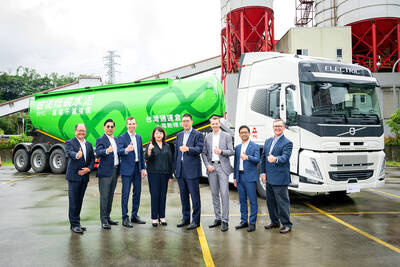
Taiwan Transport and Storage Corp (TTS, 台灣通運倉儲) yesterday unveiled its first electric tractor unit — manufactured by Volvo Trucks — in a ceremony in Taipei, and said the unit would soon be used to transport cement produced by Taiwan Cement Corp (TCC, 台灣水泥). Both TTS and TCC belong to TCC International Holdings Ltd (台泥國際集團). With the electric tractor unit, the Taipei-based cement firm would become the first in Taiwan to use electric vehicles to transport construction materials. TTS chairman Koo Kung-yi (辜公怡), Volvo Trucks vice president of sales and marketing Johan Selven, TCC president Roman Cheng (程耀輝) and Taikoo Motors Group

Among the rows of vibrators, rubber torsos and leather harnesses at a Chinese sex toys exhibition in Shanghai this weekend, the beginnings of an artificial intelligence (AI)-driven shift in the industry quietly pulsed. China manufactures about 70 percent of the world’s sex toys, most of it the “hardware” on display at the fair — whether that be technicolor tentacled dildos or hyper-realistic personalized silicone dolls. Yet smart toys have been rising in popularity for some time. Many major European and US brands already offer tech-enhanced products that can enable long-distance love, monitor well-being and even bring people one step closer to
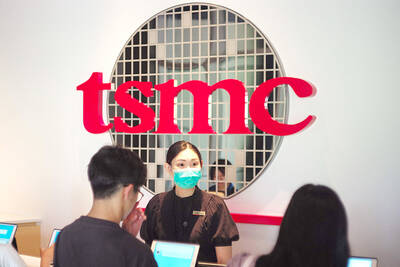
RECORD-BREAKING: TSMC’s net profit last quarter beat market expectations by expanding 8.9% and it was the best first-quarter profit in the chipmaker’s history Taiwan Semiconductor Manufacturing Co (TSMC, 台積電), which counts Nvidia Corp as a key customer, yesterday said that artificial intelligence (AI) server chip revenue is set to more than double this year from last year amid rising demand. The chipmaker expects the growth momentum to continue in the next five years with an annual compound growth rate of 50 percent, TSMC chief executive officer C.C. Wei (魏哲家) told investors yesterday. By 2028, AI chips’ contribution to revenue would climb to about 20 percent from a percentage in the low teens, Wei said. “Almost all the AI innovators are working with TSMC to address the

Malaysia’s leader yesterday announced plans to build a massive semiconductor design park, aiming to boost the Southeast Asian nation’s role in the global chip industry. A prominent player in the semiconductor industry for decades, Malaysia accounts for an estimated 13 percent of global back-end manufacturing, according to German tech giant Bosch. Now it wants to go beyond production and emerge as a chip design powerhouse too, Malaysian Prime Minister Anwar Ibrahim said. “I am pleased to announce the largest IC (integrated circuit) Design Park in Southeast Asia, that will house world-class anchor tenants and collaborate with global companies such as Arm [Holdings PLC],”


 RSS
RSS