


Nuclear power plants, shunned since the meltdown at Three Mile Island and the disaster at Chernobyl, may make a comeback in Europe and the US as companies and governments try to reduce record energy costs and pollution.
Finland is building the first nuclear plant in Europe approved since 1986, and France plans a new US$3.6 billion reactor.
NuStart LLC, a group of utilities including New Orleans-based Entergy Corp and Constellation Energy Group, last month said it expects to select two sites by October for the first US nuclear power stations in 30 years.
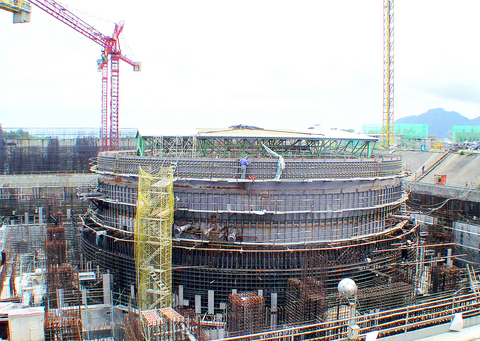
PHOTO: HUANG LI-HSIANG, TAIPEI TIMES
More than US$200 billion will be spent on nuclear power by 2030, according to the Paris-based International Energy Agency, an adviser to 26 of the world's largest energy users. A surge in oil to a record above US$59 a barrel and concern that the carbon dioxide released by burning fossil fuels leads to global warming are driving the revival.
US President George W. Bush in April said he wants to expedite the licensing of new reactors. UK Prime Minister Tony Blair may decide next year whether to replace the nation's aging nuclear plants. Even Ukraine, where the 1986 Chernobyl blast killed 31, the world's worst nuclear disaster to date, sees nuclear energy as a way to break a reliance on Russia for oil.
"Since Ukraine has uranium and zirconium fields, we should be concentrating on developing nuclear energy domestically," Prime Minister Yulia Timoshenko said last week in Kiev.
Globally, there are 440 nuclear power plants, and 24 are under construction, according to the International Atomic Energy Agency in Vienna. Any new power plants need government approvals, and in some countries, such as Switzerland, voter referendums can block such plans. In Taiwan, a US$7 billion reactor now being built and planned to start next year may not be switched on, should public concern about the project's safety persist, Minister of Economic Affairs Ho Mei-yueh (
Investors are betting on nuclear. Uranium prices have jumped 62 percent in the past year, partly driven by hedge fund purchases in a bet on growth in atomic energy, said Gerald Grandey, chief executive of Saskatoon, Canada-based Cameco Corp, the world's biggest uranium producer, in Vienna this week.
The price of uranium, used to fuel nuclear reactors, rose to US$29 per pound this month from US$17.90 a year ago, according to the Metal Bulletin's Uranium Nuexco Restricted Post Price.
`Dirty and Dangerous'
Companies that would benefit from a new round of construction include General Electric Co, Munich-based Siemens AG and Areva SA of France, which build the reactors, and Essen, Germany-based RWE AG and Dusseldorf-based E.ON AG, which operate nuclear plants that have to close under current plans.
In Western Europe and the US, approvals ground to a halt after the Chernobyl explosion in Ukraine sent radiation as far away as Sweden. Death rates among the more than half a million workers who participated in the cleanup operation soared, and thyroid cancer rates in Gomel, Belarus, increased 22-fold from 1986 through 1990.
The Three Mile Island meltdown in Middletown, Pennsylvania, in 1979 was the most serious US nuclear incident. The accident caused "negligible" harm to people and the environment but led to "fear and mistrust" of the industry and the government, according to a US Nuclear Regulatory Commission fact sheet.
Environmentalists including Greenpeace and Friends of the Earth oppose nuclear energy for being "dirty and dangerous." Nuclear waste "has no solution" and will "threaten ourselves and future generations for millions of years into the future. It carries with it the inherent risk of a catastrophic nuclear accident, spreading radioactive contamination far and wide. It routinely discharges nuclear waste into the environment, threatening the health of those in the vicinity."
Greenpeace also says on its Web site that "money spent on subsidizing nuclear stations will suppress the emergence of new, clean renewable technologies."
Radioactive Waste
The single biggest issue is storage of nuclear waste, according to the International Energy Agency. Nuclear stations have to store the spent uranium and plutonium fuels under water for months because they are radioactive. Any spillage of the waste could lead to cancer if ingested by humans, according to Greenpeace. The US and the UK are still deliberating how to dispose of nuclear waste.
Asian countries including China, India, South Korea and Japan are leading the global nuclear construction program, using technology supplied by Areva and GE, as well as Westinghouse, a unit of British Nuclear Fuels, owned by the UK government.
The French reactor is being planned by Electricite de France, Europe's largest utility, and Enel SpA in Rome. The Finnish plant's investors include Espoo, Finland-based Fortum Oyj. Suez SA of France and E.ON are also considering joining EDF.
In the US, Bush called for more reactors.
"There is a growing consensus that more nuclear power will lead to a cleaner, safer nation," Bush said on June 22 at the Calvert Cliffs Nuclear Power Plant, owned by Constellation Energy Group. "It is time for this country to start building nuclear power plants again."
The Tennessee Valley Authority, the largest public power company in the US, plans to restart its 1,200-megawatt Browns Ferry 1 reactor by 2007, 22 years after it was shut down, said Nils Diaz, chairman of the US Nuclear Regulatory Commission.
The authority idled the reactor in northern Alabama in 1985 because its physical layout didn't match architectural drawings. Restarting Browns Ferry 1 will cost about US$1.8 billion. New plants may be built within six years, Senate Energy Committee Chairman Pete Domenici, a New Mexico Republican, said in April.
Nuclear plants may contribute about 200 gigawatts of the 4,800 gigawatts of new capacity needed until 2030, according to the IEA. European countries will add more than 40 gigawatts of nuclear capacity by 2030, the IEA said.
Nuclear capacity will increase in Asia to 8 percent of the region's total in 10 years, from 5 percent now. China, the world's second-largest electricity consumer after the US, plans to add about 30 gigawatts of nuclear generation by 2030, while Russia could add another 22 gigawatts. Korea may add 17 gigawatts and Japan about 14 gigawatts, according to the IEA.
The new nuclear stations and an extended life of the present ones will offset the closure of aging plants to keep the share of nuclear energy in the global power capacity mix at 12 percent in a decade, according to estimates from PricewaterhouseCoopers.
Germany, whose parliament voted to shut down its nuclear plants in 2001, may allow them to stay open longer. Christian Democratic opposition party leader Angela Merkel plans to keep nuclear energy alive should her party, which is leading in the polls, win the German election expected on Sept. 18.
Bury the Waste?
The European Union's Energy Commissioner, Andris Piebalgs, said Finland can become a model for how to handle nuclear waste, by taking years to gain public support to build the Olkiluoto site and bury the waste in the bedrock some 500 meters underground. The commissioner in May said he wants nuclear energy to maintain its 13 percent share of the region's energy mix.
The US may follow the Finnish model and bury the waste, storing it deep within Yucca Mountain in Nevada, a US$58 billion project mired in controversy.
The UK government has postponed a decision on new reactors until the Committee for Radioactive Waste Management finishes a report next year. The Committee received proposals on how to handle the waste, or the 1 percent of uranium and plutonium that can't be reused, which included firing it in a capsule into the sun.
In Europe, where laws as of this year penalize excessive production of carbon dioxide, utilities such as Madrid-based Endesa SA, Spain's largest power company, see nuclear energy as a way of avoiding the rising costs of carbon, gas and oil.
"We are convinced nuclear is the answer for emissions and security of supply," Rafael Miranda, the chief executive of Endesa, said during the conference in Vienna. Endesa in the first quarter had to more than double power production from fuel oil-fed plants in Spain and Portugal as a dry winter depleted water supplies at hydropower plants.
In the Netherlands, the government has decided to run its Borssele nuclear plant until the end of its economic life, scrapping plans to switch it off in 2004. In Switzerland, a moratorium on construction of new nuclear plants has expired.
Sweden shut its Barseback 2 nuclear station last month, despite opposition from power lobby groups, such as Swedenergy, which argued the country will have to burn more fossil fuels. About 80 percent of Swedes now favor nuclear generation, the Financial Times said on March 22, citing a poll.
"Nuclear doesn't emit carbon dioxide, so when you close it down you will have an increase in carbon dioxide," Lars Josefsson, chief executive of Stockholm-based Vattenfall AB, the Nordic region's biggest utility, said last week in Vienna. "The debate is coming" on new nuclear reactors.
Italy's industry minister, Claudio Scajola, called for a reconsideration of Italy's ban on nuclear plants on May 26 in an address to the business association Confindustria. Italian competitiveness is undergoing a crisis "without precedent," in part because of rising power costs, he said. Italy's electricity costs are the highest in Europe. Enel, the nation's largest utility, plans to invest in the reactor France will build and in new reactors in Slovakia.
"Personally I am much in favor, nuclear is an environmental and less expensive fuel," Enel Chief Executive Fulvio Conti said in an interview in Vienna recently. "Unfortunately we cannot build in Italy, there's the law."
A study by the UK's Royal Academy of Engineering last year showed that one unit of gas generation costs four cents per megawatt-hour, compared with 4.3 cents for a nuclear plant, 4.7 cents for a coal-fired plant and 6.7 cents at a wind park.
Total costs of producing nuclear power, including construction and decommissioning, are likely to be US$46 per megawatt-hour in 2010, less than the US$50.80 for a gas-fired station and the US$54.39 for a coal-fired plant, a study published in March by UBS AG said. The calculation assumes oil prices fall to US$32.50 a barrel, after 2007. If oil prices slid below US$28, nuclear wouldn't be competitive against gas, UBS said.
Also, nuclear power plants are heavily subsidized by governments and taxpayer money. The UK government in November 2002 agreed to give US$2.74 billion of aid to British Energy Group Plc, whose nuclear plants supply about one-fifth of the nation's power. The cash was earmarked for liabilities including nuclear cleanup.
Today, nuclear energy is opposed by 52 percent of Britons, according to a survey last month by ICM Research for the British Broadcasting Corp. Blair, who has made tackling climate change a priority while leading the Group of Eight nations this year, won't rule out a new round of nuclear construction.
A UK study released in December showed the nation will be "some way short" of a goal for a 20 percent cut in carbon dioxide emissions by the end of 2010 unless more programs are put in place, the Department for Environment, Food and Rural Affairs said in a strategy document.
Blair must decide by 2009 whether to replace the nation's eight nuclear power stations that will reach the end of their life within the next 30 years. Unless new stations are built, the share of electricity generated by nuclear power will drop to about 7 percent in 2020 from about a fifth now.
"Britain has had a significant amount of its energy from nuclear power in the past," Blair said in an interview during this year's election campaign. "It won't in the future unless a new generation of power stations is built."

Stephen Garrett, a 27-year-old graduate student, always thought he would study in China, but first the country’s restrictive COVID-19 policies made it nearly impossible and now he has other concerns. The cost is one deterrent, but Garrett is more worried about restrictions on academic freedom and the personal risk of being stranded in China. He is not alone. Only about 700 American students are studying at Chinese universities, down from a peak of nearly 25,000 a decade ago, while there are nearly 300,000 Chinese students at US schools. Some young Americans are discouraged from investing their time in China by what they see

MAJOR DROP: CEO Tim Cook, who is visiting Hanoi, pledged the firm was committed to Vietnam after its smartphone shipments declined 9.6% annually in the first quarter Apple Inc yesterday said it would increase spending on suppliers in Vietnam, a key production hub, as CEO Tim Cook arrived in the country for a two-day visit. The iPhone maker announced the news in a statement on its Web site, but gave no details of how much it would spend or where the money would go. Cook is expected to meet programmers, content creators and students during his visit, online newspaper VnExpress reported. The visit comes as US President Joe Biden’s administration seeks to ramp up Vietnam’s role in the global tech supply chain to reduce the US’ dependence on China. Images on

Taiwan Transport and Storage Corp (TTS, 台灣通運倉儲) yesterday unveiled its first electric tractor unit — manufactured by Volvo Trucks — in a ceremony in Taipei, and said the unit would soon be used to transport cement produced by Taiwan Cement Corp (TCC, 台灣水泥). Both TTS and TCC belong to TCC International Holdings Ltd (台泥國際集團). With the electric tractor unit, the Taipei-based cement firm would become the first in Taiwan to use electric vehicles to transport construction materials. TTS chairman Koo Kung-yi (辜公怡), Volvo Trucks vice president of sales and marketing Johan Selven, TCC president Roman Cheng (程耀輝) and Taikoo Motors Group
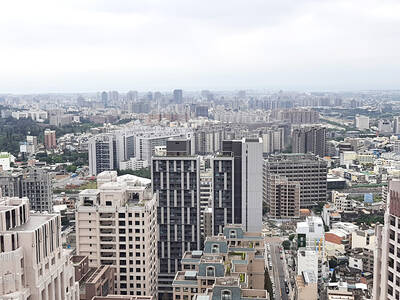
New apartments in Taiwan’s major cities are getting smaller, while old apartments are increasingly occupied by older people, many of whom live alone, government data showed. The phenomenon has to do with sharpening unaffordable property prices and an aging population, property brokers said. Apartments with one bedroom that are two years old or older have gained a noticeable presence in the nation’s six special municipalities as well as Hsinchu county and city in the past five years, Evertrust Rehouse Co (永慶房產集團) found, citing data from the government’s real-price transaction platform. In Taipei, apartments with one bedroom accounted for 19 percent of deals last


 RSS
RSS