


What does the truth look like? Google, the company last week confirmed as the biggest media firm on the planet, rather hopes that it reads something like this: WO 2005/029368.
That's the number of one of several patents filed in the US recently by the Californian internet giant. According to that patent, Google is for the first time planning to rank news stories according to their accuracy and reliability as well as their topicality.
Google, and its heavyweight competitors, are pouring billions of dollars and thousands of staff hours into trying to ensure that when you search on the internet, you receive not only exactly the information you want, but also information that is true.
During the early days of the internet boom, it was predicted that search engines would gradually lessen in importance as users latched on to their favorite sites. But the opposite has proved true, with Google and its competitors becoming the way into the web for eight in 10 web users, according to Ask Jeeves.
Google News, an offshoot that emerged directly from the company's policy of allowing its 2,700 staff to spend a fifth of their time on their own projects, links to 4,500 sources from around the world and has become a key source of traffic for the internet arms of traditional media giants. But it makes no claim for the sources' veracity or accuracy.
Now Google is looking to develop technologies that factor in the amount of important coverage produced by a source, the amount of traffic it attracts, circulation statistics, staff size, breadth of coverage and number of global operations.
A Google spokeswoman said the company did not discuss individual patents but pointed out that its news service was "evolving all the time".
But Jim Hedger, the search engine optimization manager of Canadian company Stepforth, says that "Google is in the midst of sweeping changes to the way it operates". After the posting of the patents, he wrote: "It isn't really a search engine in the fine sense of the word anymore ... It is more of an institution, the ultimate public-private partnership."
The company, famously founded in a garage by students Larry Page and Sergey Brin just seven years ago and now valued at over US$80 billion, recently revealed that it will pour US$500 million into developing new technologies this year alone.
It's not just Google that is pouring cash into discovering the internet's equivalent of the Holy Grail. Competitors Microsoft, Yahoo! and Ask Jeeves are also spending huge sums to employ armies of developers working around the clock to develop new versions of the complex algorithms that power search engines.
Charlene Li, a technology analyst from Forrester Research, said in a recent report that the search engine market was in a huge period of development and change. "As MSN launches its new search engine and players like Yahoo!, Ask Jeeves, A9 and a slew of startups continue to innovate, ... the market remains open to big shifts," she said.
Tony Macklin, vice president of European product development at Ask Jeeves, added that the difference between competitors was now "more about brand than technology."
Google is notoriously secretive about its algorithms -- the online equivalent of the recipe for Coca Cola.
The company insists its only motive is to help users make sense of the morass of information on the web. But some worry about the cultural influence of everything being filtered through the Google lens, particularly if it emerges as the arbiter of "truth" on the web.
In France, Google's plans to digitize 15 million books from Harvard, Stanford, Oxford and the New York Public Library immediately raised the kind of ire once directed at the perceived cultural imperialism of Disney. The head of the French National Library, Jean-Noel Jeanneney, writing in Le Monde, called the plans "confirmation of the risk of crushing American domination in the way future generations conceive the world".
But experts in search technology say that such objectors are shutting the stable door long after the horse has bolted. "The technology already makes quality judgments on things all the time -- that's the nature of a search engine. No matter what they do, they'll always come in for criticism," contended Danny Sullivan, editor of Search Engine Watch.
Macklin said the Ask Jeeves technology already contained a bias towards more authoritative sites for its results.
Sullivan said another dimension would be added to the debate once search technology started second guessing users' preferences by analysing their online activity and even their hard drives. Microsoft is planning to put tools based around a concept known as "implicit query" in its next version of Windows, due to be launched next year.
"It will be interesting to see when they make that further jump into modifying the results based on your behavior. People don't think about the fact they have a search profile, but they do," said Sullivan. "You'll do the same search and suddenly realize it's different to your friend's because you've got different histories. It will be a problem for some people. But if it's useful, people will believe in it and use it."
As religious leaders will attest, belief in your version of the truth largely depends on faith. Google's company motto remains "don't be evil". How long before that becomes "the way, the truth and the life?"
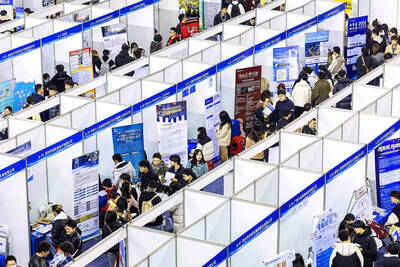
Stephen Garrett, a 27-year-old graduate student, always thought he would study in China, but first the country’s restrictive COVID-19 policies made it nearly impossible and now he has other concerns. The cost is one deterrent, but Garrett is more worried about restrictions on academic freedom and the personal risk of being stranded in China. He is not alone. Only about 700 American students are studying at Chinese universities, down from a peak of nearly 25,000 a decade ago, while there are nearly 300,000 Chinese students at US schools. Some young Americans are discouraged from investing their time in China by what they see
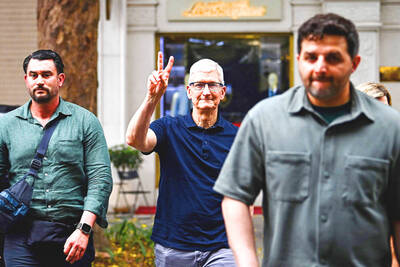
MAJOR DROP: CEO Tim Cook, who is visiting Hanoi, pledged the firm was committed to Vietnam after its smartphone shipments declined 9.6% annually in the first quarter Apple Inc yesterday said it would increase spending on suppliers in Vietnam, a key production hub, as CEO Tim Cook arrived in the country for a two-day visit. The iPhone maker announced the news in a statement on its Web site, but gave no details of how much it would spend or where the money would go. Cook is expected to meet programmers, content creators and students during his visit, online newspaper VnExpress reported. The visit comes as US President Joe Biden’s administration seeks to ramp up Vietnam’s role in the global tech supply chain to reduce the US’ dependence on China. Images on
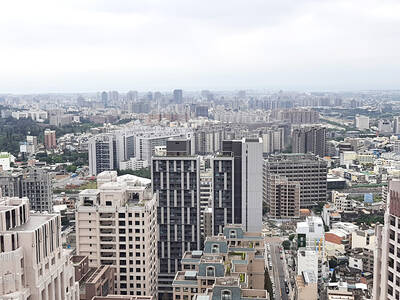
New apartments in Taiwan’s major cities are getting smaller, while old apartments are increasingly occupied by older people, many of whom live alone, government data showed. The phenomenon has to do with sharpening unaffordable property prices and an aging population, property brokers said. Apartments with one bedroom that are two years old or older have gained a noticeable presence in the nation’s six special municipalities as well as Hsinchu county and city in the past five years, Evertrust Rehouse Co (永慶房產集團) found, citing data from the government’s real-price transaction platform. In Taipei, apartments with one bedroom accounted for 19 percent of deals last
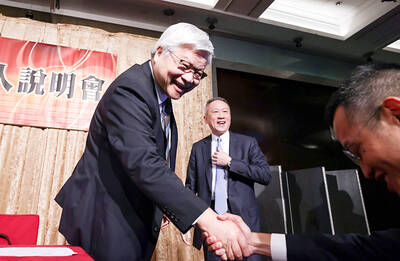
US CONSCULTANT: The US Department of Commerce’s Ursula Burns is a rarely seen US government consultant to be put forward to sit on the board, nominated as an independent director Taiwan Semiconductor Manufacturing Co (TSMC, 台積電), the world’s largest contract chipmaker, yesterday nominated 10 candidates for its new board of directors, including Ursula Burns from the US Department of Commerce. It is rare that TSMC has nominated a US government consultant to sit on its board. Burns was nominated as one of seven independent directors. She is vice chair of the department’s Advisory Council on Supply Chain Competitiveness. Burns is to stand for election at TSMC’s annual shareholders’ meeting on June 4 along with the rest of the candidates. TSMC chairman Mark Liu (劉德音) was not on the list after in December last


 RSS
RSS