


A hint of a terrorist threat in Nigeria, a major supplier of crude oil to the US, worries about a lack of refining capacity and a growing acknowledgment that OPEC's influence may be waning drove energy markets into another frenzy on Friday, pushing oil prices above US$58 a barrel.
Crude oil for July delivery climbed US$1.89, or more than 3 percent, to US$58.47 a barrel. Some traders said oil might even reach US$70 a barrel, driven primarily by demand in China and the US, before markets start to calm again.
Fears over what might affect the supply of oil, rather than what is actually affecting it, appeared to inject anxiety into the market.
"In this environment, we cannot afford to have any disruptions. We are still in the uptrend," said Thomas Bentz, senior energy analyst at BNP Paribas Commodity Futures in New York.
The closing on Friday of the consulates of the US, UK and Germany in Lagos, Nigeria's largest city, because of reports of threats from Islamic militants put traders on edge.
Nigeria, a member of the Organization of the Petroleum Exporting Countries (OPEC), supplied the US with more than 1.1 million barrels of oil a day in April.
Nigeria's main oil fields are not clustered around Lagos but lie elsewhere in the country, which is the largest oil producer in sub-Saharan Africa. Still, the possibility of a terrorist attack in Nigeria was enough to tap the oil market's fear that demand-driven pressure on prices might evolve into a full-blown supply-driven crisis.
A sudden restriction of oil supplies led to the oil shocks of the 1970s, and the lack of spare production capacity around the world, particularly of the types of crude oil easy to refine into gasoline, has made energy markets vulnerable to whispers of any potential disruption.
So do the opinions that oil is still relatively cheap. Adjusted for inflation, oil is less expensive than it was in 1981, when Iran choked off oil exports.
The average cost of oil used by American refineries at that time was US$35.24 a barrel, or US$75.44 in current dollars, according to figures from Bloomberg.
One of OPEC's concerns, which its members expressed at a meeting this week in Vienna, Austria, is that oil prices will quickly climb to a level where many automobile owners decide to switch from sport utility vehicles to compact cars, or possibly, to public transportation or carpooling.
Such a change in driving habits, while still considered unlikely, might produce a scary outcome for oil-producing countries: a crash in oil prices.
"When I go to neighborhood parties, people are always asking me when gasoline prices are coming down," said David Pursell, a principal with Pickering Energy Partners, an energy investment firm in Houston.
"Well, I always reply, `When are you going to start riding the bus?' There's lots of angst, but not enough to keep us from US$60 oil," he said.
Not everyone is convinced oil prices will continue to soar. "Scary Oil," for instance, was the title of a report written this week by Andy Xie, the greater-China economist for Morgan Stanley in Hong Kong. Xie predicted a sharp decline in oil prices, citing signs of softer demand in China, the second-largest petroleum consumer after the US; Chinese oil imports fell 1.2 percent in the first five months of this year.
"What is occurring now is probably the final frenzy, in my view," said Xie, who went on to write that the oil market's recent surge "could correct in the most speculative fashion -- it could collapse."
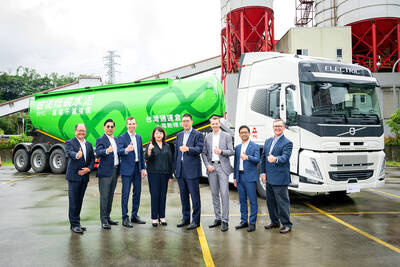
Taiwan Transport and Storage Corp (TTS, 台灣通運倉儲) yesterday unveiled its first electric tractor unit — manufactured by Volvo Trucks — in a ceremony in Taipei, and said the unit would soon be used to transport cement produced by Taiwan Cement Corp (TCC, 台灣水泥). Both TTS and TCC belong to TCC International Holdings Ltd (台泥國際集團). With the electric tractor unit, the Taipei-based cement firm would become the first in Taiwan to use electric vehicles to transport construction materials. TTS chairman Koo Kung-yi (辜公怡), Volvo Trucks vice president of sales and marketing Johan Selven, TCC president Roman Cheng (程耀輝) and Taikoo Motors Group

Among the rows of vibrators, rubber torsos and leather harnesses at a Chinese sex toys exhibition in Shanghai this weekend, the beginnings of an artificial intelligence (AI)-driven shift in the industry quietly pulsed. China manufactures about 70 percent of the world’s sex toys, most of it the “hardware” on display at the fair — whether that be technicolor tentacled dildos or hyper-realistic personalized silicone dolls. Yet smart toys have been rising in popularity for some time. Many major European and US brands already offer tech-enhanced products that can enable long-distance love, monitor well-being and even bring people one step closer to

RECORD-BREAKING: TSMC’s net profit last quarter beat market expectations by expanding 8.9% and it was the best first-quarter profit in the chipmaker’s history Taiwan Semiconductor Manufacturing Co (TSMC, 台積電), which counts Nvidia Corp as a key customer, yesterday said that artificial intelligence (AI) server chip revenue is set to more than double this year from last year amid rising demand. The chipmaker expects the growth momentum to continue in the next five years with an annual compound growth rate of 50 percent, TSMC chief executive officer C.C. Wei (魏哲家) told investors yesterday. By 2028, AI chips’ contribution to revenue would climb to about 20 percent from a percentage in the low teens, Wei said. “Almost all the AI innovators are working with TSMC to address the

Malaysia’s leader yesterday announced plans to build a massive semiconductor design park, aiming to boost the Southeast Asian nation’s role in the global chip industry. A prominent player in the semiconductor industry for decades, Malaysia accounts for an estimated 13 percent of global back-end manufacturing, according to German tech giant Bosch. Now it wants to go beyond production and emerge as a chip design powerhouse too, Malaysian Prime Minister Anwar Ibrahim said. “I am pleased to announce the largest IC (integrated circuit) Design Park in Southeast Asia, that will house world-class anchor tenants and collaborate with global companies such as Arm [Holdings PLC],”


 RSS
RSS