


The US hit a record deficit of US$195.1 billion in the first quarter in trade and capital flows with the rest of the world, the Commerce Department reported on Friday. The news reignited worries that the economy cannot sustain the growing level of global debt.
If this pace continues, the US' current account deficit could reach US$780 billion this year, a sharp increase from last year's record of US$617 billion.
The US continued to attract foreign investments at relatively low interest rates, and the rate of growth in the trade imbalance has slowed.
But the direction remains the same, and the overall current account deficit stands at 6.4 percent of GDP, also a record gap.
The current account is defined as the sum of the value of all imported goods and services (plus net returns on foreign investments), minus the value of all exported goods and services.
"Clearly the current account deficit can't go on like this forever," said Daniel Griswold, director of the Cato Institute's center for trade policy studies, a conservative research group that has generally not worried about the US' trade gap.
Economists agree that the drop in the value of the dollar is only beginning to help redress the trade imbalance, in part because China and Japan are enjoying what they see as significantly undervalued currencies. The Bush administration has been pressing China and other Asian nations to revalue their currencies.
The White House, in general, sees the widening current account deficit as a sign of strength in the US and weakness elsewhere.
"It shows overwhelmingly that the US economy is showing remarkable strength compared to our European trading partners and generating a lot more income for Americans to buy a lot more foreign goods," said Tony Fratto, a Treasury Department spokesman.
According to this analysis, the responsibility for altering the trade imbalance lies with Europe and Japan, not the US.
Those foreign economies, officials argue, have to restructure their economies and start buying more US goods and consume more of what they produce domestically.
In the meantime, however, the US borrows, in essence, US$2.1 billion every day to keep the economy afloat, according to the calculations of Stuart Hoffman, chief economist at PNC.
US trade representative Rob Portman met with Peter Mandelson, his European counterpart, on Friday ahead of the US-European summit meeting tomorrow.
Both men tried to shift the emphasis away from recent trade disputes, like the lawsuits over subsidies paid to Boeing and Airbus, and instead promote the effectiveness of the overall trade relationship.
"We have so much in common," Portman said. He was followed by Mandelson who said that the two men "had not only a very constructive meeting but a very enjoyable meeting."
Both men said they were still open to a negotiated settlement in the long-simmering dispute over government subsidies to Boeing and Airbus.
Formal discussions on an agreement broke down last month, and both sides filed cases with the World Trade Organization. While the two officials did not rule out a deal, they offered few specifics about any talks.
"The channels of communication between us are open," Mandelson said.
Several economists said that while the figures remain disappointing, one of the reasons for the unexpectedly wide gap was a US$3.3 billion increase in aid to other countries, in part a reflection of the relief sent to Southeast Asia after the tsunami hit last December.
"It's nothing to be cheerful about, but the magnitude of the relief payments and donations holds the potential to distort these figures," said Mark Vitner, a senior economist at Wachovia in Charlotte, North Carolina.
Many economists say the US should save more and spend less, especially the federal government. Griswold of Cato said nothing in the budget should be immune from serious cuts, including the defense budget and entitlements.
But Robert Scott, senior analyst at the Economic Policy Institute, a liberal research group, said that it was "ludicrous to think the deficit is caused by a shortfall in savings."
The deficit, he said, is caused by the US' voracious appetite for foreign goods and its inability to sell enough overseas to balance those purchases.

Stephen Garrett, a 27-year-old graduate student, always thought he would study in China, but first the country’s restrictive COVID-19 policies made it nearly impossible and now he has other concerns. The cost is one deterrent, but Garrett is more worried about restrictions on academic freedom and the personal risk of being stranded in China. He is not alone. Only about 700 American students are studying at Chinese universities, down from a peak of nearly 25,000 a decade ago, while there are nearly 300,000 Chinese students at US schools. Some young Americans are discouraged from investing their time in China by what they see

MAJOR DROP: CEO Tim Cook, who is visiting Hanoi, pledged the firm was committed to Vietnam after its smartphone shipments declined 9.6% annually in the first quarter Apple Inc yesterday said it would increase spending on suppliers in Vietnam, a key production hub, as CEO Tim Cook arrived in the country for a two-day visit. The iPhone maker announced the news in a statement on its Web site, but gave no details of how much it would spend or where the money would go. Cook is expected to meet programmers, content creators and students during his visit, online newspaper VnExpress reported. The visit comes as US President Joe Biden’s administration seeks to ramp up Vietnam’s role in the global tech supply chain to reduce the US’ dependence on China. Images on
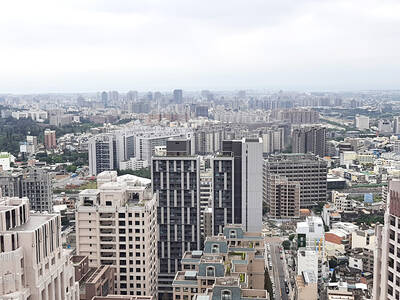
New apartments in Taiwan’s major cities are getting smaller, while old apartments are increasingly occupied by older people, many of whom live alone, government data showed. The phenomenon has to do with sharpening unaffordable property prices and an aging population, property brokers said. Apartments with one bedroom that are two years old or older have gained a noticeable presence in the nation’s six special municipalities as well as Hsinchu county and city in the past five years, Evertrust Rehouse Co (永慶房產集團) found, citing data from the government’s real-price transaction platform. In Taipei, apartments with one bedroom accounted for 19 percent of deals last

US CONSCULTANT: The US Department of Commerce’s Ursula Burns is a rarely seen US government consultant to be put forward to sit on the board, nominated as an independent director Taiwan Semiconductor Manufacturing Co (TSMC, 台積電), the world’s largest contract chipmaker, yesterday nominated 10 candidates for its new board of directors, including Ursula Burns from the US Department of Commerce. It is rare that TSMC has nominated a US government consultant to sit on its board. Burns was nominated as one of seven independent directors. She is vice chair of the department’s Advisory Council on Supply Chain Competitiveness. Burns is to stand for election at TSMC’s annual shareholders’ meeting on June 4 along with the rest of the candidates. TSMC chairman Mark Liu (劉德音) was not on the list after in December last


 RSS
RSS