


Motorola Inc, Sony Ericsson Mobile Communications Ltd and other cellphone makers attending Asia's biggest telecommunications show this week failed to convince investors including Jarmo Nieminen that their new products will drive an earnings rebound.
While Motorola, the world's second-largest mobile phone maker, and Sony Ericsson, Europe's No. 2, focused promotional spending on their latest handsets that can play music and video clips, executives said sales of cheaper handsets in emerging markets may set the pace for sales growth.
Price Erosion
"Price erosion is a serious concern," said Nieminen, a fund manager at Nordea AB in Helsinki, which manages US$130 billion, including Nokia shares.
"As they enter China and other big markets, prices will further decline," he said.
The emphasis on cheaper phones highlights the importance of China and India, where most of the population don't own a cellular phone, to the US$1.1 trillion wireless industry, which includes mobile phones. Handset prices will probably fall this year and next on rising competition and slowing subscriber growth in North America, Western Europe, and parts of Asia, according to research firm Strategy Analytics.
Illinois-based Motorola plans to increase sales of handsets with a wholesale price of less than US$40 each, which are manufactured by Compal Communications Inc (華寶通訊), David Taylor, a Motorola director, said in Singapore this week.
"We don't make as much margin from a product that costs US$50 than from a product that costs US$300, but equally, we sell an awful lot more of the products costing US$50," Taylor said.
"If you don't play in that low-tier part, you're excluding yourself from a load full of people in the marketplace and your market share suffers," he added.
Sony Ericsson, the London-based mobile-phone venture owned by Sony Corp and Ericsson AB, also said it will introduce cheaper, entry-level phones for markets in China and India.
"It's a very competitive market," Jan Wareby, executive vice president of Sony Ericsson, said this week.
The telecom services industry group has fallen 9.7 percent this year, the worst performer in Morgan Stanley Capital International Inc's World Index on concern of slowing subscriber growth in developed markets. The industry group has underperformed the MSCI World in four of the last five years.
Handset Revenue
Average handset prices will fall 4.9 percent to US$155 this year and drop 4.5 percent next year, according to Neil Mawston, a London-based analyst at Strategy Analytics.
`If you've got earnings growth, then we would be interested in telecom stocks," said Khiem Do, who oversees US$3.3 billion as head of Asian equities at Baring Asset Management in Hong Kong.
"But it's something that we are seeing very little of," he said.
Sales of the phones that work on so-called third-generation, which accounted for 3 percent of global handset revenue last year, aren't expected to top 50 percent of total sales at least until the end of the decade, according to Ben Wood, a telecom analyst at researcher Gartner Inc in London.
For companies that build the wireless networks such as Ericsson, the world's largest maker of mobile phone equipment, and Lucent Technologies Inc, the largest US telephone equipment maker, China and India are a boon for business.
Ericsson said on June 14 it won contracts worth US$250 million from Bharti Tele-Ventures Ltd, India's largest mobile phone operator. Lucent said this week it won six orders in Asia, including contracts from China, without disclosing the value.
China's Market
Seven out of 10 people don't have a cell phone in China, the world's biggest mobile phone market with almost 354 million users. Ninety percent of the more than 1 billion people in India don't own a handset.
China's subscriber growth may continue to outpace other countries and increase 70 percent to 535 million by 2009 from 317 million last year, Massachusetts-based IDC said in a press release last week.
Worldwide mobile phone subscribers may increase 50 percent to 3 billion in five years, Ericsson chief executive Carl-Henric Svanberg said this week in Singapore.
Growing local demand and lower manufacturing costs are also helping Huawei Technologies Co (
Huawei vice president Jeffrey Liu said this week the company plans to add more than 10 customers and more than double combined sales in India and 15 other Asia-Pacific countries by this year.
Cui Yi, president of ZTE's Asia-Pacific business, said the company's Asia-Pacific sales will double this year, driven by demand in Indonesia, Philippines and Malaysia.

Among the rows of vibrators, rubber torsos and leather harnesses at a Chinese sex toys exhibition in Shanghai this weekend, the beginnings of an artificial intelligence (AI)-driven shift in the industry quietly pulsed. China manufactures about 70 percent of the world’s sex toys, most of it the “hardware” on display at the fair — whether that be technicolor tentacled dildos or hyper-realistic personalized silicone dolls. Yet smart toys have been rising in popularity for some time. Many major European and US brands already offer tech-enhanced products that can enable long-distance love, monitor well-being and even bring people one step closer to

Malaysia’s leader yesterday announced plans to build a massive semiconductor design park, aiming to boost the Southeast Asian nation’s role in the global chip industry. A prominent player in the semiconductor industry for decades, Malaysia accounts for an estimated 13 percent of global back-end manufacturing, according to German tech giant Bosch. Now it wants to go beyond production and emerge as a chip design powerhouse too, Malaysian Prime Minister Anwar Ibrahim said. “I am pleased to announce the largest IC (integrated circuit) Design Park in Southeast Asia, that will house world-class anchor tenants and collaborate with global companies such as Arm [Holdings PLC],”

Sales in the retail, and food and beverage sectors last month continued to rise, increasing 0.7 percent and 13.6 percent respectively from a year earlier, setting record highs for the month of March, the Ministry of Economic Affairs said yesterday. Sales in the wholesale sector also grew last month by 4.6 annually, mainly due to the business opportunities for emerging applications related to artificial intelligence (AI) and high-performance computing technologies, the ministry said in a report. The ministry forecast that retail, and food and beverage sales this month would retain their growth momentum as the former would benefit from Tomb Sweeping Day
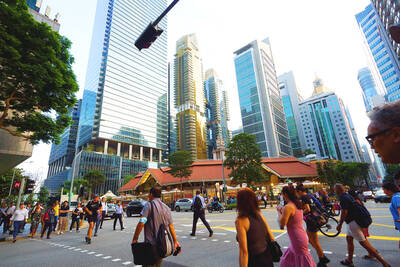
Thousands of parents in Singapore are furious after a Cordlife Group Ltd (康盛人生集團), a major operator of cord blood banks in Asia, irreparably damaged their children’s samples through improper handling, with some now pursuing legal action. The ongoing case, one of the worst to hit the largely untested industry, has renewed concerns over companies marketing themselves to anxious parents with mostly unproven assurances. This has implications across the region, given Cordlife’s operations in Hong Kong, Macau, Indonesia, the Philippines and India. The parents paid for years to have their infants’ cord blood stored, with the understanding that the stem cells they contained


 RSS
RSS