


China says it will open its state-run military industries to private and foreign-backed suppliers beginning next month, but the most sensitive weapons programs will stay under tight government control.
The announcement comes amid a multibillion-dollar modernization effort meant in part to extend China's military power beyond its shores and back up frequent threats to attack rival Taiwan.
Private companies will be allowed to supply "subsystems and special auxiliary products," the official Xinhua News Agency said on Friday, citing the Commission of Science, Technology and Industry for National Defense.
Production of "core technology and equipment" will remain under "tight state control," Xinhua said. It said the new regulations will take effect on June 15.
The report didn't give any details of which weapons or equipment programs might be open to private or foreign-backed suppliers or how they would be picked.
"It means if they meet certain standards, including technological level and financial strength, private and foreign-funded companies face no policy barriers to entering business in the second category," Liu Dongkui, director of the commission's economic coordination department, was quoted as saying.
Liu said the move is meant to "help to standardize the weapon development and production industry, promote moderate and orderly competition and improve the level of the national defense industry."
China's military is the world's biggest, but its technology lags far behind that of the US and other governments.
Leaders of the 2.5 million-member People's Liberation Army have talked since the mid-1990s about possibly allowing a foreign or private role in China's weapons industry in order to improve its technology.
Chinese commanders were jolted into action after seeing the devastating success of US high-tech weapons during the first Gulf War and the NATO campaign against Yugoslavia.
China has spent heavily on trying to acquire submarines, fighter jets, air-defense systems and other weapons that would be needed to carry out a campaign against Taiwan, the self-ruled nation that Beijing claims as its own territory.
So far, its most advanced weapons have been bought from Russia, but Beijing is eager to produce its own high-tech arms.
Private businesses are among the candidates for about 300 weapons development and production licenses that the government plans to issue in the second half of this year, Xinhua said.
"But there's no fixed link between a license and production orders," Liu was quoted as saying. "Obtaining a license does not guarantee a company production orders."
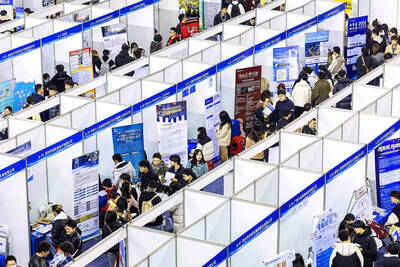
Stephen Garrett, a 27-year-old graduate student, always thought he would study in China, but first the country’s restrictive COVID-19 policies made it nearly impossible and now he has other concerns. The cost is one deterrent, but Garrett is more worried about restrictions on academic freedom and the personal risk of being stranded in China. He is not alone. Only about 700 American students are studying at Chinese universities, down from a peak of nearly 25,000 a decade ago, while there are nearly 300,000 Chinese students at US schools. Some young Americans are discouraged from investing their time in China by what they see
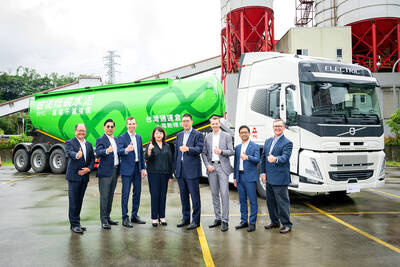
Taiwan Transport and Storage Corp (TTS, 台灣通運倉儲) yesterday unveiled its first electric tractor unit — manufactured by Volvo Trucks — in a ceremony in Taipei, and said the unit would soon be used to transport cement produced by Taiwan Cement Corp (TCC, 台灣水泥). Both TTS and TCC belong to TCC International Holdings Ltd (台泥國際集團). With the electric tractor unit, the Taipei-based cement firm would become the first in Taiwan to use electric vehicles to transport construction materials. TTS chairman Koo Kung-yi (辜公怡), Volvo Trucks vice president of sales and marketing Johan Selven, TCC president Roman Cheng (程耀輝) and Taikoo Motors Group

MAJOR DROP: CEO Tim Cook, who is visiting Hanoi, pledged the firm was committed to Vietnam after its smartphone shipments declined 9.6% annually in the first quarter Apple Inc yesterday said it would increase spending on suppliers in Vietnam, a key production hub, as CEO Tim Cook arrived in the country for a two-day visit. The iPhone maker announced the news in a statement on its Web site, but gave no details of how much it would spend or where the money would go. Cook is expected to meet programmers, content creators and students during his visit, online newspaper VnExpress reported. The visit comes as US President Joe Biden’s administration seeks to ramp up Vietnam’s role in the global tech supply chain to reduce the US’ dependence on China. Images on
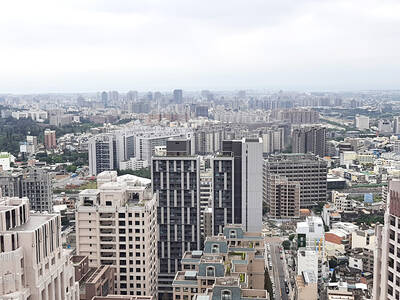
New apartments in Taiwan’s major cities are getting smaller, while old apartments are increasingly occupied by older people, many of whom live alone, government data showed. The phenomenon has to do with sharpening unaffordable property prices and an aging population, property brokers said. Apartments with one bedroom that are two years old or older have gained a noticeable presence in the nation’s six special municipalities as well as Hsinchu county and city in the past five years, Evertrust Rehouse Co (永慶房產集團) found, citing data from the government’s real-price transaction platform. In Taipei, apartments with one bedroom accounted for 19 percent of deals last


 RSS
RSS