


The Financial Committee of the Legislative Yuan yesterday passed the first reading of the drawn-out amendments to the Resolution Trust Committee Fund Regulatory Provisions (
The restructuring fund, also known as RTC, was established in July 2001 with capital of NT$140 billion. The fund is slated to expire on July 10 and will hand over its clean-up mission to the Central Depositary Insurance Corp (CDIC,
In addition, the problematic banks with a capital adequacy ratio below 2 percent will be asked to improve within three months, said Kong Jaw-sheng (
The relief mechanism would not intervene unless these ill-fated banks failed to improve their financial conditions within the grace period, Kong said.
The amendments will allow the bail-out fund to continue exist for another five years until the end of 2010, in a bid to finish the unresolved restructuring issues like the sale of mortgages, collecting business taxes paid by financial institutions and repay the fund's debts built up during the bail-out process.
"The extension of the fund relieves the shortage of capital of nearly NT$60 billion caused by the drawn-out restructuring process of Chung Shing Bank (
There remaining seven banks that see negative net value and are engaged in the self-help process through measures like raising funds, Kong said, and the RTC's extension can help prevent the potential confidence crisis if some of these banks fail to bail themselves out in the future.
To facilitate the self-help process, the amendments allow problematic banks' non-saving debts taking place within two months after July 10 to be covered by the fund.
Such non-saving debts are estimated to be around NT$7 billion, or 20 percent of these banks' total debts, according to Gary Tseng (
Nevertheless, Chinese Nationalist Party (KMT) Legislator Lee Jih-chu (
Lee advocated compensation only to the creditors that aided the debt-ridden banks by request of the government previously.
Lee also retained her power of objection to the regulation. She is therefore entitled to bring up her disagreement during the second reading of the bill, which may overturn the regulation.
The bill also allows authorities to make public the borrowers of the non-performing loans from indebted banks, if the loan is over NT$1 million.
People First Party Legislator Christina Liu (劉憶如), however, disagreed with the regulation, saying that it violates the banks' confidentiality obligation imposed by the Banking Law (銀行法) and would hurt the nation's small and medium enterprises, which already have difficulty in raising funds.
Meanwhile, the legislators watered down a regulation that terminates the levy of business taxes on financial institutions, the RTC's fund source, at the end of 2010 along with the RTC's expiration.
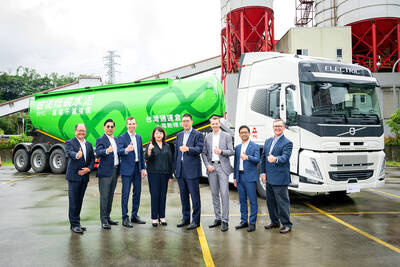
Taiwan Transport and Storage Corp (TTS, 台灣通運倉儲) yesterday unveiled its first electric tractor unit — manufactured by Volvo Trucks — in a ceremony in Taipei, and said the unit would soon be used to transport cement produced by Taiwan Cement Corp (TCC, 台灣水泥). Both TTS and TCC belong to TCC International Holdings Ltd (台泥國際集團). With the electric tractor unit, the Taipei-based cement firm would become the first in Taiwan to use electric vehicles to transport construction materials. TTS chairman Koo Kung-yi (辜公怡), Volvo Trucks vice president of sales and marketing Johan Selven, TCC president Roman Cheng (程耀輝) and Taikoo Motors Group

Among the rows of vibrators, rubber torsos and leather harnesses at a Chinese sex toys exhibition in Shanghai this weekend, the beginnings of an artificial intelligence (AI)-driven shift in the industry quietly pulsed. China manufactures about 70 percent of the world’s sex toys, most of it the “hardware” on display at the fair — whether that be technicolor tentacled dildos or hyper-realistic personalized silicone dolls. Yet smart toys have been rising in popularity for some time. Many major European and US brands already offer tech-enhanced products that can enable long-distance love, monitor well-being and even bring people one step closer to
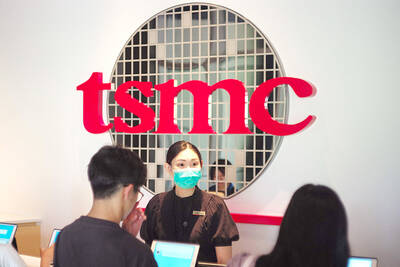
RECORD-BREAKING: TSMC’s net profit last quarter beat market expectations by expanding 8.9% and it was the best first-quarter profit in the chipmaker’s history Taiwan Semiconductor Manufacturing Co (TSMC, 台積電), which counts Nvidia Corp as a key customer, yesterday said that artificial intelligence (AI) server chip revenue is set to more than double this year from last year amid rising demand. The chipmaker expects the growth momentum to continue in the next five years with an annual compound growth rate of 50 percent, TSMC chief executive officer C.C. Wei (魏哲家) told investors yesterday. By 2028, AI chips’ contribution to revenue would climb to about 20 percent from a percentage in the low teens, Wei said. “Almost all the AI innovators are working with TSMC to address the

Malaysia’s leader yesterday announced plans to build a massive semiconductor design park, aiming to boost the Southeast Asian nation’s role in the global chip industry. A prominent player in the semiconductor industry for decades, Malaysia accounts for an estimated 13 percent of global back-end manufacturing, according to German tech giant Bosch. Now it wants to go beyond production and emerge as a chip design powerhouse too, Malaysian Prime Minister Anwar Ibrahim said. “I am pleased to announce the largest IC (integrated circuit) Design Park in Southeast Asia, that will house world-class anchor tenants and collaborate with global companies such as Arm [Holdings PLC],”


 RSS
RSS