


The NASDAQ Stock Market Inc is purchasing Instinet Group Inc's electronic trading network for US$934.5 million, a move designed to improve NASDAQ's position as competition grows among the world's stock markets.
The long-rumored announcement on Friday came two days after the New York Stock Exchange said it would merge with Archipelago Holdings Inc, operator of the ArcaEx electronic trading market, a surprise move that boosts the NYSE's electronic trading offerings and increases its competitiveness against NASDAQ and other markets.
Instinet's trading technology -- considered the fastest and best in electronic stock trading -- was a major factor in the deal, which also gives NASDAQ increased market share in its own listed stocks as well as NYSE-listed shares, and access to more trades and liquidity.

PHOTO: AP
"This transaction will position us to offer investors increased choice in listed stocks on other markets as well as increased liquidity in NASDAQ-listed stocks. [Instinet] is the ideal partner for us to offer investors the best outcome for their trades," Bob Greifeld, NASDAQ's chief executive officer, said at a press conference at NASDAQ's Marketsite in Times Square.
Instinet's technology will become the predominant electronic trading platform in the US equity market, and the NASDAQ will abandon its own system to standardize on Instinet's platform.
Instinet's broker-dealer arm, to be run by Instinet chief executive Ed Nicoll, will be sold to a private equity group, Silver Lake Partners, for US$207.5 million. Another Instinet subsidiary, which manages commission rebates, will go to the Bank of New York for US$174 million. The deal also include US$562 million in cash that Instinet currently holds, bringing the overall value of the sale to just under US$1.9 billion.
Shares of the NASDAQ Stock Market surged US$3.11, or 29.2 percent, to US$13.76, while Instinet shares fell US$0.48 to US$5.22. Instinet said in a release that investors would receive approximately US$5.44 in cash per share. British financial information company Reuters Group PLC, which owns 62 percent of Instinet, said it expects to receive US$1 billion from the deal; Reuters stock was up US$1.44 at US$49.20.
To finance the Instinet purchase, NASDAQ will take on US$955 million in new debt, to be paid within six years. Greifeld said, however, that the company will save US$100 million in synergy costs over the next two to three years, and plans to pay off the debt before it comes due.
The NYSE deal and the NASDAQ purchase put the two markets -- the 213-year-old icon versus the slick, computerized upstart -- into a head-to-head competition that will likely result in a variety of new investment products and lower transaction fees for both institutions and individual investors. Greifeld said the NYSE-Archipelago deal was not a factor in the acquisition, which was described as a long, hard auction process.
Greifeld took the opportunity to jab at the larger, older competitor -- and the human specialists who manage floor auctions on the NYSE -- in extolling the NASDAQ's all-electronic trading systems.
"We do not anoint anyone as a specialist or monopolist. It is the best of both man and machine," he said. "We certainly accept the flattery of their imitation" in adopting an electronic platform, Greifeld added.
The NYSE-Archipelago merger gives the venerable NYSE, known worldwide for its trading floor, a strong electronic trading platform that it would have taken years to otherwise develop. The combined company, NYSE Group Inc, would also make the not-for-profit NYSE a for-profit enterprise.
Analysts have said a NASDAQ-Instinet deal would help stave off increased competition from the combined NYSE Group Inc. NASDAQ itself claims a 50 percent market share in trading its own listed stocks -- though analysts say that number is around 25 percent to 30 percent -- and 15 percent volume in NYSE-listed stocks. Both ArcaEx and Instinet have about 25 percent market share each in NASDAQ stocks and a minimal share in NYSE stocks.
The NYSE has a share of more than 80 percent in its own listings, and does not trade NASDAQ stocks on the floor of the exchange. But with ArcaEx, NASDAQ's archrival now has a vested interest in not only maintaining its own listed shares, but also stealing market share from NASDAQ. The Instinet deal, in addition to improving NASDAQ's trading technology, will also shore up NASDAQ's market share in its own stocks.
Greifeld added that the NASDAQ will have a "maniacal focus" on taking additional market share in NYSE-listed stocks.

Taiwan Transport and Storage Corp (TTS, 台灣通運倉儲) yesterday unveiled its first electric tractor unit — manufactured by Volvo Trucks — in a ceremony in Taipei, and said the unit would soon be used to transport cement produced by Taiwan Cement Corp (TCC, 台灣水泥). Both TTS and TCC belong to TCC International Holdings Ltd (台泥國際集團). With the electric tractor unit, the Taipei-based cement firm would become the first in Taiwan to use electric vehicles to transport construction materials. TTS chairman Koo Kung-yi (辜公怡), Volvo Trucks vice president of sales and marketing Johan Selven, TCC president Roman Cheng (程耀輝) and Taikoo Motors Group

Among the rows of vibrators, rubber torsos and leather harnesses at a Chinese sex toys exhibition in Shanghai this weekend, the beginnings of an artificial intelligence (AI)-driven shift in the industry quietly pulsed. China manufactures about 70 percent of the world’s sex toys, most of it the “hardware” on display at the fair — whether that be technicolor tentacled dildos or hyper-realistic personalized silicone dolls. Yet smart toys have been rising in popularity for some time. Many major European and US brands already offer tech-enhanced products that can enable long-distance love, monitor well-being and even bring people one step closer to

RECORD-BREAKING: TSMC’s net profit last quarter beat market expectations by expanding 8.9% and it was the best first-quarter profit in the chipmaker’s history Taiwan Semiconductor Manufacturing Co (TSMC, 台積電), which counts Nvidia Corp as a key customer, yesterday said that artificial intelligence (AI) server chip revenue is set to more than double this year from last year amid rising demand. The chipmaker expects the growth momentum to continue in the next five years with an annual compound growth rate of 50 percent, TSMC chief executive officer C.C. Wei (魏哲家) told investors yesterday. By 2028, AI chips’ contribution to revenue would climb to about 20 percent from a percentage in the low teens, Wei said. “Almost all the AI innovators are working with TSMC to address the
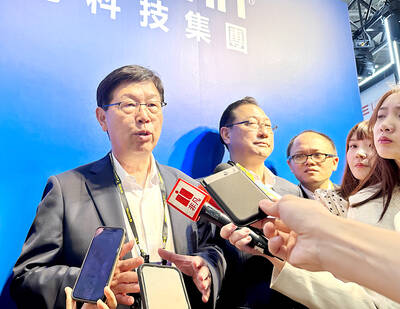
FUTURE PLANS: Although the electric vehicle market is getting more competitive, Hon Hai would stick to its goal of seizing a 5 percent share globally, Young Liu said Hon Hai Precision Industry Co (鴻海精密), a major iPhone assembler and supplier of artificial intelligence (AI) servers powered by Nvidia Corp’s chips, yesterday said it has introduced a rotating chief executive structure as part of the company’s efforts to cultivate future leaders and to enhance corporate governance. The 50-year-old contract electronics maker reported sizable revenue of NT$6.16 trillion (US$189.67 billion) last year. Hon Hai, also known as Foxconn Technology Group (富士康科技集團), has been under the control of one man almost since its inception. A rotating CEO system is a rarity among Taiwanese businesses. Hon Hai has given leaders of the company’s six


 RSS
RSS