


If time travelers from a hundred years ago were to visit a home today, much of the technology would be completely alien. The television, cordless phone and computer would probably leave them flabbergasted.
But on seeing a light bulb, they might say, "Ah! Here's something I recognize. A few of those grace my home, too."
If the visitor comes back in 15 years, the fruit of Thomas Edison's bright idea may be gone. The likely replacement: light-emitting diodes, or LEDs.
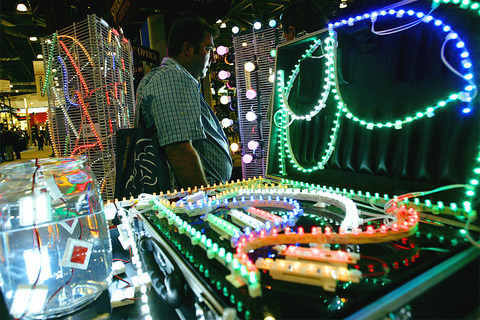
PHOTO: AP
LED lamps were unthinkable until the technology cleared a major hurdle just a dozen years ago. Since then, LEDs have evolved quickly and are being adapted for many uses, including pool illumination and reading lights, as evidenced at the Lightfair trade show in New York City this week.
More widespread use could lead to big energy savings and a minor revolution in the way we think about lighting.
LEDs have been around since the 1960s, but have mostly been relegated to showing the time in an alarm clock or the battery level of a video camera.
They haven't been used as sources of illumination because they, for a long time, could not produce white light -- only red, green and yellow. Nichia Chemical of Japan changed that in 1993 when it started producing blue LEDs, which combined with red and green produce white light, opening up a whole new field for the technology.
And the industry has been quick to exploit it. LEDs are based on semiconductor technology, just like computer processors, and are increasing in brightness, energy efficiency and longevity in a way that's reminiscent of the way each year's new crop of processors is faster and cheaper than last year's.
Just this week, researchers at the Lighting Research Center at Rensselaer Polytechnic Institute in Troy, New York, said they had boosted the light output per watt of a white LED to almost six times that of an incandescent light bulb, beating even a compact fluorescent bulb in efficiency.
The current generation of mass-produced white LEDs is not as effective. It's about twice as good as a lightbulb of the same wattage, but the energy savings isn't enough the overcome the major drawback of being expensive.
"It's hard to convince consumers based on energy savings alone," said Nadarajah Narendran, director of lighting research at Rensselaer. "If you look at compact fluorescent lamps, they're four times as efficient as incandescent lights, and how many homes have those? It's less than 5 percent penetration."
But development is brisk, and the Department of Energy has estimated that LED lighting could cut national energy consumption for lighting by 29 percent by 2025. The total savings on US household electric bills until then would be US$125 billion.
LEDs have other advantages that are propelling them into niche uses, despite their upfront cost.
Current white LEDs will last up to 50,000 hours, about 50 times as long as a 60-watt bulb. That's almost six years if they're on constantly.
That makes them attractive for places where changing bulbs is difficult or expensive -- like on the outside of buildings or in swimming pools. Osram Sylvania, the lighting subsidiary of German manufacturer Siemens AG, makes 8-meter long strips of flexible, adhesive tape covered in LEDs for such applications.
Hotels are interested in using LEDs in bedside lamps to save them the trouble of replacing burned-out bulbs, said Jim Anderson of Lamina Ceramics, which showed off a 6-watt array of LEDs that produce light equivalent to a 20-watt halogen bulb.
LEDs are also durable. Being solid-state, they can resist the vibrations in aircraft and cars, according to Narendran, who has worked with Boeing Co on designs for aircraft cabins.
General Electric Co and smaller iLight Technologies of Evanston, Illinois, make glowing LED signs that look like neon.
Neon lighting is a leading cause of fires at restaurants and the signs are vulnerable to vandalism. By contrast, LED signs made of Plexiglas are tough. At the trade show, iLight exhibited an LED sign that still worked after taking a blast from a shotgun.
The limitation: iLight's signs can't be made economically on a one-off basis, as done at small neon-sign shops around the country.
The feature of LEDs likely to propel them into homes is aesthetic, not practical. Arrays that mix red, green and blue LEDs can produce any color of the rainbow. Instead of a dimmer, you might have three sliding knobs that let you mix color.
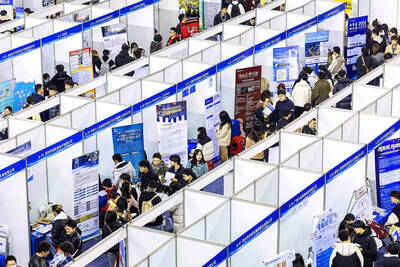
Stephen Garrett, a 27-year-old graduate student, always thought he would study in China, but first the country’s restrictive COVID-19 policies made it nearly impossible and now he has other concerns. The cost is one deterrent, but Garrett is more worried about restrictions on academic freedom and the personal risk of being stranded in China. He is not alone. Only about 700 American students are studying at Chinese universities, down from a peak of nearly 25,000 a decade ago, while there are nearly 300,000 Chinese students at US schools. Some young Americans are discouraged from investing their time in China by what they see

MAJOR DROP: CEO Tim Cook, who is visiting Hanoi, pledged the firm was committed to Vietnam after its smartphone shipments declined 9.6% annually in the first quarter Apple Inc yesterday said it would increase spending on suppliers in Vietnam, a key production hub, as CEO Tim Cook arrived in the country for a two-day visit. The iPhone maker announced the news in a statement on its Web site, but gave no details of how much it would spend or where the money would go. Cook is expected to meet programmers, content creators and students during his visit, online newspaper VnExpress reported. The visit comes as US President Joe Biden’s administration seeks to ramp up Vietnam’s role in the global tech supply chain to reduce the US’ dependence on China. Images on

Taiwan Transport and Storage Corp (TTS, 台灣通運倉儲) yesterday unveiled its first electric tractor unit — manufactured by Volvo Trucks — in a ceremony in Taipei, and said the unit would soon be used to transport cement produced by Taiwan Cement Corp (TCC, 台灣水泥). Both TTS and TCC belong to TCC International Holdings Ltd (台泥國際集團). With the electric tractor unit, the Taipei-based cement firm would become the first in Taiwan to use electric vehicles to transport construction materials. TTS chairman Koo Kung-yi (辜公怡), Volvo Trucks vice president of sales and marketing Johan Selven, TCC president Roman Cheng (程耀輝) and Taikoo Motors Group
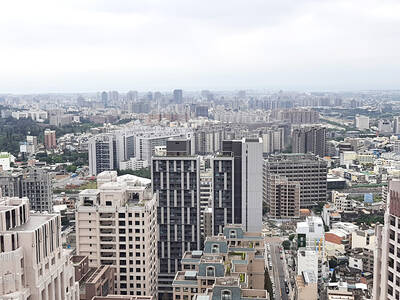
New apartments in Taiwan’s major cities are getting smaller, while old apartments are increasingly occupied by older people, many of whom live alone, government data showed. The phenomenon has to do with sharpening unaffordable property prices and an aging population, property brokers said. Apartments with one bedroom that are two years old or older have gained a noticeable presence in the nation’s six special municipalities as well as Hsinchu county and city in the past five years, Evertrust Rehouse Co (永慶房產集團) found, citing data from the government’s real-price transaction platform. In Taipei, apartments with one bedroom accounted for 19 percent of deals last


 RSS
RSS