


As they shop overseas for resources and assets lacking at home, ambitious Chinese companies are learning the pitfalls of trying to build overseas empires.
They've acquired technology and brand names through a series of large foreign acquisitions, capped by Lenovo Group's (聯想) announcement last December that it was buying IBM's PC business.
But the on again, off again courtship between bankrupt British automaker MG Rover and Shanghai Automotive Industry Corp (SAIC, 上海汽車工業) highlights the problems that can doom such deals.
On Tuesday, SAIC said it had no intention of taking on the role of white knight to the struggling British company, which was put into administration, a form of bankruptcy, last week after negotiations with SAIC collapsed.
"It remains highly unlikely that SAIC would wish to become reinvolved whilst MG Rover is in administration," said Rupert Pittman, the Shanghai-based company's spokesman in London.
SAIC was put off by the potential cost if the venture failed.
"SAIC doesn't have a global brand name and they potentially could get one," said Bob Broadfoot of the Political and Economic Risk Consultancy in Hong Kong. "But what price do you pay for a brand name?"
In some cases, Chinese plans to buy up foreign corporate assets have run afoul of regulatory or financial problems.
Lenovo's US$1.75 billion plan to buy IBM's personal computer business was approved by US regulators. But it initially ran into snags over security concerns about China acquiring technology that might be used in making weapons.
A plan by China Minmetals, a state-owned metals trading company, to buy Canadian mining company Noranda Inc fell through after Noranda took on a subsidiary that made the company too expensive.
The proposed Noranda takeover also had caused an uproar in Canada, with critics complaining that the country was losing control of its economy.
In other cases, acquisitions have been dogged by conflicts over labor rights or financial troubles back home.
In Britain, the proposed deal with SAIC, one of China's three big state-controlled auto companies, was viewed as a potential lifesaver for MG Rover.
SAIC says it never intended to buy Rover outright and that negotiations had been only for a joint venture. SAIC decided against even that after discovering it might have to repay a ?427 million (US$808 million) interest-free loan to MG Rover from former owner BMW.
BMW sank US$4.1 billion into MG Rover before selling it in 2000 to a group of British businessmen.
Still, speculation persisted that SAIC had not given up on acquiring at least some Rover assets.
"Rover Applies for Bankruptcy; SAIC Still Interested in Buying Assets," said a headline Tuesday in the state-run newspaper China Business News. It cited an unnamed source close to SAIC who it said told Chinese reporters that the automaker would find it hard to give up on Rover.
Although talks are over for now, PricewaterhouseCoopers, which is administering Rover, could eventually approach SAIC with a new offer.
SAIC, which has more than 60,000 employees, has thriving partnerships with both Volkswagen AG and General Motors Corp in what has become the world's biggest auto market.
But it makes cars under license and has no brand names of its own.
The deal with Rover was seen as a way for SAIC to acquire technology and expertise, plus a European manufacturing base.
"There are real reasons why SAIC should buy something from Rover," says Yale Zhang, an auto market specialist for consulting firm CSM Asia Corp.
"The question is whether the deal is worth the value," he said.
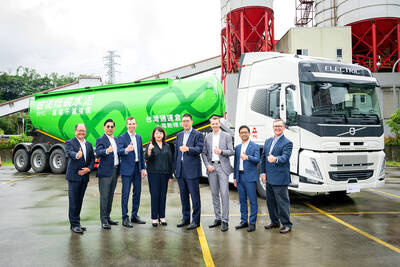
Taiwan Transport and Storage Corp (TTS, 台灣通運倉儲) yesterday unveiled its first electric tractor unit — manufactured by Volvo Trucks — in a ceremony in Taipei, and said the unit would soon be used to transport cement produced by Taiwan Cement Corp (TCC, 台灣水泥). Both TTS and TCC belong to TCC International Holdings Ltd (台泥國際集團). With the electric tractor unit, the Taipei-based cement firm would become the first in Taiwan to use electric vehicles to transport construction materials. TTS chairman Koo Kung-yi (辜公怡), Volvo Trucks vice president of sales and marketing Johan Selven, TCC president Roman Cheng (程耀輝) and Taikoo Motors Group

Among the rows of vibrators, rubber torsos and leather harnesses at a Chinese sex toys exhibition in Shanghai this weekend, the beginnings of an artificial intelligence (AI)-driven shift in the industry quietly pulsed. China manufactures about 70 percent of the world’s sex toys, most of it the “hardware” on display at the fair — whether that be technicolor tentacled dildos or hyper-realistic personalized silicone dolls. Yet smart toys have been rising in popularity for some time. Many major European and US brands already offer tech-enhanced products that can enable long-distance love, monitor well-being and even bring people one step closer to

RECORD-BREAKING: TSMC’s net profit last quarter beat market expectations by expanding 8.9% and it was the best first-quarter profit in the chipmaker’s history Taiwan Semiconductor Manufacturing Co (TSMC, 台積電), which counts Nvidia Corp as a key customer, yesterday said that artificial intelligence (AI) server chip revenue is set to more than double this year from last year amid rising demand. The chipmaker expects the growth momentum to continue in the next five years with an annual compound growth rate of 50 percent, TSMC chief executive officer C.C. Wei (魏哲家) told investors yesterday. By 2028, AI chips’ contribution to revenue would climb to about 20 percent from a percentage in the low teens, Wei said. “Almost all the AI innovators are working with TSMC to address the
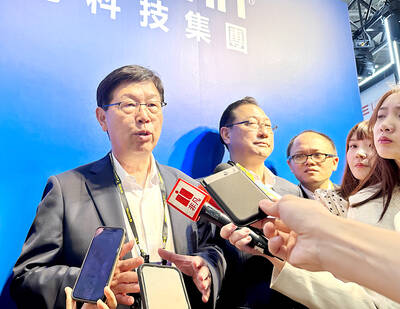
FUTURE PLANS: Although the electric vehicle market is getting more competitive, Hon Hai would stick to its goal of seizing a 5 percent share globally, Young Liu said Hon Hai Precision Industry Co (鴻海精密), a major iPhone assembler and supplier of artificial intelligence (AI) servers powered by Nvidia Corp’s chips, yesterday said it has introduced a rotating chief executive structure as part of the company’s efforts to cultivate future leaders and to enhance corporate governance. The 50-year-old contract electronics maker reported sizable revenue of NT$6.16 trillion (US$189.67 billion) last year. Hon Hai, also known as Foxconn Technology Group (富士康科技集團), has been under the control of one man almost since its inception. A rotating CEO system is a rarity among Taiwanese businesses. Hon Hai has given leaders of the company’s six


 RSS
RSS