


Syngenta, the Swiss agrochemicals company, was fined US$375,000 by the US Department of Agriculture for inadvertently selling unapproved genetically altered corn seed, the company said on Friday.
The Department of Agriculture also required Syngenta to develop a training program to keep the mix-up in seeds from happening again, the company said.
"We welcome the settlement with the USDA and the government's conclusion that Syngenta's misidentification of Bt 10 corn, while a regrettable mistake, does not pose any risks to consumers, public health or the environment," said Mike Mack, chief operating officer of Syngenta Seeds, a unit of Syngenta in Golden Valley, Minnesota.
Markus Payer, a spokesman for Syngenta in Basel, Switzerland, said the EU had also asked for details on the mix-up in the unapproved seed, Bt 10. On Tuesday the European Commission said it thought that about 1,000 tonnes of the unauthorized corn entered union countries as animal feed, corn flour and corn oil.
The EU, which has strict limits on the use of genetically modified crops, also asked Syngenta how to identify corn grown from the Bt 10 seed, Payer said.
Syngenta reiterated on Friday that the Bt 10 corn was almost biologically identical to Bt 11, another genetically modified corn seed that has been approved in both the US and Europe.
"This has no impact on the safety of the corn," Syngenta said in a statement on Friday.
Environmentalists, however, say that the unapproved corn could promote resistance to antibiotics, a crucial difference between Bt 10 and Bt 11.
Syngenta believes that the problem began with an inadvertent switching of the two types of corn seed by its researchers in the US in the mid-1990s when some Bt 10 seeds were probably mislabeled as Bt 11, Payer said.
After Bt 11, which produces a protein toxic to the European corn borer, won approval in the US and Europe, the company set aside the development of Bt 10.
About 14,000 bags of Bt 10 seeds, or enough to plant almost 15,000 hectares, were sold from 2001 until last year, mainly to farmers in the United States, but also in Canada and Argentina, Payer said. Farmers could have produced an estimated 150,000 tonnes of corn from this area, he added. Assuming export of one-fifth of that, which is the overall ratio of corn exported to the EU, then the amount of Bt 10 corn that ended up in the European countries was probably quite small, Payer said.
Syngenta became aware of the problem late last year while conducting a review of breeding lines in the US, Payer said.
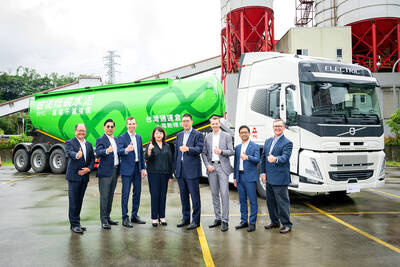
Taiwan Transport and Storage Corp (TTS, 台灣通運倉儲) yesterday unveiled its first electric tractor unit — manufactured by Volvo Trucks — in a ceremony in Taipei, and said the unit would soon be used to transport cement produced by Taiwan Cement Corp (TCC, 台灣水泥). Both TTS and TCC belong to TCC International Holdings Ltd (台泥國際集團). With the electric tractor unit, the Taipei-based cement firm would become the first in Taiwan to use electric vehicles to transport construction materials. TTS chairman Koo Kung-yi (辜公怡), Volvo Trucks vice president of sales and marketing Johan Selven, TCC president Roman Cheng (程耀輝) and Taikoo Motors Group

Among the rows of vibrators, rubber torsos and leather harnesses at a Chinese sex toys exhibition in Shanghai this weekend, the beginnings of an artificial intelligence (AI)-driven shift in the industry quietly pulsed. China manufactures about 70 percent of the world’s sex toys, most of it the “hardware” on display at the fair — whether that be technicolor tentacled dildos or hyper-realistic personalized silicone dolls. Yet smart toys have been rising in popularity for some time. Many major European and US brands already offer tech-enhanced products that can enable long-distance love, monitor well-being and even bring people one step closer to

RECORD-BREAKING: TSMC’s net profit last quarter beat market expectations by expanding 8.9% and it was the best first-quarter profit in the chipmaker’s history Taiwan Semiconductor Manufacturing Co (TSMC, 台積電), which counts Nvidia Corp as a key customer, yesterday said that artificial intelligence (AI) server chip revenue is set to more than double this year from last year amid rising demand. The chipmaker expects the growth momentum to continue in the next five years with an annual compound growth rate of 50 percent, TSMC chief executive officer C.C. Wei (魏哲家) told investors yesterday. By 2028, AI chips’ contribution to revenue would climb to about 20 percent from a percentage in the low teens, Wei said. “Almost all the AI innovators are working with TSMC to address the

Malaysia’s leader yesterday announced plans to build a massive semiconductor design park, aiming to boost the Southeast Asian nation’s role in the global chip industry. A prominent player in the semiconductor industry for decades, Malaysia accounts for an estimated 13 percent of global back-end manufacturing, according to German tech giant Bosch. Now it wants to go beyond production and emerge as a chip design powerhouse too, Malaysian Prime Minister Anwar Ibrahim said. “I am pleased to announce the largest IC (integrated circuit) Design Park in Southeast Asia, that will house world-class anchor tenants and collaborate with global companies such as Arm [Holdings PLC],”


 RSS
RSS