


The dollar fell against the euro, erasing a weekly gain, after a report that a suspicious plane was intercepted in Rome when it flew into the no-fly zone imposed for the funeral of Pope John Paul II.
"Whenever there are rumors of terrorism, the market sells dollars," said John Cholakis, a currency trader in New York at Natexis Banques Populaires, France's fifth-biggest lender. "It got the ball rolling."
Italian officials sent two F-16 fighter planes to escort a plane to a base south of Rome after "intelligence" indicated a bomb might be aboard, said an Italian air force spokesman who asked not to be named. The plane was searched and released, the spokesman said.
The dollar fell to US$1.2932 per euro at 5pm in New York, from US$1.2857 late yesterday, and dropped 0.1 percent this week, according to electronic currency-dealing system EBS. It fell to ?108.24, from ?108.62, for a weekly gain of 0.6 percent. The dollar reached US$1.28 per euro on April 5, the strongest since February.
"The dollar really never recovered from that airline scare," said Tim Mazanec, senior currency strategist in Boston at Investors Bank & Trust Co.
Euro buyers also emerged as the European currency approached the US$1.28 level, said Enrico Caruso, chief currency trader at currency hedge fund Tempest Asset Management in Newport Beach, California.
"The gist of the day was trying to take out US$1.28," which would have triggered pre-set euro sell orders and exacerbated the euro's drop, he said. "The battle was lost at US$1.28."
Speculation that central banks were selling dollars and buying euros near US$1.28 also fed into the dollar's decline, Caruso said.
The dollar gained in earlier trading, putting it on track for a fourth week of gains against the euro, after Federal Reserve Bank of St. Louis President William Poole said policy makers may need to lift interest rates "more vigorously" should inflation accelerate.
Bigger rate increases by the Fed may widen the gap with Europe and Japan, where policy makers left borrowing costs unchanged this week. Evidence the Fed is concerned inflation pressure is building helped spur the dollar to a seven-week high against the euro and five-month high versus the yen on April 5.
"The potential of continued rate hikes is going to be dollar-supportive," particularly if the Fed opts for bigger rate boosts, said Firas Askari, head of currency trading in Toronto at the Bank of Montreal. "It's just interest rate differentials. Money flocks there."
Demand for the dollar also climbed yesterday after Philadelphia Federal Reserve Bank president Anthony Santomero signaled he wasn't worried about last month's slowdown in job growth, in a speech in Washington.
"Should we see evidence that we are really getting into a more fundamental inflation problem, which I say is not my best guess, then you are going to see the Federal Reserve react more vigorously," Poole told reporters late yesterday after a speech in St. Louis. He doesn't vote on interest rates this year.
European Central Bank policy makers yesterday left their benchmark interest rate at 2 percent, and the Bank of Japan this week kept borrowing costs near zero. The Fed has lifted its target a quarter point seven times since June, to 2.75 percent.
The dollar may struggle going into next week as a government report is projected to show the US trade deficit probably widened in February to US$59 billion.
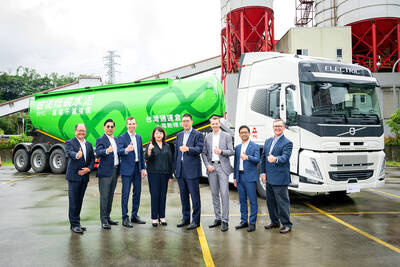
Taiwan Transport and Storage Corp (TTS, 台灣通運倉儲) yesterday unveiled its first electric tractor unit — manufactured by Volvo Trucks — in a ceremony in Taipei, and said the unit would soon be used to transport cement produced by Taiwan Cement Corp (TCC, 台灣水泥). Both TTS and TCC belong to TCC International Holdings Ltd (台泥國際集團). With the electric tractor unit, the Taipei-based cement firm would become the first in Taiwan to use electric vehicles to transport construction materials. TTS chairman Koo Kung-yi (辜公怡), Volvo Trucks vice president of sales and marketing Johan Selven, TCC president Roman Cheng (程耀輝) and Taikoo Motors Group

Among the rows of vibrators, rubber torsos and leather harnesses at a Chinese sex toys exhibition in Shanghai this weekend, the beginnings of an artificial intelligence (AI)-driven shift in the industry quietly pulsed. China manufactures about 70 percent of the world’s sex toys, most of it the “hardware” on display at the fair — whether that be technicolor tentacled dildos or hyper-realistic personalized silicone dolls. Yet smart toys have been rising in popularity for some time. Many major European and US brands already offer tech-enhanced products that can enable long-distance love, monitor well-being and even bring people one step closer to

RECORD-BREAKING: TSMC’s net profit last quarter beat market expectations by expanding 8.9% and it was the best first-quarter profit in the chipmaker’s history Taiwan Semiconductor Manufacturing Co (TSMC, 台積電), which counts Nvidia Corp as a key customer, yesterday said that artificial intelligence (AI) server chip revenue is set to more than double this year from last year amid rising demand. The chipmaker expects the growth momentum to continue in the next five years with an annual compound growth rate of 50 percent, TSMC chief executive officer C.C. Wei (魏哲家) told investors yesterday. By 2028, AI chips’ contribution to revenue would climb to about 20 percent from a percentage in the low teens, Wei said. “Almost all the AI innovators are working with TSMC to address the

Malaysia’s leader yesterday announced plans to build a massive semiconductor design park, aiming to boost the Southeast Asian nation’s role in the global chip industry. A prominent player in the semiconductor industry for decades, Malaysia accounts for an estimated 13 percent of global back-end manufacturing, according to German tech giant Bosch. Now it wants to go beyond production and emerge as a chip design powerhouse too, Malaysian Prime Minister Anwar Ibrahim said. “I am pleased to announce the largest IC (integrated circuit) Design Park in Southeast Asia, that will house world-class anchor tenants and collaborate with global companies such as Arm [Holdings PLC],”


 RSS
RSS