


The nation's lenders will be banned from airing their television, movie and radio advertisements for cash-advance cards, as the financial regulator decides to use stricter regulations to govern the popular consumer banking product.
Taking effect on May 1, the new rules will also prohibit the cash-card advertisements to be shown on outdoor billboards, the Financial Supervisory Commission said. In addition, any applicant who already owns five cash cards will be required to present salary or financial statements when applying for an additional one.
The commission came up with the new rules with the Bankers Association (
A Consumers' Foundation (
"This is belated justice as the cash-card business has already created negative effects, especially on young people, for years," said Terry Huang (
"But the rules saying cardholders with more than five cash cards or a total credit line exceeding NT$1 million will be supervised still fall short of our expectations. Every card application should be carefully monitored," Huang added.
Cash cards, which first appeared in the Taiwan market after Cosmos Bank Taiwan (
The three largest cash-card issuing banks control more than 50 percent of the market: Cosmos Bank, Taishin International Bank (台新銀行) and Chinatrust Commercial Bank (中國信託).
The eligibility requirements for cash cards are significantly lower than those for other types of consumer debt including credit cards, with some banks even issuing cards to prospective applicants with no steady income. Consequently, the abuse of cash cards by young users has forced the financial regulator to demand local lenders equip themselves with sophisticated monitoring and collection systems, as well as comprehensive credit policies to control credit risk.
A Taishin public-relations official said the new restrictions on cash card advertisements will not create a marked impact on business because other marketing methods are still available, such as ads in newspapers, magazines and on the Internet.
"Our investment in TV commercials does not constitute a major proportion of this. However, we think these regulations might deal a big blow to the largest issuer, Cosmos Bank, or the small competitors who rely much on TV commercials for image publicity," the official said.

Taiwan Transport and Storage Corp (TTS, 台灣通運倉儲) yesterday unveiled its first electric tractor unit — manufactured by Volvo Trucks — in a ceremony in Taipei, and said the unit would soon be used to transport cement produced by Taiwan Cement Corp (TCC, 台灣水泥). Both TTS and TCC belong to TCC International Holdings Ltd (台泥國際集團). With the electric tractor unit, the Taipei-based cement firm would become the first in Taiwan to use electric vehicles to transport construction materials. TTS chairman Koo Kung-yi (辜公怡), Volvo Trucks vice president of sales and marketing Johan Selven, TCC president Roman Cheng (程耀輝) and Taikoo Motors Group

Among the rows of vibrators, rubber torsos and leather harnesses at a Chinese sex toys exhibition in Shanghai this weekend, the beginnings of an artificial intelligence (AI)-driven shift in the industry quietly pulsed. China manufactures about 70 percent of the world’s sex toys, most of it the “hardware” on display at the fair — whether that be technicolor tentacled dildos or hyper-realistic personalized silicone dolls. Yet smart toys have been rising in popularity for some time. Many major European and US brands already offer tech-enhanced products that can enable long-distance love, monitor well-being and even bring people one step closer to
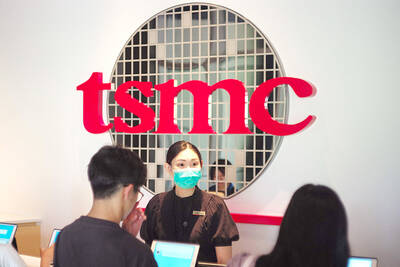
RECORD-BREAKING: TSMC’s net profit last quarter beat market expectations by expanding 8.9% and it was the best first-quarter profit in the chipmaker’s history Taiwan Semiconductor Manufacturing Co (TSMC, 台積電), which counts Nvidia Corp as a key customer, yesterday said that artificial intelligence (AI) server chip revenue is set to more than double this year from last year amid rising demand. The chipmaker expects the growth momentum to continue in the next five years with an annual compound growth rate of 50 percent, TSMC chief executive officer C.C. Wei (魏哲家) told investors yesterday. By 2028, AI chips’ contribution to revenue would climb to about 20 percent from a percentage in the low teens, Wei said. “Almost all the AI innovators are working with TSMC to address the

Malaysia’s leader yesterday announced plans to build a massive semiconductor design park, aiming to boost the Southeast Asian nation’s role in the global chip industry. A prominent player in the semiconductor industry for decades, Malaysia accounts for an estimated 13 percent of global back-end manufacturing, according to German tech giant Bosch. Now it wants to go beyond production and emerge as a chip design powerhouse too, Malaysian Prime Minister Anwar Ibrahim said. “I am pleased to announce the largest IC (integrated circuit) Design Park in Southeast Asia, that will house world-class anchor tenants and collaborate with global companies such as Arm [Holdings PLC],”


 RSS
RSS