


The state-run Chinese Petroleum Corp (CPC,
CPC, Taiwan's largest oil refiner, produces around 13 million tonnes of carbon dioxide every year, or 5 percent of the national total, company vice president Lin Cheng-Hsiung (
After the Kyoto Protocol took effect in February, the Ministry of Economic Affairs called on CPC to reduce its emissions by 450,000 tonnes over the next four years. CPC has volunteered to cut another 50,000 tonnes, mainly by boosting fuel efficiency, Lin said.
When the company established its Fifth Naphtha Cracker in Kaohsiung in 1989, CPC decided to curtail greenhouse gas emissions by using natural gas, instead of coal or fuel oil, to refine its crude oil, which costs the company an extra NT$2 billion (US$63.3 million) per year, Lin said.
Burning natural gas procures half the volume of greenhouse gases that coal does, he said.
Another measure CPC is pursuing to reduce carbon dioxide emissions is importing low-sulfur crude oil from West Africa, which currently comprises 20 percent of CPC's total oil imports and adds another NT$7 billion to NT$8 billion to the company's costs every year, according to Lin.
CPC will further lower the sulfur content in its gas oil from the current 50 parts per million (ppm) to below 10ppm by 2009, as required by the Environmental Protection Administration, he said.
As for the fluctuating global oil prices, which have triggered market speculation over the possibility of another hike in gasoline prices at home, Lin repeated that CPC will only raise prices if crude oil shoots past US$60 a barrel.
He added that a sharp rise in oil prices is not expected in the next few months, as summer in the Northern Hemisphere is an off-peak season for oil consumption.
CPC chairman Kuo Chin-tsai (郭進財) said on March 24 that the company will not raise gasoline prices if crude oil prices stay under US$60 a barrel, while Minister of Economic Affairs Ho Mei-yueh (何美玥) said on March 14 that CPC will not be allowed to raise its wholesale gasoline and diesel prices unless the company's rivals do so first.
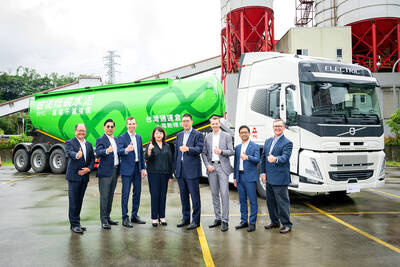
Taiwan Transport and Storage Corp (TTS, 台灣通運倉儲) yesterday unveiled its first electric tractor unit — manufactured by Volvo Trucks — in a ceremony in Taipei, and said the unit would soon be used to transport cement produced by Taiwan Cement Corp (TCC, 台灣水泥). Both TTS and TCC belong to TCC International Holdings Ltd (台泥國際集團). With the electric tractor unit, the Taipei-based cement firm would become the first in Taiwan to use electric vehicles to transport construction materials. TTS chairman Koo Kung-yi (辜公怡), Volvo Trucks vice president of sales and marketing Johan Selven, TCC president Roman Cheng (程耀輝) and Taikoo Motors Group

Among the rows of vibrators, rubber torsos and leather harnesses at a Chinese sex toys exhibition in Shanghai this weekend, the beginnings of an artificial intelligence (AI)-driven shift in the industry quietly pulsed. China manufactures about 70 percent of the world’s sex toys, most of it the “hardware” on display at the fair — whether that be technicolor tentacled dildos or hyper-realistic personalized silicone dolls. Yet smart toys have been rising in popularity for some time. Many major European and US brands already offer tech-enhanced products that can enable long-distance love, monitor well-being and even bring people one step closer to

RECORD-BREAKING: TSMC’s net profit last quarter beat market expectations by expanding 8.9% and it was the best first-quarter profit in the chipmaker’s history Taiwan Semiconductor Manufacturing Co (TSMC, 台積電), which counts Nvidia Corp as a key customer, yesterday said that artificial intelligence (AI) server chip revenue is set to more than double this year from last year amid rising demand. The chipmaker expects the growth momentum to continue in the next five years with an annual compound growth rate of 50 percent, TSMC chief executive officer C.C. Wei (魏哲家) told investors yesterday. By 2028, AI chips’ contribution to revenue would climb to about 20 percent from a percentage in the low teens, Wei said. “Almost all the AI innovators are working with TSMC to address the

Malaysia’s leader yesterday announced plans to build a massive semiconductor design park, aiming to boost the Southeast Asian nation’s role in the global chip industry. A prominent player in the semiconductor industry for decades, Malaysia accounts for an estimated 13 percent of global back-end manufacturing, according to German tech giant Bosch. Now it wants to go beyond production and emerge as a chip design powerhouse too, Malaysian Prime Minister Anwar Ibrahim said. “I am pleased to announce the largest IC (integrated circuit) Design Park in Southeast Asia, that will house world-class anchor tenants and collaborate with global companies such as Arm [Holdings PLC],”


 RSS
RSS