


Business leaders and economists yesterday urged the government not to reverse its policy of liberalizing China-bound investment, saying such a move would hurt the nation's economic development.
The remarks came after the Presidential Office announced a "seven-point" conclusion following a meeting of senior Cabinet and Democratic Progressive Party members. They said the government's move to review cross-strait policies is a reaction to China's passage of its "Anti-Secession" Law last month, but also to Chinese Nationalist Party (KMT) Vice Chairman Chiang Pin-kun's (江丙坤) trip to China last week, in which Chiang came to an agreement with Beijing officials.
The new policy aims to prevent any further private agreements by unauthorized groups or political parties, they said.
But they noted that the sixth conclusion states that the government should not simply open cross-strait investments while ignoring "effective management."
The government, opposition parties and private businesses reached a consensus in August 2001 to implement the so-called "active opening, effective management" trade policies for China-bound investment.
POLICY QUESTION
Cabinet Spokesman Chou Jung-tai (卓榮泰) stressed yesterday the policy remains unchanged. He said that the government must not ignore the "effective management" part.
Hsu Sung-ken (許松根), an industrial economist at the Academia Sinica, said effective management is indeed needed given the hostility posed by Beijing, especially after the passage of its Anti-Secession Law.
"Protecting our technology is a basic principle to ensure industry competitiveness ... furthermore, companies such as UMC have received government subsidies, so it is inappropriate for them to export technology to China," Hsu said.
The administration's latest move triggered speculation that it may implement stricter China-bound investment regulations, at a time when several government agencies are probing United Microelectronics Corp (UMC, 聯電) for possible illegal investment in a Chinese chipmaker.
Among the China-bound investment applications which await permission from the Ministry of Economic Affairs are proposals for two 10-inch wafer manufacturing plants, naphtha crackers and investments in IC design and IC packaging and testing. Those applications may be affected by the re-evaluation of investment rules.
Still, Luo Huai-jia (羅懷家), executive director of the Taiwan Electrical and Electronic Manufacturers' Association (電電公會), said political disputes should not influence economic development.
"To strengthen local industries' competitiveness, the government should not suspend the investment projects in China, or freeze negotiations on direct cargo flights as planned after the Lunar New Year," Luo said.
The government's sluggish moves to liberalize cross-strait investment has displeased local businesspeople, who urged the government to accelerate deregulation.
One such case is that of Douglas Hsu (徐旭東), chairman of the Far Eastern Group (遠東集團), who has repeatedly called for the liberalization of China-bound investment.
BUSINESSPEOPLE UNHAPPY
"Some Taiwanese businesspeople are unhappy with the government's slow progress in opening up cross-strait investment, but they remain silent to avoid getting in trouble," said Tsai Horng-ming (
Instead of trying to block investment from flowing into China, the government should help local industries take advantage of the massive and growing market, said KMT Legislator Lee Jih-chu (李紀珠), who is also an economics professor at National Chengchi University.
"We have to admit the fact that our economic dependence on China is growing, while China's dependence in Taiwan is declining," Lee said.
"Other foreign companies have already introduced the technologies that we ban in China," the lawmaker said.
If the government keeps preventing businesses from capitalizing on China's cheap labor and resources, companies such as UMC will find a way to invest there anyway by getting around regulations, Lee said.
China has become Taiwan's largest trading partner, with the bilateral trading volume reaching NT$7.66 billion in January -- a 42.5 percent jump from a year ago, according to statistics from the Ministry of Economic Affairs.
An unnamed banking executive told the Central News Agency yesterday that the banking sector will respect the government's decision in terms of adjusting its cross-strait policies.
But the executive expressed the hope that the government will continue a policy of openness when it comes to cross-strait trade and investment.

Taiwan Transport and Storage Corp (TTS, 台灣通運倉儲) yesterday unveiled its first electric tractor unit — manufactured by Volvo Trucks — in a ceremony in Taipei, and said the unit would soon be used to transport cement produced by Taiwan Cement Corp (TCC, 台灣水泥). Both TTS and TCC belong to TCC International Holdings Ltd (台泥國際集團). With the electric tractor unit, the Taipei-based cement firm would become the first in Taiwan to use electric vehicles to transport construction materials. TTS chairman Koo Kung-yi (辜公怡), Volvo Trucks vice president of sales and marketing Johan Selven, TCC president Roman Cheng (程耀輝) and Taikoo Motors Group

Among the rows of vibrators, rubber torsos and leather harnesses at a Chinese sex toys exhibition in Shanghai this weekend, the beginnings of an artificial intelligence (AI)-driven shift in the industry quietly pulsed. China manufactures about 70 percent of the world’s sex toys, most of it the “hardware” on display at the fair — whether that be technicolor tentacled dildos or hyper-realistic personalized silicone dolls. Yet smart toys have been rising in popularity for some time. Many major European and US brands already offer tech-enhanced products that can enable long-distance love, monitor well-being and even bring people one step closer to
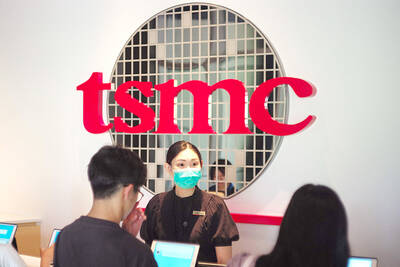
RECORD-BREAKING: TSMC’s net profit last quarter beat market expectations by expanding 8.9% and it was the best first-quarter profit in the chipmaker’s history Taiwan Semiconductor Manufacturing Co (TSMC, 台積電), which counts Nvidia Corp as a key customer, yesterday said that artificial intelligence (AI) server chip revenue is set to more than double this year from last year amid rising demand. The chipmaker expects the growth momentum to continue in the next five years with an annual compound growth rate of 50 percent, TSMC chief executive officer C.C. Wei (魏哲家) told investors yesterday. By 2028, AI chips’ contribution to revenue would climb to about 20 percent from a percentage in the low teens, Wei said. “Almost all the AI innovators are working with TSMC to address the
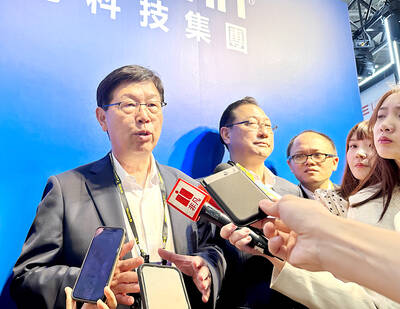
FUTURE PLANS: Although the electric vehicle market is getting more competitive, Hon Hai would stick to its goal of seizing a 5 percent share globally, Young Liu said Hon Hai Precision Industry Co (鴻海精密), a major iPhone assembler and supplier of artificial intelligence (AI) servers powered by Nvidia Corp’s chips, yesterday said it has introduced a rotating chief executive structure as part of the company’s efforts to cultivate future leaders and to enhance corporate governance. The 50-year-old contract electronics maker reported sizable revenue of NT$6.16 trillion (US$189.67 billion) last year. Hon Hai, also known as Foxconn Technology Group (富士康科技集團), has been under the control of one man almost since its inception. A rotating CEO system is a rarity among Taiwanese businesses. Hon Hai has given leaders of the company’s six


 RSS
RSS