


The Taiwan Stock Exchange Corp (TSE) said yesterday that it had not been instructed to defer a planned relaxation of the stock market's daily trading limit in September, in response to market speculation about a possible delay.
"We did not receive any instruction [to put off the plan]," TSE chairman Wu Nai-jen (吳乃仁) said in a phone interview yesterday.
The relaxation may still go ahead in September as scheduled, Wu said, without elaborating.
Premier Frank Hsieh (謝長廷) said on Monday after meeting with the Cabinet's financial and economic heads that financial authorities should more cautiously evaluate the original schedule to widen the daily trading limit to 15 percent from the current 7 percent in September.
Hsieh asked regulators to take into account the nation's financial and political stability, as well as non-economic factors overseas, and to formulate support measures before putting the loosening plan into practice.
"We can not see the exact time for implementation for the time being," local newspaper reports quoted Cabinet Spokesman Chou Jung-tai (卓榮泰) as saying yesterday.
In response, the Financial Supervisory Commission will in the near future hand over details of support measures to the Cabinet for review and finalize any necessary changes, such as those to computer systems, by the end of September, according to reports from the Central News Agency that cited the commission's vice chairman Lu Daung-yen (
Lu was not available yesterday to confirm the reports.
Despite the concerns voiced by the Cabinet, the nation's institutional investors did not seem to be worried about the relaxation plan.
"We see the possible delay in carrying out the plan as a neutral factor to the stock market," said George Wu (
The implementation is not expected to have an impact on the local bourse while a postponement is not expected to bring back a bull market, either, Wu said, adding that he thought the nation's stock market is mature enough to bear the change.
Charles Yeh (
"After all, they would need to bear the blame from investors, who are also voters, if the stock market crashes," Yeh said.
However, since the loosening measures would benefit the local bourse in the long-run by encouraging the public to make more prudent investments and pushing the stock market toward international standards, "I would like to see at least the gradual relaxation [of the daily trading limit] to 10 percent from 7 percent in September," the academic said.
Alongside the loosening policy, the authorities can introduce support measures, such as speed bumps that delay program trading, trading halts for specific stocks or circuit breakers that allow trading to be suspended to prevent panic selling, Yeh said.
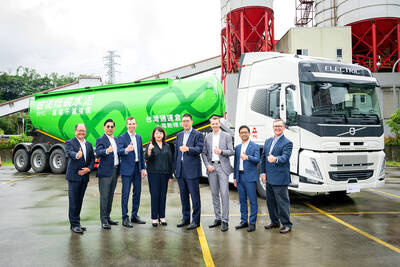
Taiwan Transport and Storage Corp (TTS, 台灣通運倉儲) yesterday unveiled its first electric tractor unit — manufactured by Volvo Trucks — in a ceremony in Taipei, and said the unit would soon be used to transport cement produced by Taiwan Cement Corp (TCC, 台灣水泥). Both TTS and TCC belong to TCC International Holdings Ltd (台泥國際集團). With the electric tractor unit, the Taipei-based cement firm would become the first in Taiwan to use electric vehicles to transport construction materials. TTS chairman Koo Kung-yi (辜公怡), Volvo Trucks vice president of sales and marketing Johan Selven, TCC president Roman Cheng (程耀輝) and Taikoo Motors Group

Among the rows of vibrators, rubber torsos and leather harnesses at a Chinese sex toys exhibition in Shanghai this weekend, the beginnings of an artificial intelligence (AI)-driven shift in the industry quietly pulsed. China manufactures about 70 percent of the world’s sex toys, most of it the “hardware” on display at the fair — whether that be technicolor tentacled dildos or hyper-realistic personalized silicone dolls. Yet smart toys have been rising in popularity for some time. Many major European and US brands already offer tech-enhanced products that can enable long-distance love, monitor well-being and even bring people one step closer to
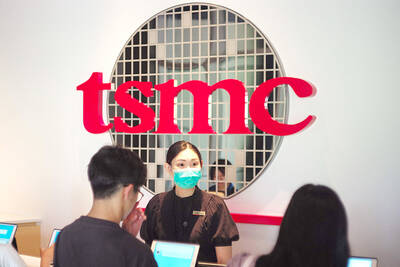
RECORD-BREAKING: TSMC’s net profit last quarter beat market expectations by expanding 8.9% and it was the best first-quarter profit in the chipmaker’s history Taiwan Semiconductor Manufacturing Co (TSMC, 台積電), which counts Nvidia Corp as a key customer, yesterday said that artificial intelligence (AI) server chip revenue is set to more than double this year from last year amid rising demand. The chipmaker expects the growth momentum to continue in the next five years with an annual compound growth rate of 50 percent, TSMC chief executive officer C.C. Wei (魏哲家) told investors yesterday. By 2028, AI chips’ contribution to revenue would climb to about 20 percent from a percentage in the low teens, Wei said. “Almost all the AI innovators are working with TSMC to address the

Malaysia’s leader yesterday announced plans to build a massive semiconductor design park, aiming to boost the Southeast Asian nation’s role in the global chip industry. A prominent player in the semiconductor industry for decades, Malaysia accounts for an estimated 13 percent of global back-end manufacturing, according to German tech giant Bosch. Now it wants to go beyond production and emerge as a chip design powerhouse too, Malaysian Prime Minister Anwar Ibrahim said. “I am pleased to announce the largest IC (integrated circuit) Design Park in Southeast Asia, that will house world-class anchor tenants and collaborate with global companies such as Arm [Holdings PLC],”


 RSS
RSS