


Much has been made of the United Microelectronics Corp's (UMC,
UMC, the world's No. 2 contract chipmaker, has been pulling out all the stops to narrow the gap between it and bigger rival Taiwan Semiconductor Manufacturing Co (TSMC,
That explains why UMC forged an ambiguous alliance with He Jian Technology, whom it called "a friendly partner" in the past, at a time when the Taiwanese government still restricts investment in and technology transfer to Chinese chipmakers for fear of losing the nation's competitive edge.
The UMC fiasco started on Feb. 15, when investigators searched the company's offices in both Taipei and Hsinchu and arrested He Jian chief executive Shyu Jiann-hwa (
After local prosecutors began questioning several He Jian engineers in early March, Tsao again published an open letter to all shareholders on March 21, announcing that UMC may obtain a 15-percent stake worth US$110 million in He Jian in exchange for UMC's past assistance. Tsao has admitted that he gave management advice to He Jian, many of whose top executives are former UMC employees.
It's still too soon to tell if Tsao -- a noted chess enthusiast -- will elude the authorities' attempts to corner him. But "UMC's crooked way of tapping into the fast-growing chip industry in China is pushing the government and its shareholders to the limit," said Bill Lan (藍新仁), a portfolio manager who helps oversee a NT$5 billion fund for Jih Sun Securities Investment Trust Co (日盛投信).
Stock regulators have requested that Tsao, who was expected to return to Taiwan from an overseas trip yesterday, give a clear explanation on the exact nature of the "assistance" UMC has provided to He Jian in exchange for the Chinese company's offer of a 15 percent stake.
Two-track policy
Premier Frank Hsieh (
Authorities' second target was Richard Chang (
The government plans to approve local chipmakers to invest in three factories in China by the end of this year to produce chips at less-advanced 0.25-micron processing technologies. TSMC is currently the only local chipmaker allowed to produce semiconductors in China.
Not convinced
Investors apparently did not buy UMC Chairman Tsao's explanation in his public statements about his company's ties with He Jian.
UMC shares plunged to NT$18.60 after hitting an all-time low of NT$18.35 in the middle of the session on March 22, a day after Tsao published a public letter.
"We almost unloaded all of our UMC shares because of the worry of UMC's losing competitiveness to He Jian," Lan said.
UMC has struggled to boost capacity usage to improve its profitability in recent quarters, while He Jian achieved the amazing success of booking profits within the first four years of its establishment, Lan said.
"The transfer of value to He Jian has been one key reason why we have been cautious on UMC," said Bhavin Shah, an analyst with JP Morgan, in his report released in mid-February.
Shah retained his underweight rating on UMC, despite signs pointing to a gradual improvement of the semiconductor industry on falling inventory.
The probe into UMC could be disruptive to the company's operations and is certainly likely to affect its reputation, Shah said.
"This will make it difficult for institutional investors to justify owning the stock," Shah said. "In the past, we have demonstrated why, at least in our view, certain decisions taken by UMC may not be in the best interests of shareholders."
Welcome change
Yeh Yin-hua (
"Shareholders' interests should be highly respected, if UMC's aid to He Jian involves the transfer of intellectual property rights held by UMC," Yeh said.
Yeh added that the 15-percent stake offer by He Jian should be valued by a third party rather than a negotiation between UMC's vice chairman John Hsuan (
But although the offer has come under fire from investors and government officials, most investors -- including Shah and Lan -- saw it in a positive light.
"The government is unlikely to OK [the] proposal in the next several months," Lan said. "But in the long run, UMC is highly likely to gain a strong foothold in China, the world's fastest-growing chip industry."

Taiwan Transport and Storage Corp (TTS, 台灣通運倉儲) yesterday unveiled its first electric tractor unit — manufactured by Volvo Trucks — in a ceremony in Taipei, and said the unit would soon be used to transport cement produced by Taiwan Cement Corp (TCC, 台灣水泥). Both TTS and TCC belong to TCC International Holdings Ltd (台泥國際集團). With the electric tractor unit, the Taipei-based cement firm would become the first in Taiwan to use electric vehicles to transport construction materials. TTS chairman Koo Kung-yi (辜公怡), Volvo Trucks vice president of sales and marketing Johan Selven, TCC president Roman Cheng (程耀輝) and Taikoo Motors Group

Among the rows of vibrators, rubber torsos and leather harnesses at a Chinese sex toys exhibition in Shanghai this weekend, the beginnings of an artificial intelligence (AI)-driven shift in the industry quietly pulsed. China manufactures about 70 percent of the world’s sex toys, most of it the “hardware” on display at the fair — whether that be technicolor tentacled dildos or hyper-realistic personalized silicone dolls. Yet smart toys have been rising in popularity for some time. Many major European and US brands already offer tech-enhanced products that can enable long-distance love, monitor well-being and even bring people one step closer to
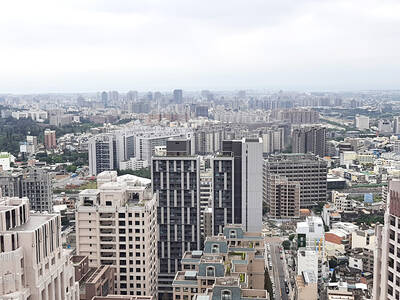
New apartments in Taiwan’s major cities are getting smaller, while old apartments are increasingly occupied by older people, many of whom live alone, government data showed. The phenomenon has to do with sharpening unaffordable property prices and an aging population, property brokers said. Apartments with one bedroom that are two years old or older have gained a noticeable presence in the nation’s six special municipalities as well as Hsinchu county and city in the past five years, Evertrust Rehouse Co (永慶房產集團) found, citing data from the government’s real-price transaction platform. In Taipei, apartments with one bedroom accounted for 19 percent of deals last
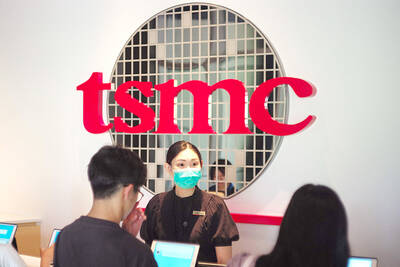
RECORD-BREAKING: TSMC’s net profit last quarter beat market expectations by expanding 8.9% and it was the best first-quarter profit in the chipmaker’s history Taiwan Semiconductor Manufacturing Co (TSMC, 台積電), which counts Nvidia Corp as a key customer, yesterday said that artificial intelligence (AI) server chip revenue is set to more than double this year from last year amid rising demand. The chipmaker expects the growth momentum to continue in the next five years with an annual compound growth rate of 50 percent, TSMC chief executive officer C.C. Wei (魏哲家) told investors yesterday. By 2028, AI chips’ contribution to revenue would climb to about 20 percent from a percentage in the low teens, Wei said. “Almost all the AI innovators are working with TSMC to address the


 RSS
RSS