


Due to a lack of effective government polices to stimulate consumer sentiment, the nation's Consumer Confidence Index last month slid to a new low in six months, although the fluctuation is minute, according to a monthly survey released by National Central University yesterday.
Composed of six components, the index edged down 1.83 points from February to 75.13 points last month as more respondents questioned in the survey turned pessimistic about the economy in the near future.
The index gauges the public's expectations on stock performance, household finances, durable goods, job opportunities, consumer price fluctuations and the domestic economic outlook for the next six months.
Public confidence in stock market investments showed the biggest drop, with 63.8 percent of respondents saying they would stay away from the stock market within the next half year, up from 58.7 percent polled in February, according to the university's Research Center for Taiwan Economic Development, the report's issuer.
The escalation of international crude oil prices, meanwhile, continues to haunt consumers, as a startling 83.8 percent said they expect consumer prices to climb, while only 13.3 percent said prices would remain stable in the near future.
Shia Ben-chang (謝邦昌), professor of statistics and information science at Fu Jen Catholic University, said weaker consumer sentiment was mainly driven by rising oil prices, the lackluster performance of stocks and China's "Anti-Secession" Law, although the law only had a limited impact.
"Although the index did not show a marked drop, it should serve as a warning to the government as it is failing to present stimulating policies to boost consumer confidence," Shia said.
"The housing market looks rosy, but people remain cautious over buying durable goods. Government officials should do something to reverse people's indifference toward the market," he added.
As only limited fluctuations in the US dollar are expected in the near future, Shia said the future trend of the Chinese yuan would play a major role in the direction of the index.
The survey interviewed 2,080 residents between March 18 and March 23.

Stephen Garrett, a 27-year-old graduate student, always thought he would study in China, but first the country’s restrictive COVID-19 policies made it nearly impossible and now he has other concerns. The cost is one deterrent, but Garrett is more worried about restrictions on academic freedom and the personal risk of being stranded in China. He is not alone. Only about 700 American students are studying at Chinese universities, down from a peak of nearly 25,000 a decade ago, while there are nearly 300,000 Chinese students at US schools. Some young Americans are discouraged from investing their time in China by what they see

Taiwan Transport and Storage Corp (TTS, 台灣通運倉儲) yesterday unveiled its first electric tractor unit — manufactured by Volvo Trucks — in a ceremony in Taipei, and said the unit would soon be used to transport cement produced by Taiwan Cement Corp (TCC, 台灣水泥). Both TTS and TCC belong to TCC International Holdings Ltd (台泥國際集團). With the electric tractor unit, the Taipei-based cement firm would become the first in Taiwan to use electric vehicles to transport construction materials. TTS chairman Koo Kung-yi (辜公怡), Volvo Trucks vice president of sales and marketing Johan Selven, TCC president Roman Cheng (程耀輝) and Taikoo Motors Group

MAJOR DROP: CEO Tim Cook, who is visiting Hanoi, pledged the firm was committed to Vietnam after its smartphone shipments declined 9.6% annually in the first quarter Apple Inc yesterday said it would increase spending on suppliers in Vietnam, a key production hub, as CEO Tim Cook arrived in the country for a two-day visit. The iPhone maker announced the news in a statement on its Web site, but gave no details of how much it would spend or where the money would go. Cook is expected to meet programmers, content creators and students during his visit, online newspaper VnExpress reported. The visit comes as US President Joe Biden’s administration seeks to ramp up Vietnam’s role in the global tech supply chain to reduce the US’ dependence on China. Images on
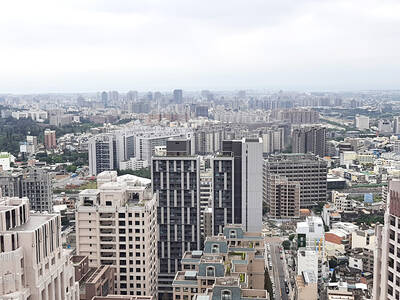
New apartments in Taiwan’s major cities are getting smaller, while old apartments are increasingly occupied by older people, many of whom live alone, government data showed. The phenomenon has to do with sharpening unaffordable property prices and an aging population, property brokers said. Apartments with one bedroom that are two years old or older have gained a noticeable presence in the nation’s six special municipalities as well as Hsinchu county and city in the past five years, Evertrust Rehouse Co (永慶房產集團) found, citing data from the government’s real-price transaction platform. In Taipei, apartments with one bedroom accounted for 19 percent of deals last


 RSS
RSS