


While the Taiwan Stock Exchange will formally implement a new measure today for new companies trading shares in Taiwan, another proposed measure is expected to have a more profound effect on the stock market in the long run, pundits said yesterday.
The stock exchange will from today allow initial public offerings (IPOs) by companies to trade without restriction for the first five days. But as from September, the stock exchange will also apply a so-called "circuit-breaker" system to prevent panic-selling in the market.
The circuit-breaker system will work as a reminder for stock investors to address excessive volatility in the local stock market without interfering in its normal daily trading, a stock exchange official said.
"Once the circuit breaker has been triggered, investors will have a short period of time to calm down and manage any downward movement of shares so as to prevent losses," said the Taiwan Stock Exchange Corp (TSE) senior executive vice president Su Song-chin (
"It will be executed once a day so as to respect the market mechanism [once the daily limit is proposed to be raised from 7 percent to 15 percent]," Su said.
The implementation of a circuit breaker is a mechanism to bring stock trading to a temporary halt to ease the market. It is usually employed when a certain index falls below a pre-determined level in one session, to prevent further losses.
The stock exchange, last Thursday, announced that it will officially phase out a rule in September that prevents locally traded stocks from rising or falling by more than 7 percent a day. The 7 percent daily limit will also be raised to 15 percent in September, according to the exchange.
Supporting measures will also kick in to ensure the stock market's stability, including the implementation of circuit breakers to halt trading for 30 minutes when the TAIEX falls by more than 10 percent from the previous day's close.
The proposed circuit breaker can be used as much as once per day but won't be employed in the last trading hour, the stock regulator's statement said.
Circuit breakers are widely used in other stock markets, like in the US and South Korea, to stop panic-selling.
According to Su, the proposed change in the share regulations follows the example of the Seoul Bourse, which also has a 15 percent daily limit.
During the 30 minutes when trading stops, the market will be given enough time to cool off and companies will have time to dissemble any negative news that impacted their share prices, while investors will have the time to make well-considered investment decisions, Su said.
According to Robert Schwartz, a finance professor at the University of New York, the circuit-breaker procedure could be effective if properly used.
But there were times it wasn't effective, Schwartz said in a paper he prepared for a AEI-Brooking Joint Center Conference in April, 2000.
For example, the US activated a circuit breaker on Oct. 27, 1997 -- a day the Dow Jones Industrial Average fell a total of 554 points, from 7,715 to 7,161. But upon the market's reopening in the afternoon, traders sensing that the market could be closed again, shot in their sell orders and the market plunged another 200 points in half an hour.
A second circuit breaker then kicked in and stopped trading for the rest of the day.
"Clearly, it is not easy to control the emotions of traders and keeping them from the market is not the way to do it," Schwartz said in the paper.
"Neither is it a good idea to prevent the market from producing much-needed price information," he said.
Therefore, Andy Liang (梁永煌), president of the Chinese-language business journal Win Win Weekly (今周刊), yesterday said that he expects the yet-to-be-launched circuit breakers and regulatory changes to have minimal impact on stock investment behaviors.
He said that the circuit breaker will only be activated when major disasters occur such as terrorist attacks, earthquakes or even tsunamis to send the benchmark down by 10 percent.
The new 15 percent daily limit, however, will positively increase investors' sense of risk, since their equity investments may now fall up to 15 percent in one trading day, Liang said.
Liang gave credit to the government's stock-regulatory changes, which are in line with international standards.
Once new regulatory changes are implemented, "Foreign investors will have more confidence in the TAIEX, whose liquidity may be further boosted," Liang said.
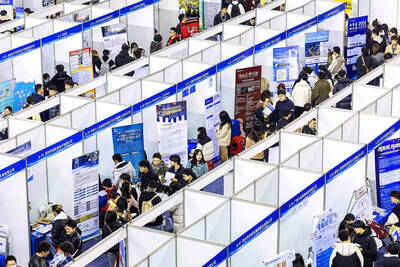
Stephen Garrett, a 27-year-old graduate student, always thought he would study in China, but first the country’s restrictive COVID-19 policies made it nearly impossible and now he has other concerns. The cost is one deterrent, but Garrett is more worried about restrictions on academic freedom and the personal risk of being stranded in China. He is not alone. Only about 700 American students are studying at Chinese universities, down from a peak of nearly 25,000 a decade ago, while there are nearly 300,000 Chinese students at US schools. Some young Americans are discouraged from investing their time in China by what they see

MAJOR DROP: CEO Tim Cook, who is visiting Hanoi, pledged the firm was committed to Vietnam after its smartphone shipments declined 9.6% annually in the first quarter Apple Inc yesterday said it would increase spending on suppliers in Vietnam, a key production hub, as CEO Tim Cook arrived in the country for a two-day visit. The iPhone maker announced the news in a statement on its Web site, but gave no details of how much it would spend or where the money would go. Cook is expected to meet programmers, content creators and students during his visit, online newspaper VnExpress reported. The visit comes as US President Joe Biden’s administration seeks to ramp up Vietnam’s role in the global tech supply chain to reduce the US’ dependence on China. Images on

Taiwan Transport and Storage Corp (TTS, 台灣通運倉儲) yesterday unveiled its first electric tractor unit — manufactured by Volvo Trucks — in a ceremony in Taipei, and said the unit would soon be used to transport cement produced by Taiwan Cement Corp (TCC, 台灣水泥). Both TTS and TCC belong to TCC International Holdings Ltd (台泥國際集團). With the electric tractor unit, the Taipei-based cement firm would become the first in Taiwan to use electric vehicles to transport construction materials. TTS chairman Koo Kung-yi (辜公怡), Volvo Trucks vice president of sales and marketing Johan Selven, TCC president Roman Cheng (程耀輝) and Taikoo Motors Group
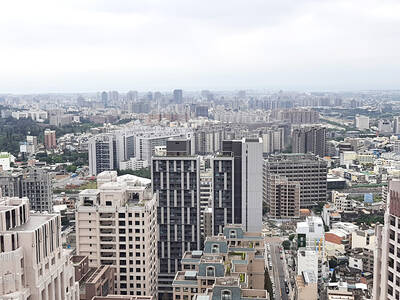
New apartments in Taiwan’s major cities are getting smaller, while old apartments are increasingly occupied by older people, many of whom live alone, government data showed. The phenomenon has to do with sharpening unaffordable property prices and an aging population, property brokers said. Apartments with one bedroom that are two years old or older have gained a noticeable presence in the nation’s six special municipalities as well as Hsinchu county and city in the past five years, Evertrust Rehouse Co (永慶房產集團) found, citing data from the government’s real-price transaction platform. In Taipei, apartments with one bedroom accounted for 19 percent of deals last


 RSS
RSS