


When Tsann Kuen Group (
Instead, its China business has so far seen heavy losses and its chairman, Wu Tsann-kuen (
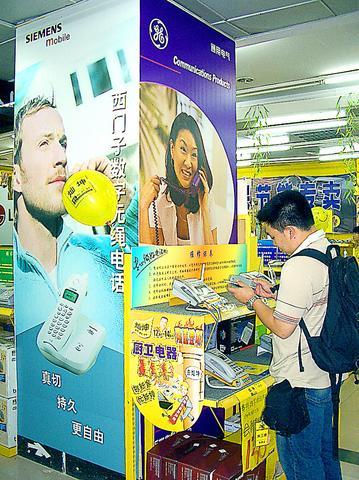
PHOTO: AMBER CHUNG, TAIPEI TIMES
"The [China] business has caused us a loss of US$31 million so far, which ate into our net profit," said the group's chief accounting officer Jack Huang (
Tsann Kuen opened more than 50 outlets across China, beginning last year. But the swelling losses have forced the company to trim back to just 31 outlets, mainly in the prosperous eastern and southern coastal areas of China.
In the first three quarters of this year, the company saw a combined net profit of US$3.02 million, which is significantly down from US$17 million a year ago, while revenue grew to US$560 million from US$310 million year-on-year, the company said last month.
Tsann Kuen, established in 1978, started out as a small home appliance maker. Its lucrative manufacturing business is expected to create US$600 million in total revenue this year and deliver 66 million units of home appliances, including coffee makers, grills and irons, to almost 90 percent of home appliance brands worldwide, such as Starbucks, Royal Philips Electronics, and General Electronic Co.
The company broke into Taiwan's home appliance and electronics retailing market in 1991 and has since expanded into the sector's dominant player with 153 outlets nationwide. In the first three quarters of this year its pre-tax income was NT$1.1 billion, with earnings per share of NT$5.06, on revenue of NT$22.89 billion.
"But it just didn't work out the way we thought," said Huang Fu-shan (
The fast expansion tactics also led to soaring costs for the retail in rental, personnel and inventory, he added.
The company, for instance, intended to set a new standard by using clean and purely yellow-colored outer walls and interior designs hoping it would help differentiate the chain from rivals in China in order to attract a growing number of China's wealthy customers, Huang Fu-shan said.
But they soon discovered that China's retail environment is very different, and they replaced their stores' design with colorful, large advertisements of various product brands to grab consumers' attention while securing extra advertising income from those vendors.
"Unlike Taiwan, the competition among product brands in China is far sharper than that among retailers," Huang Fu-shan said. He noted that Chinese electronics retailers are more like landlords that lease space to product vendors who not only bear all the costs including furnishing, personnel and inventory but pay rebates to retailers on monthly, quarterly, or even yearly basis.
In Taiwan, Tsann Kuen's salesclerks usually don't want to bother shoppers who are browsing in their stores. But customers in China have different shopping behavior, and actually feel insulted that no clerks come up to help them. Therefore they have introduced "shopping guides" in their China outlets, which have gotten a positive response from customers, Huang said.
Following the adoption of a new operating model since the middle of this year, the retailer has seen sales increase by around 60 percent, boosting the monthly revenue of a single store to between 12 million and 13 million Chinese yuan from 8 million yuan before, he added.
Tsann Kuen hopes its new business strategy will help its retail business in China break even by October next year, Huang said, noting that the company has received positive support from Taiwanese lenders such as Taishin International Bank (台新銀行) and Chinatrust Commercial Bank (中國信託). These banks, however, declined to comment.
To analysts, the clearance of inventory is the key issue to the retailer's future success.
"The company's retail business in China will see better performance only when they improve inventory management," said Chen Yen-liang (
"Tsann Kuen is still groping for ways to be successful in China like it was in its home market," the analyst said on condition of anonymity. Whether Tsann Kuen's new strategy will pay off is yet to be seen, he said.
But the company's advantages -- entering the China market early and a common cultural background with Chinese -- should help it withstand competition from foreign players once China lifts its restrictions over foreign capital's direct investment in the country's retailing this month, the analyst added.
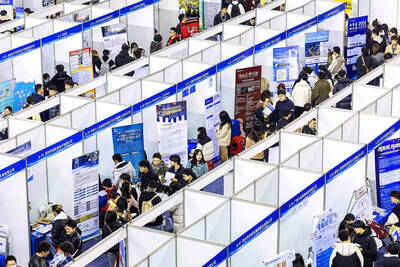
Stephen Garrett, a 27-year-old graduate student, always thought he would study in China, but first the country’s restrictive COVID-19 policies made it nearly impossible and now he has other concerns. The cost is one deterrent, but Garrett is more worried about restrictions on academic freedom and the personal risk of being stranded in China. He is not alone. Only about 700 American students are studying at Chinese universities, down from a peak of nearly 25,000 a decade ago, while there are nearly 300,000 Chinese students at US schools. Some young Americans are discouraged from investing their time in China by what they see
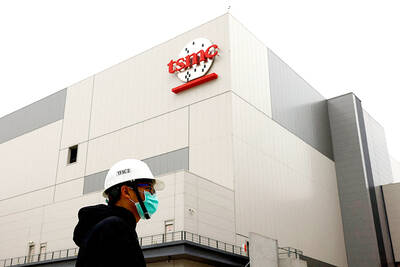
Taiwan Semiconductor Manufacturing Co (TSMC, 台積電), the world’s largest contract chipmaker, yesterday reported record sales for the first quarter, which analysts attributed to solid demand for emerging technologies. Consolidated revenue totaled NT$592.64 billion (US$18.51 billion) in the January-to-March period, up 16.5 percent from a year earlier, but down 5.26 percent from the previous quarter, TSMC said in a statement. The first-quarter revenue beat analysts’ average projection of NT$579.5 billion, Bloomberg News reported. That performance lends weight to expectations that the world’s most valuable chipmaker would return to solid growth this year after weathering a post-COVID-19-pandemic cratering of smartphone and computer sales. TSMC is budgeting

MAJOR DROP: CEO Tim Cook, who is visiting Hanoi, pledged the firm was committed to Vietnam after its smartphone shipments declined 9.6% annually in the first quarter Apple Inc yesterday said it would increase spending on suppliers in Vietnam, a key production hub, as CEO Tim Cook arrived in the country for a two-day visit. The iPhone maker announced the news in a statement on its Web site, but gave no details of how much it would spend or where the money would go. Cook is expected to meet programmers, content creators and students during his visit, online newspaper VnExpress reported. The visit comes as US President Joe Biden’s administration seeks to ramp up Vietnam’s role in the global tech supply chain to reduce the US’ dependence on China. Images on
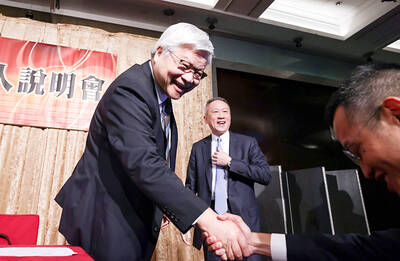
US CONSCULTANT: The US Department of Commerce’s Ursula Burns is a rarely seen US government consultant to be put forward to sit on the board, nominated as an independent director Taiwan Semiconductor Manufacturing Co (TSMC, 台積電), the world’s largest contract chipmaker, yesterday nominated 10 candidates for its new board of directors, including Ursula Burns from the US Department of Commerce. It is rare that TSMC has nominated a US government consultant to sit on its board. Burns was nominated as one of seven independent directors. She is vice chair of the department’s Advisory Council on Supply Chain Competitiveness. Burns is to stand for election at TSMC’s annual shareholders’ meeting on June 4 along with the rest of the candidates. TSMC chairman Mark Liu (劉德音) was not on the list after in December last


 RSS
RSS