


The government plans to form a mergers and acquisitions (M&A) task force, led by the chair of the nation's financial watchdog, to push forward President Chen Shui-bian's (
"The task force will recruit M&A experts from within the commission and organize consultations with several internationally renowned financial consulting companies within one month, before hammering out concrete measures in December in order to meet the president's financial goals," said Financial Supervisory Commission chairman Kong Jaw-sheng (龔照勝) at a press conference yesterday.
"Local banks need to get bigger in size or assets, in order to compete with their regional rivals in the Asia-Pacific markets," he said.
Although the banker-turned-official believes that the president's financial goals are attainable, he said that "the market mechanism, instead of government intervention, will be respected to accelerate the financial sector's consolidation through M&As."
After meeting with his economic advisors, the president on Wednesday, said he hopes to reduce the number of state-run banks from 12 to six by the end of next year, while increasing the market share of three domestic banks to above 10 percent each.
Chen also proposed halving the number of financial holding companies by 2006, while encouraging at least one domestic bank to list shares in an overseas stock market or to turn its management over to a foreign owner.
According to Kong, the government will provide tax and business incentives to encourage mergers among the nation's financial institutions while playing an active role in facilitating the private sector's consolidation.
For example, the nation's financial holding companies will be allowed to relocate branches if the market share of their banking subsidiaries exceeds 10 percent. Otherwise, poorly performing banks will be encouraged to seek merger opportunities with other competitive financial institutions, according to Kong.
Citing a survey conducted by the Taiwan Academy of Banking and Finance (
Previously, Kong had said that financial authorities have decided to halt the issuance of new branch licenses, meaning that financial institutions will have no way of expanding their number of branches in the future except through acquiring smaller rival banks.
He rejected a notion that the authorities will stop issuing new licenses to financial holding companies, however, saying that the seven strongest mega banks will remain in the marketplace, be they newly established or not.
Although the Ministry of Finance is the biggest shareholder in the 12 state-owned banks, the yet-to-be-established task force will also coordinate with the ministry to reduce the number of state-owned banks to six by next year, Kong said.
The government plans to develop up to three of the domestic financial institutions into regional players, while urging banks to take up over 10 percent of market share.
It is also welcoming foreign investors to take up controlling stakes in domestic banks or completely take over local banks.
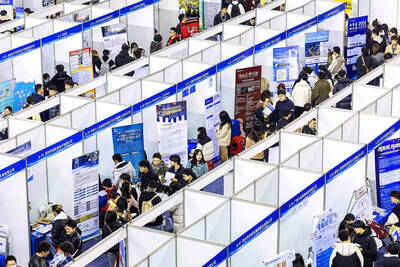
Stephen Garrett, a 27-year-old graduate student, always thought he would study in China, but first the country’s restrictive COVID-19 policies made it nearly impossible and now he has other concerns. The cost is one deterrent, but Garrett is more worried about restrictions on academic freedom and the personal risk of being stranded in China. He is not alone. Only about 700 American students are studying at Chinese universities, down from a peak of nearly 25,000 a decade ago, while there are nearly 300,000 Chinese students at US schools. Some young Americans are discouraged from investing their time in China by what they see
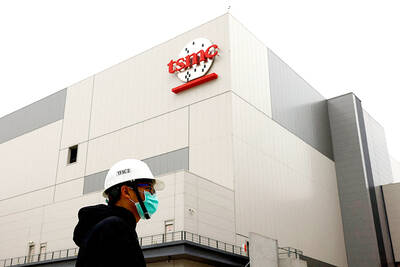
Taiwan Semiconductor Manufacturing Co (TSMC, 台積電), the world’s largest contract chipmaker, yesterday reported record sales for the first quarter, which analysts attributed to solid demand for emerging technologies. Consolidated revenue totaled NT$592.64 billion (US$18.51 billion) in the January-to-March period, up 16.5 percent from a year earlier, but down 5.26 percent from the previous quarter, TSMC said in a statement. The first-quarter revenue beat analysts’ average projection of NT$579.5 billion, Bloomberg News reported. That performance lends weight to expectations that the world’s most valuable chipmaker would return to solid growth this year after weathering a post-COVID-19-pandemic cratering of smartphone and computer sales. TSMC is budgeting

MAJOR DROP: CEO Tim Cook, who is visiting Hanoi, pledged the firm was committed to Vietnam after its smartphone shipments declined 9.6% annually in the first quarter Apple Inc yesterday said it would increase spending on suppliers in Vietnam, a key production hub, as CEO Tim Cook arrived in the country for a two-day visit. The iPhone maker announced the news in a statement on its Web site, but gave no details of how much it would spend or where the money would go. Cook is expected to meet programmers, content creators and students during his visit, online newspaper VnExpress reported. The visit comes as US President Joe Biden’s administration seeks to ramp up Vietnam’s role in the global tech supply chain to reduce the US’ dependence on China. Images on
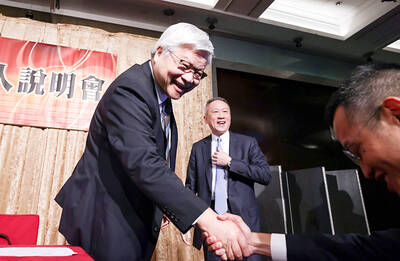
US CONSCULTANT: The US Department of Commerce’s Ursula Burns is a rarely seen US government consultant to be put forward to sit on the board, nominated as an independent director Taiwan Semiconductor Manufacturing Co (TSMC, 台積電), the world’s largest contract chipmaker, yesterday nominated 10 candidates for its new board of directors, including Ursula Burns from the US Department of Commerce. It is rare that TSMC has nominated a US government consultant to sit on its board. Burns was nominated as one of seven independent directors. She is vice chair of the department’s Advisory Council on Supply Chain Competitiveness. Burns is to stand for election at TSMC’s annual shareholders’ meeting on June 4 along with the rest of the candidates. TSMC chairman Mark Liu (劉德音) was not on the list after in December last


 RSS
RSS