


The world will be living with volatile oil prices for years to come, but this year's price spike should not be serious enough to push the country into a recession, Federal Reserve Chairman Alan Greenspan said on Friday.
Greenspan gave a generally upbeat assessment of the economy's ability to withstand the spike in oil prices of recent months, saying that he did not believe the country will see a replay of the oil shocks of the 1970s and early 1980s that triggered a series of recessions. But he added some major qualifiers.
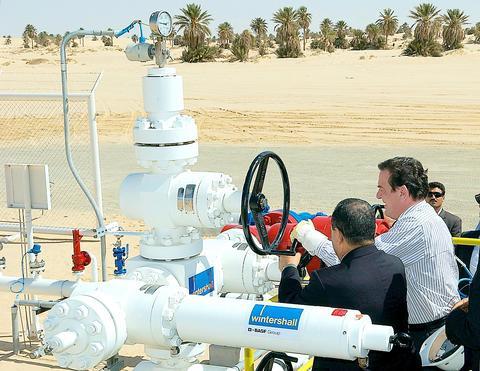
PHOTO: EPA
"We and the rest of the world doubtless will have to live with the uncertainties of the oil markets for some time to come," he said in a speech to an Italian-American group.
Greenspan also said his forecast of a milder economic impact from the current price spike depended on oil prices not rising significantly higher than they already have.
"Obviously, the risk of more serious negative consequences would intensify if oil prices were to move materially higher," Greenspan said.
The Fed chairman spoke on a day when crude oil prices climbed further into record territory, with the price in New York trading hitting US$54.93, up US$0.17 from Thursday's record close.
Greenspan said that even at current levels, crude oil prices are still about 40 percent below the all-time highs -- in inflation-adjusted terms -- of February 1981.
"The impact of the current surge in oil prices, though noticeable, is likely to prove less consequential to economic growth and inflation than in the 1970s," Greenspan said.
His comments had a soothing impact on Wall Street, giving a boost to stock prices that had suffered a 153-point drop over the previous two days as investors faced new supply worries due to threats to production in the Middle East and other key oil producing countries. The Dow Jones industrial average rose 38.93 points on Friday to close at 9,933.38.
Greenspan predicted the global economy will adjust to the recent surge in prices by boosting energy exploration and production and by increasing fuel efficiency.
He said this year's rise in oil prices, which currently stand 80 percent higher than 12 months ago, had the effect of imposing a tax on US consumers equivalent to 0.75 percent of the country's total economic output, or about US$80 billion.
That was a smaller dampening effect than the oil crises of the 1970s and early 1980s, he said, which were severe enough to send the country into a number of recessions.
"Greenspan is saying that the increase in energy prices is a minor, not a major, problem," said David Wyss, chief economist at Standard & Poor's in New York. "But nobody knows for sure because nobody knows what is going to happen in the Middle East."
Wyss said he believes oil price increases that have already occurred will trim about 1 percentage point from economic growth next year. He is forecasting the gross domestic product will expand by just 3.5 percent next year, compared with estimates by many analysts of 4 percent-plus GDP growth this year.
Greenspan several months ago said the jump in oil prices had helped push the country into a "soft patch" of sharply slower economic growth as consumers cut back drastically on their spending. However, last month Greenspan said he believed the economy has "regained some traction."

Taiwan Transport and Storage Corp (TTS, 台灣通運倉儲) yesterday unveiled its first electric tractor unit — manufactured by Volvo Trucks — in a ceremony in Taipei, and said the unit would soon be used to transport cement produced by Taiwan Cement Corp (TCC, 台灣水泥). Both TTS and TCC belong to TCC International Holdings Ltd (台泥國際集團). With the electric tractor unit, the Taipei-based cement firm would become the first in Taiwan to use electric vehicles to transport construction materials. TTS chairman Koo Kung-yi (辜公怡), Volvo Trucks vice president of sales and marketing Johan Selven, TCC president Roman Cheng (程耀輝) and Taikoo Motors Group

MAJOR DROP: CEO Tim Cook, who is visiting Hanoi, pledged the firm was committed to Vietnam after its smartphone shipments declined 9.6% annually in the first quarter Apple Inc yesterday said it would increase spending on suppliers in Vietnam, a key production hub, as CEO Tim Cook arrived in the country for a two-day visit. The iPhone maker announced the news in a statement on its Web site, but gave no details of how much it would spend or where the money would go. Cook is expected to meet programmers, content creators and students during his visit, online newspaper VnExpress reported. The visit comes as US President Joe Biden’s administration seeks to ramp up Vietnam’s role in the global tech supply chain to reduce the US’ dependence on China. Images on
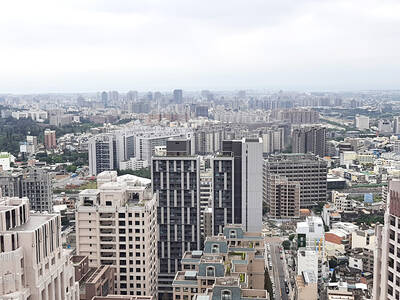
New apartments in Taiwan’s major cities are getting smaller, while old apartments are increasingly occupied by older people, many of whom live alone, government data showed. The phenomenon has to do with sharpening unaffordable property prices and an aging population, property brokers said. Apartments with one bedroom that are two years old or older have gained a noticeable presence in the nation’s six special municipalities as well as Hsinchu county and city in the past five years, Evertrust Rehouse Co (永慶房產集團) found, citing data from the government’s real-price transaction platform. In Taipei, apartments with one bedroom accounted for 19 percent of deals last
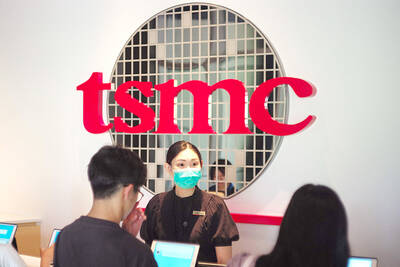
RECORD-BREAKING: TSMC’s net profit last quarter beat market expectations by expanding 8.9% and it was the best first-quarter profit in the chipmaker’s history Taiwan Semiconductor Manufacturing Co (TSMC, 台積電), which counts Nvidia Corp as a key customer, yesterday said that artificial intelligence (AI) server chip revenue is set to more than double this year from last year amid rising demand. The chipmaker expects the growth momentum to continue in the next five years with an annual compound growth rate of 50 percent, TSMC chief executive officer C.C. Wei (魏哲家) told investors yesterday. By 2028, AI chips’ contribution to revenue would climb to about 20 percent from a percentage in the low teens, Wei said. “Almost all the AI innovators are working with TSMC to address the


 RSS
RSS