


By the end of next year, Taipei City will become the first city where people will be able to access the Internet with their notebook computers, personal digital assistants (PDAs) or even mobile phones via wireless networks wherever they go, Mayor Ma Ying-jeou (
Ma made the announcement during a press conference that was also attended by Carly Fiorina, chairman and CEO of computer giant Hewlett-Packard Co (HP), who was in town for a two-day business visit.
HP is serving as chief consultant of the city's "M-City" (mobile city) project.
"We are entering an era where every physical process is becoming digital, mobile, virtual and personal," Fiorina said.
"Digital, mobile and virtual are perhaps obvious, but personal is all about the individual citizen or the individual consumer being more able to control their own lives and experience. This, I think, is also what M-City is all about," she added.
HP, along with other consultants including Intel Corp, Microsoft Corp and Cisco System Inc, will provide advice on design and applications for the project's five segments.
Elaborating on HP's role in the project, Andy Lai (賴昭輝), a general manager of HP Taiwan, said the company would offer suggestions on how government departments and companies can apply wireless Internet access to facilitate their business, as well as bringing in viable business models for companies.
One example Lai mentioned is a "music bar" project in conjunction with Starbucks. In a partnership with HP, Starbucks opened its first "Hear Music Coffeehouse" in its stores in March in Santa Monica, California. These facilities allow customers to create their own music compilations from a digital library and burn them to CD.
This business model can also be introduced to local companies interested in setting up kiosks that enable music or file downloading via wireless connection in the city, Lai said.
The project will be implemented by Qware Systems Inc (安源資訊), an arm of Uni-President Group (統一集團), whose tender was accepted in August. Qware will invest US$70 million to build the wireless infrastructure around Taipei, starting with 20 MRT stations, where the service is scheduled to be completed by the end of the year.
By June next year, the wireless service will provide access to 50 percent of Taipei's 2.6 million residents. This number is projected to climb to over 90 percent by the end of next year.
Currently, the city government has completed wireless infrastructure covering a 6,000m2 area in Taipei's Xinyi district.
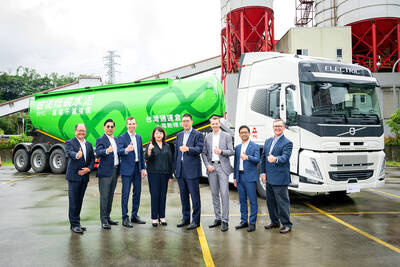
Taiwan Transport and Storage Corp (TTS, 台灣通運倉儲) yesterday unveiled its first electric tractor unit — manufactured by Volvo Trucks — in a ceremony in Taipei, and said the unit would soon be used to transport cement produced by Taiwan Cement Corp (TCC, 台灣水泥). Both TTS and TCC belong to TCC International Holdings Ltd (台泥國際集團). With the electric tractor unit, the Taipei-based cement firm would become the first in Taiwan to use electric vehicles to transport construction materials. TTS chairman Koo Kung-yi (辜公怡), Volvo Trucks vice president of sales and marketing Johan Selven, TCC president Roman Cheng (程耀輝) and Taikoo Motors Group

Among the rows of vibrators, rubber torsos and leather harnesses at a Chinese sex toys exhibition in Shanghai this weekend, the beginnings of an artificial intelligence (AI)-driven shift in the industry quietly pulsed. China manufactures about 70 percent of the world’s sex toys, most of it the “hardware” on display at the fair — whether that be technicolor tentacled dildos or hyper-realistic personalized silicone dolls. Yet smart toys have been rising in popularity for some time. Many major European and US brands already offer tech-enhanced products that can enable long-distance love, monitor well-being and even bring people one step closer to

RECORD-BREAKING: TSMC’s net profit last quarter beat market expectations by expanding 8.9% and it was the best first-quarter profit in the chipmaker’s history Taiwan Semiconductor Manufacturing Co (TSMC, 台積電), which counts Nvidia Corp as a key customer, yesterday said that artificial intelligence (AI) server chip revenue is set to more than double this year from last year amid rising demand. The chipmaker expects the growth momentum to continue in the next five years with an annual compound growth rate of 50 percent, TSMC chief executive officer C.C. Wei (魏哲家) told investors yesterday. By 2028, AI chips’ contribution to revenue would climb to about 20 percent from a percentage in the low teens, Wei said. “Almost all the AI innovators are working with TSMC to address the

Malaysia’s leader yesterday announced plans to build a massive semiconductor design park, aiming to boost the Southeast Asian nation’s role in the global chip industry. A prominent player in the semiconductor industry for decades, Malaysia accounts for an estimated 13 percent of global back-end manufacturing, according to German tech giant Bosch. Now it wants to go beyond production and emerge as a chip design powerhouse too, Malaysian Prime Minister Anwar Ibrahim said. “I am pleased to announce the largest IC (integrated circuit) Design Park in Southeast Asia, that will house world-class anchor tenants and collaborate with global companies such as Arm [Holdings PLC],”


 RSS
RSS