


Oil prices held above US$53 a barrel on Friday, marking a new record, on lingering concerns about winter fuel supplies in the US, operational snags in the Gulf of Mexico and labor strife in petroleum-rich Nigeria.
Light crude for November delivery surged US$0.64 to a new settlement high of US$53.31 per barrel on the New York Mercantile Exchange, a rise of more than US$3 per barrel from a week ago. In London, Brent crude for November delivery surged US$0.81 to US$49.71 per barrel on the International Petroleum Exchange.
"Until we reach price levels where an economic slowdown is inevitable, that means we haven't reached the high yet," said James Cordier, head trader at Liberty Trading Group Inc of Tampa, Florida.
Cordier believes "we're getting close" to the price where the global demand for oil could begin to taper off in a meaningful way, "and at that point you could have quite a correction."
While oil prices are about 79 percent higher than a year ago, they are US$27 below the peak inflation-adjusted price reached in 1981, leading many economists to conclude that the US, which is more energy efficient today, has the ability to absorb the increase without taking a big financial hit.
Still, airlines and trucking companies are getting squeezed by higher fuel costs, and retailers have blamed lackluster sales on the fact that Americans are spending more of their money getting from once place to another.
Friday's oil-price runup came as Nigerian government and labor union negotiators failed to reach an agreement on state-controlled fuel prices, setting the stage for a nationwide workers' strike on Monday in Africa's largest oil producer.
A general strike in Nigeria last year did not affect oil exports, though oil traders have pushed prices higher for months over the mere possibility of supply disruptions in Iraq, Russia and Venezuela.
The underlying concern is the world's scarce surplus production capacity, or supply buffer, which is dangerously thin at around 1 percent above the global demand of 82 million barrels daily.
"The fact is the market can't afford to have too many supply cuts. That's driving the prices high even though theoretically there is no shortage," said Victor Shum, an oil analyst for Texas-headquartered energy consultancy Purvin & Gertz in Singapore.
In a sign that high energy prices are beginning to rattle the global economy, Japan's fiscal policy minister Heizo Takenaka said the record run in oil prices threatened to derail the country's recovery and he made a plea for worldwide conservation.
"I think it's important that Japan do its utmost to conserve energy and that oil-consuming countries cooperate" to boost energy efficiency to ease price strains, Takenaka said.

Stephen Garrett, a 27-year-old graduate student, always thought he would study in China, but first the country’s restrictive COVID-19 policies made it nearly impossible and now he has other concerns. The cost is one deterrent, but Garrett is more worried about restrictions on academic freedom and the personal risk of being stranded in China. He is not alone. Only about 700 American students are studying at Chinese universities, down from a peak of nearly 25,000 a decade ago, while there are nearly 300,000 Chinese students at US schools. Some young Americans are discouraged from investing their time in China by what they see

MAJOR DROP: CEO Tim Cook, who is visiting Hanoi, pledged the firm was committed to Vietnam after its smartphone shipments declined 9.6% annually in the first quarter Apple Inc yesterday said it would increase spending on suppliers in Vietnam, a key production hub, as CEO Tim Cook arrived in the country for a two-day visit. The iPhone maker announced the news in a statement on its Web site, but gave no details of how much it would spend or where the money would go. Cook is expected to meet programmers, content creators and students during his visit, online newspaper VnExpress reported. The visit comes as US President Joe Biden’s administration seeks to ramp up Vietnam’s role in the global tech supply chain to reduce the US’ dependence on China. Images on
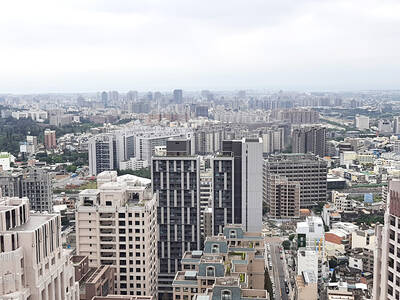
New apartments in Taiwan’s major cities are getting smaller, while old apartments are increasingly occupied by older people, many of whom live alone, government data showed. The phenomenon has to do with sharpening unaffordable property prices and an aging population, property brokers said. Apartments with one bedroom that are two years old or older have gained a noticeable presence in the nation’s six special municipalities as well as Hsinchu county and city in the past five years, Evertrust Rehouse Co (永慶房產集團) found, citing data from the government’s real-price transaction platform. In Taipei, apartments with one bedroom accounted for 19 percent of deals last

Taiwan Transport and Storage Corp (TTS, 台灣通運倉儲) yesterday unveiled its first electric tractor unit — manufactured by Volvo Trucks — in a ceremony in Taipei, and said the unit would soon be used to transport cement produced by Taiwan Cement Corp (TCC, 台灣水泥). Both TTS and TCC belong to TCC International Holdings Ltd (台泥國際集團). With the electric tractor unit, the Taipei-based cement firm would become the first in Taiwan to use electric vehicles to transport construction materials. TTS chairman Koo Kung-yi (辜公怡), Volvo Trucks vice president of sales and marketing Johan Selven, TCC president Roman Cheng (程耀輝) and Taikoo Motors Group


 RSS
RSS