


Japanese regulators have never had the reputation of being particularly tough, but after the surprisingly harsh penalty imposed against Citigroup in Japan last month, that may change.
Getting in trouble with Japanese financial regulators in the past often resulted in nothing more than a request to shape up. So it came as a shock to many in Japan's financial industry when regulators brought out the big guns and penalized Citigroup by shutting its private banking business in Japan for what they described as severe violations of banking laws.
Analysts say such harsh penalties could become more common as financial system watchdogs adopt a more aggressive stance amid sweeping changes that will allow banks to enter new businesses, like selling stocks and offering investment advice.
"This is a signal for other financial institutions to tighten up their businesses in terms of compliance," said Yoshinobu Yamada, bank analyst at Merrill Lynch, in Tokyo.
"As banks or financial institutions get more power, they need to have a very clear and tough compliance system," Yamada said.
And contrary to perceptions in the past, it is not just foreign banks that may face regulators' wrath.
Citigroup is only the second bank to have a license to operate branches revoked. In 1999, the Financial Services Agency, Japan's chief bank regulator, revoked the banking license of a Credit Suisse Group unit, Credit Suisse Financial Products, after it found that the company was engineering financial products specifically to help companies hide losses and that employees had obstructed regulators by destroying or hiding files.
One of the toughest penalties issued against Japanese financial firms came in 1999 when the agency took action against the Dai-Ichi Kangyo Bank, then the nation's third-largest lender, and three top brokerage firms, including Nomura Securities, for paying off corporate racketeers. More than two dozen executives were convicted of viola-ting securities laws and regulators shut crucial parts of the companies for up to five months.
Dai-Ichi, for instance, was prohibited from making new loans to businesses for five months and forbidden to open new branches or business lines for a year.
The penalties were estimated at the time to have resulted in hun-dreds of millions of dollars in lost revenues for the companies.
One executive at a US brokerage house in Japan said that until four or five years ago, regulators tended to look at banks in groups. If a US bank was caught in a violation, other US banks could expect to get a closer look.
But recently, he said, the regulatory agency have added personnel and become much more sophisticated. He said that there was little sense that the action against Citibank was causing alarm among foreign firms, which have been strengthening compliance in the last couple of years as signs of tougher regulation arose.
Citibank's actions were seen as overly aggressive and a clear breach of financial rules, he said.
Regulators cited a long list of problems at Citigroup's Japanese private banking unit, including failure to prevent possible money laun-dering and making loans to clients engaged in various forms of wrong-doing, including tax evasion and stock manipulation. Regulators also said bankers misled customers about investment risk and overcharged for some products.
Citigroup was ordered to stop accepting new business after Sept. 29 at the four branches where it offered private banking services and to shut those branches completely by October next year. It was barred from participating in government bond auctions.
Citigroup did not refute any of the agency's findings and pledged to change its operations in Japan.
Meanwhile, Citigroup Inc was asked by the Financial Supervisory Commission in Taipei to explain its business practices in the wake of Japan's actions.
"We have asked Citigroup to submit a formal explanation in the near term on its misdeeds in Japan," said Jong Huey-jen (鍾慧貞), director-general of the commission's Bureau of Monetary Affairs.
"Based on Citigroup's formal explanation, we'll decide whether to conduct a formal investigation," she said.
If Citigroup can prove its Jap-anese operation is an independent case, the commission won't take into account its penalties in Japan when approving licenses, or mergers and acquisitions in this country, Jong said.
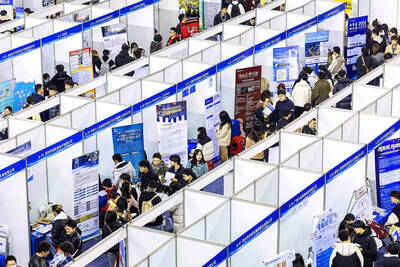
Stephen Garrett, a 27-year-old graduate student, always thought he would study in China, but first the country’s restrictive COVID-19 policies made it nearly impossible and now he has other concerns. The cost is one deterrent, but Garrett is more worried about restrictions on academic freedom and the personal risk of being stranded in China. He is not alone. Only about 700 American students are studying at Chinese universities, down from a peak of nearly 25,000 a decade ago, while there are nearly 300,000 Chinese students at US schools. Some young Americans are discouraged from investing their time in China by what they see

Taiwan Transport and Storage Corp (TTS, 台灣通運倉儲) yesterday unveiled its first electric tractor unit — manufactured by Volvo Trucks — in a ceremony in Taipei, and said the unit would soon be used to transport cement produced by Taiwan Cement Corp (TCC, 台灣水泥). Both TTS and TCC belong to TCC International Holdings Ltd (台泥國際集團). With the electric tractor unit, the Taipei-based cement firm would become the first in Taiwan to use electric vehicles to transport construction materials. TTS chairman Koo Kung-yi (辜公怡), Volvo Trucks vice president of sales and marketing Johan Selven, TCC president Roman Cheng (程耀輝) and Taikoo Motors Group

MAJOR DROP: CEO Tim Cook, who is visiting Hanoi, pledged the firm was committed to Vietnam after its smartphone shipments declined 9.6% annually in the first quarter Apple Inc yesterday said it would increase spending on suppliers in Vietnam, a key production hub, as CEO Tim Cook arrived in the country for a two-day visit. The iPhone maker announced the news in a statement on its Web site, but gave no details of how much it would spend or where the money would go. Cook is expected to meet programmers, content creators and students during his visit, online newspaper VnExpress reported. The visit comes as US President Joe Biden’s administration seeks to ramp up Vietnam’s role in the global tech supply chain to reduce the US’ dependence on China. Images on
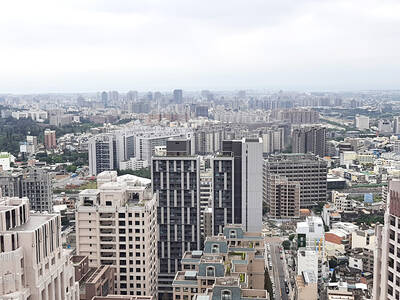
New apartments in Taiwan’s major cities are getting smaller, while old apartments are increasingly occupied by older people, many of whom live alone, government data showed. The phenomenon has to do with sharpening unaffordable property prices and an aging population, property brokers said. Apartments with one bedroom that are two years old or older have gained a noticeable presence in the nation’s six special municipalities as well as Hsinchu county and city in the past five years, Evertrust Rehouse Co (永慶房產集團) found, citing data from the government’s real-price transaction platform. In Taipei, apartments with one bedroom accounted for 19 percent of deals last


 RSS
RSS