


Deficit hawks on Friday demanded that the EU's battered budget rules be strengthened, while serial violators France and Germany insisted making them more flexible would not weaken the pact.
The differing tones at the start of a two-day meeting of EU finance ministers foreshadowed months of wrangling intended to revive the so-called stability and growth pact, which underpins the euro.
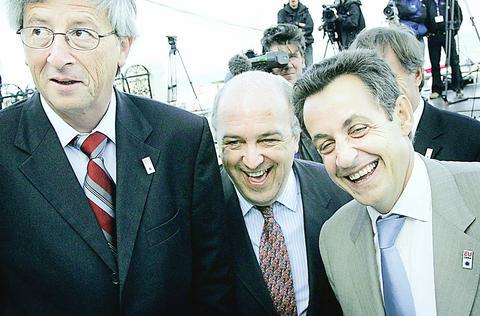
PHOTO: EPA
Arriving at this seaside resort, French Finance Minister Nicolas Sarkozy also defended his controversial proposal to deny EU development funds to new members that lure jobs from their western neighbors with low taxes.
The suggestion has provoked an outraged response from poor eastern countries that joined the EU in May, but Sarkozy said he was only responding to worries in the west about outsourcing.
"It's hard to explain to our citizens these countries are rich enough to cut their taxes ... but poor enough to merit structural funds," he said.
He told reporters he thought reforms to the so-called stability pact were "going in the right direction."
But Dutch Finance Minister Gerrit Zalm, the host, said after a day of debate that big differences remained, chiefly on whether to broaden the definition of "exceptional circumstances," when a country can get more time to bring a too-high deficit down.
Current rules allow greater leeway only in time of recession -- meaning negative growth -- but the European Commission, the EU's head office, proposed last week loosening that to include prolonged periods of weak, but still positive growth.
No agreement
"There's no agreement on that," Zalm conceded. "But we had some common ground ... that gives some hope for reaching a consensus."
Ministers charged EU Economic and Monetary Affairs Commissioner Joaquin Almunia to come back with more concrete proposals based on the initial input.
Almunia, meanwhile, signaled he would hold off on disciplinary action against France and Germany until the "same date" as when the debate on reforming the pact is finished -- meaning most likely early next year.
Paris and Berlin managed to suspend the rules last November despite repeated overspending, but the EU's top court annulled their action this summer.
The commission insists its proposals to take more account of a country's growth rate and overall debt would strengthen enforcement, but critics -- including the influential German central bank -- charge they amount to a weakening of the rules that could lead to more deficits and higher interest rates.
Zalm's Austrian counterpart and fellow deficit hawk, Karl-Heinz Grasser, said ministers had to state strongly "that they want a strict and equal implementation of the pact" to counter such perceptions.
"We are not joining a weakening of the pact," he said.
Luxembourg Prime Minister Jean-Claude Juncker, newly appointed as chief spokesman for the euro-using countries, said he wanted to see the pact made "more efficient, not more flexible.
"We should not allow compromises to weaken the pact," he said.
But German Finance Minister Hans Eichel insisted that allowing countries facing economic rough patches more time to get their house in order won't weaken the pact.
"It's not about weakening but about sensible application," he said, calling for more "economic logic."
UK Treasury chief Gordon Brown said in comments published on Friday that reforming the pact to take greater account of cycles and debt levels was "essential" for EU economic stability.
Fragile recovery
In an opinion article in the Fi-nancial Times, he also said more was needed to spur the euro-zone's chronically underperforming economy, which he said was threatening the "uneven and fragile" global recovery.
"It is the weakness of European Union growth that lies at the root of the imbalances," he wrote. "The euro zone has grown by 3 percent or more in just one of the last 10 years, while the US has averaged more than 3 percent."
Ministers were to discuss Dutch ideas for "reducing the administrative burden on companies" yesterday.
Zalm signaled he expected no action on Sarkozy's calls to punish new EU members in Eastern Europe that lure jobs from the west with low taxes.
Sarkozy -- who is expected to step down in November to bid for the leadership of French President Jacques Chirac's conservative party -- stuck to his guns on Friday. He noted that such fears could turn public opinion against the EU just as voters are being asked to approve a controversial EU constitution.
"Eight of the countries concerned will have to go through a referendum," he said. "Think about that."
Zalm said he would first see whether there was support for harmonizing the EU's corporate tax base, a commission proposal that raises hackles in Britain, Ireland and other low-tax countries -- each of which has a veto.
"If that question is answered with `no,' then all the other questions are irrelevant," Zalm said.
France and Germany are the biggest advocates of minimum taxes to prevent poaching of investment, especially by the low-wage eastern countries that joined the EU last May.
Commission figures show taxes in the east average 21.5 percent, compared to 31.4 percent in the old EU of 15 countries.
The new members argue their lower taxes are necessary to counter disadvantages such as poor infrastructure or distance from major markets.
Many look to Ireland as an example, which boomed through the 1990s through a combination of low taxes and EU funds. Ireland still has the EU's lowest corporate tax rates at 12.5 percent.
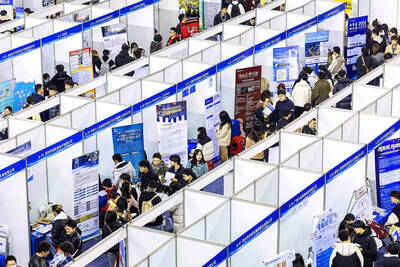
Stephen Garrett, a 27-year-old graduate student, always thought he would study in China, but first the country’s restrictive COVID-19 policies made it nearly impossible and now he has other concerns. The cost is one deterrent, but Garrett is more worried about restrictions on academic freedom and the personal risk of being stranded in China. He is not alone. Only about 700 American students are studying at Chinese universities, down from a peak of nearly 25,000 a decade ago, while there are nearly 300,000 Chinese students at US schools. Some young Americans are discouraged from investing their time in China by what they see
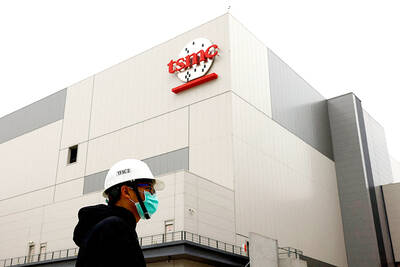
Taiwan Semiconductor Manufacturing Co (TSMC, 台積電), the world’s largest contract chipmaker, yesterday reported record sales for the first quarter, which analysts attributed to solid demand for emerging technologies. Consolidated revenue totaled NT$592.64 billion (US$18.51 billion) in the January-to-March period, up 16.5 percent from a year earlier, but down 5.26 percent from the previous quarter, TSMC said in a statement. The first-quarter revenue beat analysts’ average projection of NT$579.5 billion, Bloomberg News reported. That performance lends weight to expectations that the world’s most valuable chipmaker would return to solid growth this year after weathering a post-COVID-19-pandemic cratering of smartphone and computer sales. TSMC is budgeting
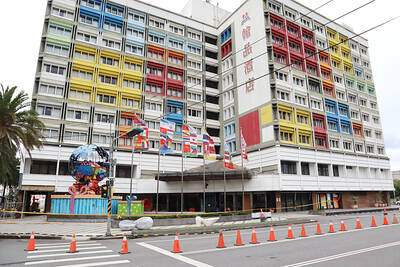
HUALIEN BRANCH: The company had been planning to rebuild the hotel before it was damaged in the quake and vowed to give affected employees the option to transfer The owner of Chateau de Chine Hualien (花蓮翰品酒店) is planning to lay off 86 workers after shutting down the hotel due to damage it sustained in a powerful earthquake on Wednesday last week, the Ministry of Labor said yesterday. The hotel has submitted a layoff report to the Hualien County Government and expects to let 69 workers go this month and 17 next month, the ministry said. LDC Hotels & Resorts Group (雲朗觀光集團), the owner of Chateau de Chine Hualien, confirmed the layoff plan in a statement yesterday. LDC said the hotel has been closed since Wednesday last week when the temblor occurred
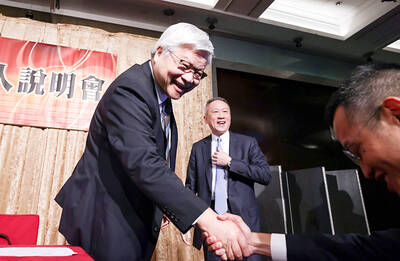
US CONSCULTANT: The US Department of Commerce’s Ursula Burns is a rarely seen US government consultant to be put forward to sit on the board, nominated as an independent director Taiwan Semiconductor Manufacturing Co (TSMC, 台積電), the world’s largest contract chipmaker, yesterday nominated 10 candidates for its new board of directors, including Ursula Burns from the US Department of Commerce. It is rare that TSMC has nominated a US government consultant to sit on its board. Burns was nominated as one of seven independent directors. She is vice chair of the department’s Advisory Council on Supply Chain Competitiveness. Burns is to stand for election at TSMC’s annual shareholders’ meeting on June 4 along with the rest of the candidates. TSMC chairman Mark Liu (劉德音) was not on the list after in December last


 RSS
RSS