


Number of SMEs rises
The number of small and medium-sized enterprises (SMEs) grew significantly last year from the previous year as the world economy improved, according to a report to be released by the Ministry of Economic Affairs.
The report said that as of the end of last year, there were 1.15 million SMEs in the nation, a 3.77 percent increase from a year ago. The number constituted 97.83 percent of all registered companies. These companies hired 7.43 million of employees, which was 77.56 percent of the nation's labor force, according to the report.
During the same period, SMEs reported NT$8.71 trillion in revenues, up by 16.17 percent from a year ago, and composed of 31.47 percent of total company revenues in the nation, the report said.
The ministry said SMEs are facing competition from China, as well as market liberalization after Taiwan joined the WTO, so the government is drafting various measures ranging from financial support, information technology application and others to advance these businesses.
Foreign reserves increase
The nation's foreign-currency reserves, the third-biggest in the world, rose in August for the 38th month to a record US$231.6 billion, the central bank said in a statement.
The figure was up from the US$230.4 billion at the end of July and up US$24.98 billion from the end of last year, the bank said.
The increase mainly reflects returns from foreign exchange reserve management, it said.
Workforce threatened
The head of the Council for Economic Planning and Development (CEPD) warned yesterday of the various crises threatening Taiwan's human resources.
While there is a shortage of highly skilled workers and a constant drain of semi-skilled workers, menial workers are facing unemployment because of the inflow of foreign workers, according to CEPD Chairman Hu Sheng-cheng (胡勝正).
Hu made the remarks during a seminar on foreign worker policy hosted by the Academia Sinica's Institute of Economics.
A study conducted by the institute shows that importing foreign workers will lower enterprises' desire to invest in research and development and thus hamper the enhancement of their technology.
To solve the problem, the study proposes that the government levy a salary tax on enterprises hiring foreign workers and use the fund to subsidize these enterprises' research and development programs.
Lehman bets on yen, NT dollar
Lehman Brothers Holdings Inc said investors should keep positions betting on a rise in the yen and the New Taiwan dollar on expectations they will be less affected than other currencies by a slowdown in the global economy.
The Japanese and Taiwanese governments have policies aimed at preventing their currencies from becoming too strong, which restrained their appreciation as global growth accelerated, Lehman said. Now these currencies are less likely than others to weaken "from the ensuing manufacturing slowdown," Lehman foreign exchange analysts wrote.
"Asian currencies are undervalued, and the mounting concerns about rising oil prices and a slowdown in China have made many of them even cheaper in recent months," Jim McCormick, Lehman's head of global currency research in London, wrote in the firm's currency-strategy report.
NT dollar stays strong
The New Taiwan dollar remained strong against its US counterpart, edging up NT$0.013 to close at NT$33.907 on the Taipei foreign exchange market.
Turnover was US$515 million.
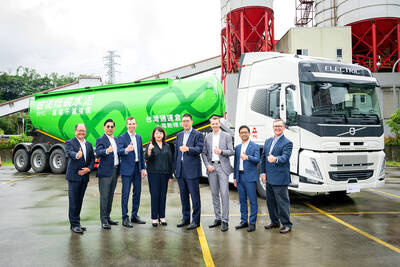
Taiwan Transport and Storage Corp (TTS, 台灣通運倉儲) yesterday unveiled its first electric tractor unit — manufactured by Volvo Trucks — in a ceremony in Taipei, and said the unit would soon be used to transport cement produced by Taiwan Cement Corp (TCC, 台灣水泥). Both TTS and TCC belong to TCC International Holdings Ltd (台泥國際集團). With the electric tractor unit, the Taipei-based cement firm would become the first in Taiwan to use electric vehicles to transport construction materials. TTS chairman Koo Kung-yi (辜公怡), Volvo Trucks vice president of sales and marketing Johan Selven, TCC president Roman Cheng (程耀輝) and Taikoo Motors Group

Among the rows of vibrators, rubber torsos and leather harnesses at a Chinese sex toys exhibition in Shanghai this weekend, the beginnings of an artificial intelligence (AI)-driven shift in the industry quietly pulsed. China manufactures about 70 percent of the world’s sex toys, most of it the “hardware” on display at the fair — whether that be technicolor tentacled dildos or hyper-realistic personalized silicone dolls. Yet smart toys have been rising in popularity for some time. Many major European and US brands already offer tech-enhanced products that can enable long-distance love, monitor well-being and even bring people one step closer to
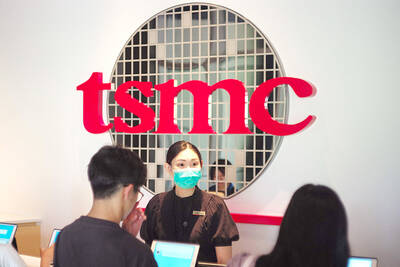
RECORD-BREAKING: TSMC’s net profit last quarter beat market expectations by expanding 8.9% and it was the best first-quarter profit in the chipmaker’s history Taiwan Semiconductor Manufacturing Co (TSMC, 台積電), which counts Nvidia Corp as a key customer, yesterday said that artificial intelligence (AI) server chip revenue is set to more than double this year from last year amid rising demand. The chipmaker expects the growth momentum to continue in the next five years with an annual compound growth rate of 50 percent, TSMC chief executive officer C.C. Wei (魏哲家) told investors yesterday. By 2028, AI chips’ contribution to revenue would climb to about 20 percent from a percentage in the low teens, Wei said. “Almost all the AI innovators are working with TSMC to address the

Malaysia’s leader yesterday announced plans to build a massive semiconductor design park, aiming to boost the Southeast Asian nation’s role in the global chip industry. A prominent player in the semiconductor industry for decades, Malaysia accounts for an estimated 13 percent of global back-end manufacturing, according to German tech giant Bosch. Now it wants to go beyond production and emerge as a chip design powerhouse too, Malaysian Prime Minister Anwar Ibrahim said. “I am pleased to announce the largest IC (integrated circuit) Design Park in Southeast Asia, that will house world-class anchor tenants and collaborate with global companies such as Arm [Holdings PLC],”


 RSS
RSS