


Rising from what was once a muddy expanse of sugar cane fields here are huge greenhouses and the concrete shells of what will soon be a flower exposition hall, a genetic modification laboratory and more -- the first steps in Taiwan's plan to dominate the world's US$2 billion orchid industry.
If the Taiwan effort is successful, orchids could lose their image as the high-priced but finicky princes of the floral world and become lesser nobility, almost as inexpensive as poinsettias. The favored flower for debutantes' corsages a generation ago, orchids are already starting to appear in rows of US$15 potted specimens at mass merchandisers like Home Depot, and seem poised to become even cheaper.
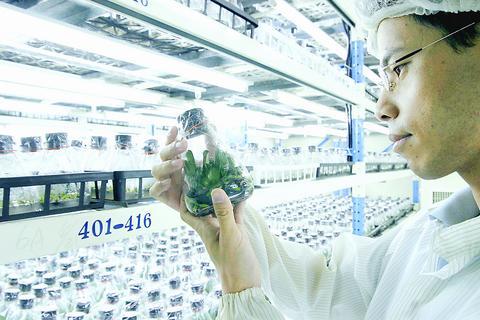
PHOTO: NY TIMES
With their mysteriously complex shapes and colors and their exotic and inaccessible homes in swamps and tropical forests, orchids were the darlings of wealthy collectors in Victorian days. They were hunted across the globe by adventurers who not infrequently gave their lives in pursuit of very rare varieties that even today can sometimes bring thousands of dollars.
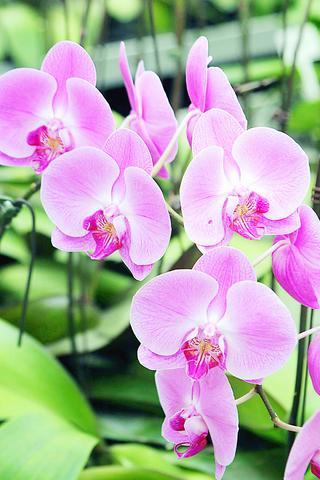
PHOTO: NY TIMES
Large commercial greenhouses have robbed orchids of some of their elite cachet since then. Now, if Taiwan is successful, there could be orchids for the masses. Seeking a cash crop to replace sugar, which is plagued by falling prices, Taiwan is hoping to double its orchid business, and the government plans to bring heavy public spending into the previously private world of growing orchids.
But Taiwan's ambitious plans to become a flower power have set off legal, economic, environmental and political debates from here to Washington.
A federal court in the US is scheduled to hear arguments this autumn from Hawaiian orchid growers who contend that Taiwan's ambitions threaten their livelihood and the environment.
Nearly a quarter of the world's orchids now spend at least part of their lives in Taiwanese greenhouses.
Taiwan produces mainly a lovely genus of orchids known as phalaenopsis, or moth orchids. The blossoms come in many hues, from gold to lilac to white, and in striped and polka-dot patterns. These are the mainstay of the orchid industry, although oncidiums also sell well. Fancier varieties sold by florists, like cattleyas and vandas, can cost several times as much.
With globalization and outsourcing, orchids have been getting ever cheaper. Many are now started in labs in industrialized countries like the US and Japan and then shipped by air in glass flasks to places like Thailand to grow. They are then shipped back by air in boxes, their roots bare of soil, to be potted and grown in greenhouses close to their final markets for the last six to eight months before they bloom.
This summer, after six years of sometimes bitter review, the US Department of Agriculture approved regulations that would allow potted phalaenopsis to be imported from Taiwan. But orchid growers in Hawaii have asked a federal court for a preliminary injunction to block the imports.
The Hawaiian growers contend that the potting material, a type of moss, could harbor dangerous insects like blood-sucking midges and tiny thrips, which can carry plant diseases.
"What effect would it have on the ecology, and the safety of our plants, with the introduction of pathogens and pests and so forth from Southeast Asia?" asked Walter Mo, the president of the Hawaii Orchid Growers Association. The Hawaiian growers are also upset by what they see as unfair subsidies from Taiwan's Democratic Progressive Party government, which favors greater independence from China.
The government of Taiwan is paying US$65 million to cover the construction costs of everything except the greenhouses -- and is offering government-backed, 10-year loans at 2 percent interest to help farmers build those.
Yen Chun-tso (
When finished, the Taiwan Orchid Plantation will have not only an exposition hall and genetics laboratory, but also a quarantine site, shipping and packing areas, a grid of new roads edged by tidy brick sidewalks and water and electrical hookups for more than 200 industrial-size greenhouses. It will create 1,500 jobs.
Like Taipei 101, which will become the world's tallest building by most measures when it opens in December, the Taiwan Orchid Plantation here is a monument to the vaulting ambitions of Chen Shui-bian (
Yen said that local officials from Chen's Democratic Progressive Party would cite the plantation in future election campaigns.
Orchid farmers here say that while they want to bring mass production to orchids, they also care deeply about their flowers. Lin Fan-jung, an orchid farmer, walked through his greenhouses recently and pointed out the unused automatic sprinkler system. It does not provide exactly the right amount of water, so workers water each plant by hand, he said.
Walking through four doors, including an air lock with powerful fans to remove dust and bacteria from visitors, Lin showed off a lab where young women wearing hair nets used sharp knives to carefully divide baby orchid plants.
Orchid buyers should never smoke around their plants because orchids are very sensitive to air pollution, he said, adding: "An orchid is something with its own life. You should take care of it like your own children." Farmers here say that they ship live potted orchids to countries across Asia, Europe and Latin America without problems from insects or diseases. Taiwan's growers persuaded the US Agriculture Department that finely woven nets over greenhouse air vents here would keep bugs away from the plants.
US growers respond that European and Japanese importers douse arriving plants with pesticides that US law does not allow. The Hawaiian growers also contend that three species of wild orchids indigenous to their islands could be devastated if dangerous insects or plant diseases arrived from Taiwan.
Taiwan has a huge advantage on labor costs. Greenhouse workers here earn US$600 a month, a third of what workers doing similar jobs earn in expensive Hawaii.
Shipping orchids in pots, instead of with bare roots in boxes, would allow Taiwan to export bigger plants that would require less time to mature in US greenhouses. After Taiwan's recent success, the Netherlands, which dominates the European market, petitioned the Agriculture Department to allow Dutch growers to ship potted phalaenopsis to the US, too; the department has not yet acted on the petition.
Many restaurants also use Thai orchids to decorate tropical meals, to the dismay of orchid experts. Leon Lin, an orchid adviser to the Tainan County government, wrinkled his nose in disgust when his lunch plate of fried rice in Hsinying, the county seat, came with a cut purple orchid on top. "All orchids are drenched with pesticides -- they should never be allowed to touch food,'' he said, grimacing as he gingerly removed the flower with his right thumb and forefinger and tossed it in the middle of the table.
As in many industries, the spectacular economic expansion in China has cushioned orchid growers somewhat from rising competition. In January, Chinese buyers bought up practically every live red orchid in Asia and Europe for Chinese New Year, paying breathtaking prices of as much as US$30 a plant at wholesale, said Andrew Easton, an executive at Kerry's Bromeliads in Homestead, Florida.
But the long-term trend in orchid prices is clearly downward, even as quality improves. Mr. Easton remembers paying US$80 in 1958 for a small purple cattleya.
"Now,'' he said, "I can get an orchid as good as that one for US$25.''
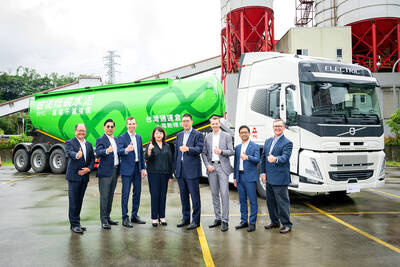
Taiwan Transport and Storage Corp (TTS, 台灣通運倉儲) yesterday unveiled its first electric tractor unit — manufactured by Volvo Trucks — in a ceremony in Taipei, and said the unit would soon be used to transport cement produced by Taiwan Cement Corp (TCC, 台灣水泥). Both TTS and TCC belong to TCC International Holdings Ltd (台泥國際集團). With the electric tractor unit, the Taipei-based cement firm would become the first in Taiwan to use electric vehicles to transport construction materials. TTS chairman Koo Kung-yi (辜公怡), Volvo Trucks vice president of sales and marketing Johan Selven, TCC president Roman Cheng (程耀輝) and Taikoo Motors Group

Among the rows of vibrators, rubber torsos and leather harnesses at a Chinese sex toys exhibition in Shanghai this weekend, the beginnings of an artificial intelligence (AI)-driven shift in the industry quietly pulsed. China manufactures about 70 percent of the world’s sex toys, most of it the “hardware” on display at the fair — whether that be technicolor tentacled dildos or hyper-realistic personalized silicone dolls. Yet smart toys have been rising in popularity for some time. Many major European and US brands already offer tech-enhanced products that can enable long-distance love, monitor well-being and even bring people one step closer to
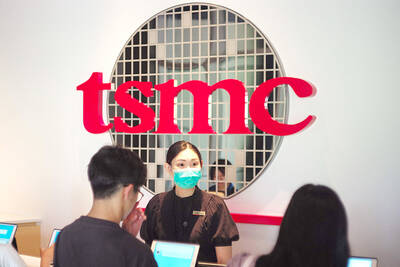
RECORD-BREAKING: TSMC’s net profit last quarter beat market expectations by expanding 8.9% and it was the best first-quarter profit in the chipmaker’s history Taiwan Semiconductor Manufacturing Co (TSMC, 台積電), which counts Nvidia Corp as a key customer, yesterday said that artificial intelligence (AI) server chip revenue is set to more than double this year from last year amid rising demand. The chipmaker expects the growth momentum to continue in the next five years with an annual compound growth rate of 50 percent, TSMC chief executive officer C.C. Wei (魏哲家) told investors yesterday. By 2028, AI chips’ contribution to revenue would climb to about 20 percent from a percentage in the low teens, Wei said. “Almost all the AI innovators are working with TSMC to address the

Malaysia’s leader yesterday announced plans to build a massive semiconductor design park, aiming to boost the Southeast Asian nation’s role in the global chip industry. A prominent player in the semiconductor industry for decades, Malaysia accounts for an estimated 13 percent of global back-end manufacturing, according to German tech giant Bosch. Now it wants to go beyond production and emerge as a chip design powerhouse too, Malaysian Prime Minister Anwar Ibrahim said. “I am pleased to announce the largest IC (integrated circuit) Design Park in Southeast Asia, that will house world-class anchor tenants and collaborate with global companies such as Arm [Holdings PLC],”


 RSS
RSS