


Asian semiconductor-related stocks fell this week on concern earnings growth will slow after Intel Corp said profit margins would fall and Merrill Lynch & Co cut its rating on the industry. Tokyo Electron Ltd paced declines.
The Morgan Stanley Capital International Asia-Pacific Index, which tracks more than 900 stocks in the region, shed 0.3 percent to 90.14 this week, its third decline. The MSCI Asia-Pacific Information Technology Index slid 3.1 percent.
"Going into the second half of this year, earnings of technology companies are likely to lose momentum," said Naohiko Sasaki, who oversees US$31 billion as co-head of investments at Kokusai Asset Management Co in Tokyo. Demand "is disappointing and making us stay away from technology stocks." South Korea's Kospi index shed 1.1 percent for the week, its sixth weekly drop in seven. The TAIEX slid 4.8 percent, the biggest weekly decline since the week ended June 4.
All benchmarks in the region fell for the week except for Japan, Singapore, India, mainland China and New Zealand.
JAPAN
Japan's Nikkei 225 Stock Average gained 0.1 percent and the broader Topix climbed 0.4 percent, buoyed by banking stocks after Mitsubishi Tokyo Financial Group Inc, the nation's largest bank by market value, and UFJ Holdings Inc, the fourth biggest by assets, agreed to start merger talks. Mitsubishi Tokyo surged 11 percent for the week. UFJ gained 2.8 percent.
Intel, the world's largest chipmaker, said Wednesday gross margin, or the percentage of revenue left after subtracting the cost of goods sold, will be about 60 percent this year, compared with a previous forecast of about 62 percent because it's cutting prices to reduce inventories.
Merrill Lynch earlier in the week recommended investors sell chip shares on concern earnings growth is slowing. Novellus Systems Inc, whose equipment builds circuits in computer chips, said orders missed its own forecast.
"Earnings momentum for technology companies seems to be peaking," said Nobuki Goto, who helps manage US$14 billion at Tokio Marine Asset Management Co in Tokyo.
"Demand isn't keeping pace with production," Goto said.
Tokyo Electron, the world's second-largest maker of semiconductor production equipment, fell 4.6 percent, its biggest weekly loss in a month.
Chartered Semiconductor Manufacturing Ltd, the world's fourth-largest supplier of made-to-order chips, plunged 9.5 percent, its largest weekly drop since the week ended April 30.
Andrew Lu, an analyst at Citigroup Inc's Smith Barney unit, and Merrill Lynch's Daniel Heyler cut the stock to "sell" from "buy." Taiwan Semiconductor Manufacturing Co (
Citigroup's Smith Barney unit recommended investors to sell shares of both.
SAMSUNG
Samsung Electronics Co, the world's No. 2 semiconductor maker, fell 0.2 percent, narrowing a loss of as much as 5.8 percent. The company said Friday second-quarter earnings more than tripled and that it would pay an interim dividend that's 10 times more than a year ago.
UFJ, the only lender among Japan's four largest banks to post a loss last fiscal year, said Wednesday it would seek a merger with Mitsubishi Tokyo. Mitsubishi Tokyo has the lowest bad-debt ratio of the four banks.
Mitsubishi Tokyo soared on expectations that a possible merger with UFJ will help it cut costs and gain more customers.
"A weaker bank tying up with a strong bank is surely great news," said Marc Desmidt, who oversees US$9.2 billion as head of investment at Merrill Lynch Investment Managers Co in Tokyo.
"Consolidation in the industry would mean more cost cutting, revenue growth and these sorts of things will create much more upside to their earnings."
Officials from the two lenders on Friday said the banks plan to merge by September 2005.
National Australia Bank Ltd, the nation's largest lender, plunged 8.1 percent.
The company on Wednesday said second-half operating profit may slump as much as 23 percent because increased competition and higher costs reduced income.

Taiwan Transport and Storage Corp (TTS, 台灣通運倉儲) yesterday unveiled its first electric tractor unit — manufactured by Volvo Trucks — in a ceremony in Taipei, and said the unit would soon be used to transport cement produced by Taiwan Cement Corp (TCC, 台灣水泥). Both TTS and TCC belong to TCC International Holdings Ltd (台泥國際集團). With the electric tractor unit, the Taipei-based cement firm would become the first in Taiwan to use electric vehicles to transport construction materials. TTS chairman Koo Kung-yi (辜公怡), Volvo Trucks vice president of sales and marketing Johan Selven, TCC president Roman Cheng (程耀輝) and Taikoo Motors Group

Among the rows of vibrators, rubber torsos and leather harnesses at a Chinese sex toys exhibition in Shanghai this weekend, the beginnings of an artificial intelligence (AI)-driven shift in the industry quietly pulsed. China manufactures about 70 percent of the world’s sex toys, most of it the “hardware” on display at the fair — whether that be technicolor tentacled dildos or hyper-realistic personalized silicone dolls. Yet smart toys have been rising in popularity for some time. Many major European and US brands already offer tech-enhanced products that can enable long-distance love, monitor well-being and even bring people one step closer to
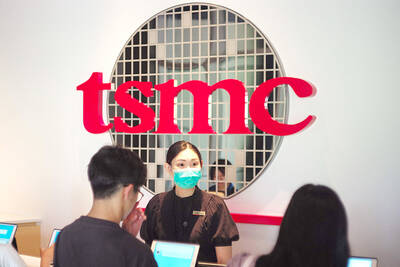
RECORD-BREAKING: TSMC’s net profit last quarter beat market expectations by expanding 8.9% and it was the best first-quarter profit in the chipmaker’s history Taiwan Semiconductor Manufacturing Co (TSMC, 台積電), which counts Nvidia Corp as a key customer, yesterday said that artificial intelligence (AI) server chip revenue is set to more than double this year from last year amid rising demand. The chipmaker expects the growth momentum to continue in the next five years with an annual compound growth rate of 50 percent, TSMC chief executive officer C.C. Wei (魏哲家) told investors yesterday. By 2028, AI chips’ contribution to revenue would climb to about 20 percent from a percentage in the low teens, Wei said. “Almost all the AI innovators are working with TSMC to address the

Malaysia’s leader yesterday announced plans to build a massive semiconductor design park, aiming to boost the Southeast Asian nation’s role in the global chip industry. A prominent player in the semiconductor industry for decades, Malaysia accounts for an estimated 13 percent of global back-end manufacturing, according to German tech giant Bosch. Now it wants to go beyond production and emerge as a chip design powerhouse too, Malaysian Prime Minister Anwar Ibrahim said. “I am pleased to announce the largest IC (integrated circuit) Design Park in Southeast Asia, that will house world-class anchor tenants and collaborate with global companies such as Arm [Holdings PLC],”


 RSS
RSS