


The World Bank and International Monetary Fund (IMF) are fraternal twins born of the global economic collapse of the 1930s and sired by the cataclysm of World War II.
In July 1944, with the unconditional defeat of Germany and Japan on the horizon, the UN -- as the global allies called
themselves -- held a monetary and financial conference at the exclusive mountain resort of Bretton Woods in the northeastern state of New Hampshire.
The International Bank for Reconstruction and Development (later redubbed the World Bank) and the IMF were both up and running by the summer of 1946.
To commemorate the 60th anniversary of the New Hampshire meeting, the IMF is co-hosting a conference on Monday and Tuesday in Madrid: Dollars, Debt, and Deficits -- 60 Years After Bretton Woods.
The World Bank was meant to rebuild the developed economies whose physical assets had been wrecked in the war. Issuing bonds guar-anteed by its member governments, the bank was able to raise money from private capital markets for reconstruction loans to the bombed out countries of Europe.
Meanwhile, the IMF was created to revive world trade, lending foreign exchange to cash-strapped post-war economies and using the US dollar secured by gold as the foundation for global commerce.
But both institutions saw their original mandates fade over time.
For the World Bank, Western Europe was largely rebuilt by the late 1950s. At the same time, dozens of new nations emerged in the post-war era as the once-great colonial powers dismantled their empires in Europe and Asia. So the bank's mission shifted to the Third World.
The IMF was able to stay in business by becoming the lender of last resort to help developing countries steer their economies out of the ditch.
It's sometimes described as a good cop-bad cop system: the World Bank aims to build infrastructure and foster development, while the IMF tries to straighten out mismanaged economies.
Traditionally, the World Bank has been headed by an American while a European directs the IMF; former Spanish economy minister Rodrigo Rato just took over the fund this month. British aid group Oxfam, a frequent critic of both institutions, calls the arrangement an outdated "gentlemen's agreement."
Several of the world's richest countries each appoint their own member to the agencies' boards of directors, while 27 African countries share a single director and other poor regions of Latin America and Asia are similarly lumped together. But the management is meant to represent not global population but who picks up the tab.
The policies espoused by the agencies have come under criticism from both wings of the political spectrum.
On the left, many criticize the agencies for loaning money to poor countries that is too often wasted on the wrong projects or lost down the sinkhole of mismanagement and graft.
Often, corrupt or undemocratic regimes have run up huge debts that cripple successor governments, a complaint that has rained down on the World Bank and IMF.
In May, the US Senate heard testimony from one American economist who suggested that at least US$100 billion -- one fifth of all loans in World Bank history -- has been lost to corruption. A bank spokes-man insisted that the allegation had "no basis in fact."
Some critics accuse the IMF in particular of imposing free-market reforms -- such as privatization of state-owned industries -- as a prerequisite for helping countries in desperate need of cash to stave off economic collapse.
From the other side, though, free marketeers accuse both institutions of encouraging government intervention in developing economics where overregulation has discouraged private investment and initiative. IMF demands for budget discipline have often produced steep tax hikes on already-contracting economies, which conventional economic theory suggests would exacerbate a slowdown.
Ed Lotterman, a columnist at the Pioneer Press of St. Paul, Minnesota and former economist for the Minneapolis Federal Reserve Bank who has worked on development projects in Latin America, said that the shift from bombed-out Europe to developing countries left the World Bank continuing to do what it knew how to do.
For years, the bank was neglecting the human capital -- education and health care -- that was underdeveloped in the Third World while overemphasizing the same heavy infrastructure that had been needed in Europe.
"There was this implicit assumption that that's also what Brazil and Zaire needed," Lotterman said. "Well, it's not what they needed."
The institutions have also critiqued themselves.
Vijayendra Rao was one of two World Bank economists who co-edited Culture and Public Action, a book arguing that culture must be considered along with economics when designing anti-poverty and development programs.
"What we're arguing for is a much more participatory dialogue," Rao said. "It should be more listening than telling."
He offered two examples from the book.
During a famine among the Dinka ethnic group of Sudan in 1998, aid workers found that old women were giving their consignments of grain to their clan chiefs. The relief workers perceived it as looting, a case of the elites capturing scarce resources.
But the Dinka were following a redistributive principle of sharing resources equally within the kinship group.
"An anthropologist in the field was telling [the aid workers] these things," Rao said, "and they weren't listening."
Noting the shift by the development agencies from their original mandates, Lotterman suggested that a "Bretton Woods II" meeting to re-evaluate their functions is long overdue.
"Sixty years have passed. Let's explicitly talk about what we should do," he said. "I don't think given the world leadership that's likely to happen, but it would be good."

Stephen Garrett, a 27-year-old graduate student, always thought he would study in China, but first the country’s restrictive COVID-19 policies made it nearly impossible and now he has other concerns. The cost is one deterrent, but Garrett is more worried about restrictions on academic freedom and the personal risk of being stranded in China. He is not alone. Only about 700 American students are studying at Chinese universities, down from a peak of nearly 25,000 a decade ago, while there are nearly 300,000 Chinese students at US schools. Some young Americans are discouraged from investing their time in China by what they see

MAJOR DROP: CEO Tim Cook, who is visiting Hanoi, pledged the firm was committed to Vietnam after its smartphone shipments declined 9.6% annually in the first quarter Apple Inc yesterday said it would increase spending on suppliers in Vietnam, a key production hub, as CEO Tim Cook arrived in the country for a two-day visit. The iPhone maker announced the news in a statement on its Web site, but gave no details of how much it would spend or where the money would go. Cook is expected to meet programmers, content creators and students during his visit, online newspaper VnExpress reported. The visit comes as US President Joe Biden’s administration seeks to ramp up Vietnam’s role in the global tech supply chain to reduce the US’ dependence on China. Images on

New apartments in Taiwan’s major cities are getting smaller, while old apartments are increasingly occupied by older people, many of whom live alone, government data showed. The phenomenon has to do with sharpening unaffordable property prices and an aging population, property brokers said. Apartments with one bedroom that are two years old or older have gained a noticeable presence in the nation’s six special municipalities as well as Hsinchu county and city in the past five years, Evertrust Rehouse Co (永慶房產集團) found, citing data from the government’s real-price transaction platform. In Taipei, apartments with one bedroom accounted for 19 percent of deals last
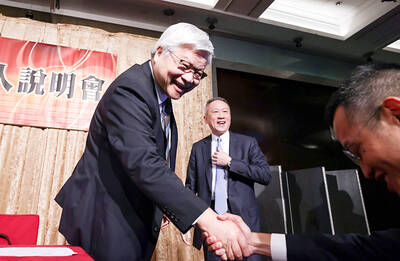
US CONSCULTANT: The US Department of Commerce’s Ursula Burns is a rarely seen US government consultant to be put forward to sit on the board, nominated as an independent director Taiwan Semiconductor Manufacturing Co (TSMC, 台積電), the world’s largest contract chipmaker, yesterday nominated 10 candidates for its new board of directors, including Ursula Burns from the US Department of Commerce. It is rare that TSMC has nominated a US government consultant to sit on its board. Burns was nominated as one of seven independent directors. She is vice chair of the department’s Advisory Council on Supply Chain Competitiveness. Burns is to stand for election at TSMC’s annual shareholders’ meeting on June 4 along with the rest of the candidates. TSMC chairman Mark Liu (劉德音) was not on the list after in December last


 RSS
RSS